
The K-shaped economy, one marked by strong spend at the top end and softer spend in the middle, has been a boon for luxury hotels and a drag on midscale, select-service properties. The tide, however, is changing, according to Marriott International. It said as much on its first-quarter earnings call.
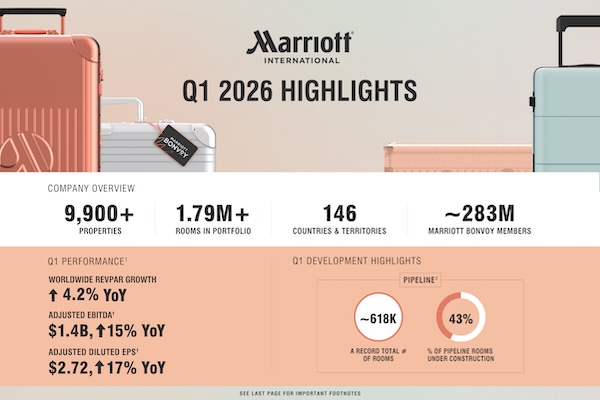
RevPAR in the quarter increased 4.2% worldwide, with 4% percent growth in the U.S. & Canada and 4.6% growth in international markets. (For comparison, global RevPAR at Hilton increased 3.6% in Q1 compared to the same time a year ago.) While luxury RevPAR rose nearly 7% in the quarter, select-service RevPAR increased 3.5%, in what Marriott International President and CEO Tony Capuano called “meaningful improvement” from the fourth quarter, when select-service RevPAR was down more than 1% year over year.
“Across demographics, we continue to see a prioritization of travel and experiences over consumption of hard goods,” Capuano said. “Even in lower-income households, you’re seeing that shift, and that’s having a pretty materially positive impact on the performance of our select-service brands.”
In Development
On the development front, new construction of hotels has remained well below the per-annum average. It makes sense: higher interest rates put a pause on new development since they made it more expensive to finance projects. Meanwhile, hotel companies have pushed out new brands and retrofitted others to take advantage of the conversions trend—taking an existing property, typically under a rival brand, and transforming it under the new brand.
Conversions remain a major focus for hotel companies, and that focus doesn’t appear to be abating. At the end of the first quarter, Marriott reported that its worldwide development pipeline reached a new record and totaled over 4,100 properties and nearly 618,000 rooms, with 43% of pipeline rooms under construction, including hotels that are pending conversion. Conversions, including multi-unit deals, remained a significant driver of growth for Marriott in Q1, representing over 35% of signings and over 40% of openings in the quarter.
Capuano said that a concerted effort was being made by its development teams to chase down larger portfolio-conversion opportunities. “The runway for growth and for conversions, in markets like Europe, where you’ve still got a very significant portion of the lodging supply that is independent, is fertile hunting grounds for us,” Capuano said.
First-quarter deal signings increased 9% year over year. Marriott added roughly 15,900 net rooms globally during the quarter and net rooms grew 5% from the end of the first quarter of 2025. Expectations are for net rooms growth between 4.5% and 5% for the year.
Middle East Drag
Conflict in the Middle East showed up in Marriott’s hotel performance in March, with RevPAR in the region declining 30%. Overall, international RevPAR grew 4.5% in Q1 compared to the same time a year ago. “Middle East travel corridor disruption started to impact select APAC markets, including India and the Maldives,” Capuano noted.
First-quarter RevPAR in EMEA increased over 3% with increases in Europe and Africa partially offset by a decline in the Middle East. RevPAR in Europe Rose 4% as the impact of the conflict in the Middle East on European markets was relatively minimal, Capuano said, and largely contained to countries near the Middle East, such as Cyprus and Azerbaijan.
In the first quarter, leisure RevPAR rose 6% globally and group RePAR rose 5% both globally and in the US and Canada. Q1 business transient RevPAR rose 1% globally.
Despite warnings about soft hotel bookings ahead of the World Cup, Marriott said it expects 30 to 35 basis points of global RevPAR lift from the event.
Marriott said it was raising its full-year global RevPAR guidance and now expects growth of 2% to 3%.

Tech Moves
Marriott continues to roll out its technology platform to hotels, having now transitioned its 1,000th hotel over to its new tech ecosystem, which, Capuano said, automate multiple processes that used to be done manually. Artificial intelligence continues to be a focus. The company is rolling out AI-powered desktop assistance at its customer engagement centers and using AI for guest pre-arrival communications. “As AI platforms continue to enrich the trip-planning experience, we believe our unparalleled depth of inventory and global reach are significant competitive advantages,” Capuano said. “While it’s early days for travel searching and planning and AI, we believe AI presents an exciting opportunity to connect directly and in a more personalized manner with our customers.”
Marriott said it is beginning a phased rollout of natural language search experience on Marriott.com and within its app by the end of the second quarter. “This experience will leverage real-time inventory to respond to guest inquiries and help them explore our portfolio more easily,” Capuano said.
The Marriott Bonvoy loyalty program had nearly 283 million members as of the end of March.
