
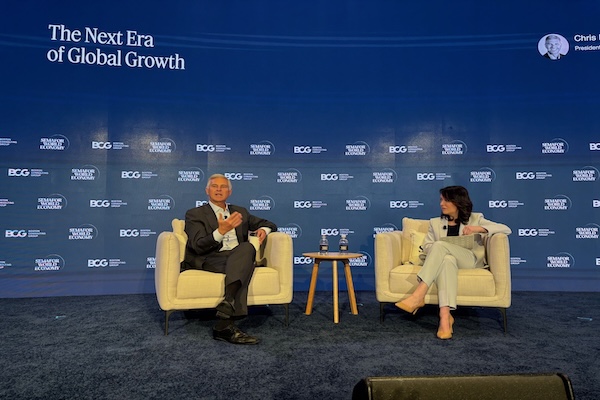
WASHINGTON — Chris Nassetta, the long-time president and CEO of Hilton, is known for maintaining a sunny disposition. That distinction was put to the test during a conversation at the Semafor World Economy conference, here at the Conrad Washington, D.C., home-field advantage notwithstanding.
Though the overall tone of his 15-minute discussion was overall sanguine, he was not beyond pointing out data that suggest the U.S. has become less attractive as a travel destination.
“If you go back 20 or 30 years,” he said, “U.S. market share for inbound international travel was 15%. If you look at it today, it’s 8% and going down.”
That decline, he continued, has resulted in a huge economic deficiency, including job losses and “probably $200 billion of economic activity.”
According to Nassetta, the paucity of inbound U.S. travel isn’t sensible given what he referred to as the “best attractions, unbelievable culture and infrastructure.” His entreaty to the current White House administration and those to come revolves around making a concerted effort over the next decade to bolster the numbers. “This is not a criticism of this administration,” he said, citing its efforts to reduce visa wait times—though up to now this has focused on shortening wait times for religious workers, while putting onerous restrictions on visa programs like H-1B. He closed his scrutiny by saying that if Hilton’s market share had halved during his tenure, he wouldn’t have a job. “To me, it’s economic activity, because every time somebody comes here, it’s an export. We went from a $100-billion surplus 10 years ago, to a $50-million deficit. I think this White House is willing to listen.”
Better Days
Gloomy commentary quickly gave way to a more propitious outlook, especially related to the business of hotels. Though the high end of the market has been the dominating force and rewards beneficiaries in the so-named K-shaped economy, Nassetta coined a new phrase: the convergence economy, where, he said, the middle and the bottom is going to come up and, ultimately, meet the top. “The bulk of our business is in the mid-market and had not been doing well. But as we got to the middle of last year, it became obvious to me that if you lift it up, above the noise of Washington and the geopolitical things that were going on, there were some really good macro trends that were building blocks to serious improvement in the economy,” he said.
Part of reason for his case centered on inflation, which, he said, was structurally coming down, if you pull out “the temporary issue” of higher gas prices. “Rates have come down,” he said. “You’re in the one of the most powerful deregulatory environments in modern history. In other words, the tide is coming in and the tide is unstoppable. We’re going to see a convergence, this C economy, and we’re going to get away from the K economy.”
This imminent shift, Nassetta said, is buoyed by data and trend lines that began to appear in the fourth quarter last year and carried into Q1; namely, more middle-of-the-week and business travel in a growing amount of mid-market locations that benefit such Hilton brands as Hampton, Home2 Suites, Hilton Garden Inn and Tru that cater to the space.
Huge investments across industries, none more than in AI, is another sign Nassetta pointed to as reason for optimism. “Productivity associated with AI has to be deflationary,” he said. His rosy outlook extends to investment programs implemented during the past administration—the $1.6-trillion infrastructure bill and the $28-billion CHIPS and Science Act, both of which pump money into U.S. economy. Both programs, he said, have yet to be fully realized, with only small portions of the actual money yet spent. “If that’s not enough, you have the backdrop of one of the greatest productivity booms of all time, led by AI,” he said.
Hilton is not immune to the current wobbly geo-political and macro-economic picture pockmarked by the war in Iran that has inflated oil prices and stifled supply chains. Asked about Hilton’s Middle East business, Nassetta said that he expected “hundreds” more Hilton hotels to be developed in the region; however, he stressed, it’s contingent on its development partners there: Hilton is out of the business of owning hotels, relying instead on partners to spend money and finance the development of properties that will carry one of Hilton’s brands on them. “We’re a consumer-branded business. We either operate or license our brand. We own nothing,” he said. “When we say we are building anywhere in the world, it really is with local partners. Laws of economics will drive what the ultimate outcome is in terms of our development there.”
Though the Middle East remains a growth priority, it pales in comparison to Asia Pacific, specifically India, Nassetta said, where population and population growth far overshadows the Middle East. “If you asked are we going to have as many hotels in the Middle East as we’re going to have in Asia Pacific, the answer is no,” he said. The opportunity in the region is 10x that of the Middle East. “You have billions of people you’re serving; in the Middle East, it’s much smaller population,” he said.
