
Ask a global hotel CEO where the next great growth market is, and in 2026, you’ll get the same answer: India.
Marriott International expects India to become the company’s third-largest market worldwide within three to four years, overtaking Mexico and China. Hyatt Hotels is targeting a five-fold expansion of its India footprint over five years, calling it “a long-term bet.” IHG Hotels & Resorts posted a record 24 India signings in the first half of 2026 alone, pushing its pipeline to 110 hotels on top of 53 already open. Accor calls India a “priority market” and has signed or reached preliminary agreements on 46 hotels in just the last six months. Radisson’s leadership describes India as one of the most promising development markets on earth.
This isn’t scattered optimism; the data back the trend.
Behind the Headlines
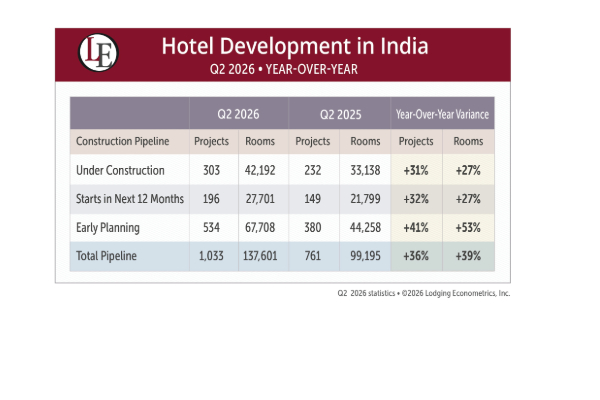
According to Lodging Econometrics’ latest India Construction Pipeline Report, India’s total hotel pipeline stood at 1,033 projects and 137,601 rooms, up 36% by project count and 39% by rooms compared to Q2 2025’s 761 projects and 99,195 rooms. The existing hotel census grew right alongside the pipeline and stands at 4,832 open hotels and 295,282 rooms, up 9% and 10% year-over-year. Hotel construction is underway as India has 303 projects and 42,192 rooms under construction, up 31% and 27% YOY, with another wave close behind: 196 projects and 27,701 rooms are scheduled to begin construction anytime within the next 12 months, up 32% by projects and 27% by rooms YOY. Farther out, the early planning stage is where the boom shows up most clearly, with 534 projects and 67,708 rooms in the pipeline, a 41% jump by projects and a 53% jump by rooms YOY, the steepest growth rate of any stage of the pipeline. Additionally, new project announcements over the last four quarters hit 446 projects and 55,028 rooms, up 76% by project count and 60% by rooms YOY—a sign that developers aren’t slowing their signing pace; they’re accelerating it.
Among chain scales, luxury is where the growth rate is among the strongest. Luxury projects in the pipeline reached 163 projects and 29,396 rooms, up 47% by project count and 48% by rooms YOY—the clearest sign yet that India’s hotel boom isn’t just about volume, it’s about chain scales. Upper upscale wasn’t far behind, up 33% by project count and 34% by rooms. Upscale climbed 42% by projects and 51% by rooms to reach 299 projects and 38,017 rooms, and upper midscale posted gains of 48% by projects and 47% by rooms.
 Why Now?
The short answer is that demand is outpacing supply, and the pipeline suggests developers are working to close the gap.
India has roughly one branded hotel room for every 3,000 people, a ratio Wyndham Hotels & Resorts’ own leadership in India cited as proof of how undersupplied the market remains relative to its population. That gap is the opportunity and the demand behind it isn’t foreign tourists it’s also the people of India themselves and their extended families. Domestic trips hit an estimated 4.287 billion in 2025, up nearly 46% over the prior year, proving far steadier than international arrivals. That demand is also skewing upmarket: luxury, upper-upscale, upscale and upper-midscale hotels made up about 63% of new openings last year.
What’s really changed is where the demand is showing up. Infrastructure caught up first: India has built more than 70 new airports over the past decade, more than doubling the country’s airport total, and new expressways and rail corridors have turned once-remote cities into hour-away destinations. For most of the last two decades, branded hotel development in India primarily meant six cities: Delhi, Mumbai, Bengaluru, Chennai, Hyderabad and Pune. That’s no longer the case. Recent Lodging Econometrics’ data shows nearly three-quarters of all hotel signings by room count are now occurring in secondary cities, places like Jaipur, Goa, Lucknow, Amritsar and Guwahati, with a growing share of those signings in the upper-chain scales, not just midscale and economy.
New demand categories are also fueling this shift. Destination weddings are migrating into new resort markets. Meetings, incentive trips, conferences, exhibitions have rebounded, spreading business travel across the country instead of clustering it in a few metro hubs.
Finally, there’s the mechanism making all this possible so quickly: the asset-light model. Almost every brand expanding in India today is doing it through management contracts and franchise agreements rather than owning real estate outright.
What’s Next
None of this is projected to slow down soon. Indian Hotels Company Limited just posted its 17th consecutive record quarter, and its CEO has put a number on where the broader market is headed: India’s branded room supply, having already doubled to roughly 200,000 rooms over the past decade, could reach 300,000 well before 2030. ITC Hotels is opening new guestrooms on a 25% year-over-year pace, even while navigating regional headwinds.
The construction pipeline data back the trajectory up. Lodging Econometrics is tracking 129 new hotels set to open in India in 2026, adding 12,190 rooms to supply. Another 281 hotels with 35,281 rooms are expected to open in 2027 and 2028 combined, and a further 688 hotels/95,586 rooms are in the pipeline for 2029 and beyond. Altogether, if all these projects come to fruition, that’s 1,098 new hotels and 143,057 new rooms for India’s supply.
Story contributed by Bruce Ford, SVP & Global Business Development Director for Lodging Econometrics.
