
Hotels are complicated to run, but there is one easy concept: If revenues are higher than expenses, turning a profit is the result. Unfortunately, the broader hotel industry is looking down the barrel of a cost-filled gun that isn’t shooting blanks.
According to new data from asset manager and hotel appraisal firm LW Hospitality Advisors, cost creep is not uniform across segments, but hotel operators deluged with higher expenses are being tasked to tame costs against a backdrop of enervated revenue.
“There’s only so much you can do, especially as costs are rising,” said Dominic Finn, SVP of asset management at LWHA. “For the most part, operators are doing their part to manage against limited RevPAR growth.”
As 2025 played out, expenses across departments rose, dealing a blow to operators having to deal with lower revenue generation. It was not a recipe for success. In 2025, annual U.S. hotel occupancy and revenue per available room fell year over year for the first time since 2020, according to data from CoStar. RevPAR was down 0.3% in 2025 versus 2024.
“RevPAR growth can often mask underlying expense creep,” added Ben Ketcham, AVP of asset management at LWHA. “In the current operating environment, disciplined expense management is one of the most important levers for improving flow-through, protecting margins and maximizing overall hotel performance.”
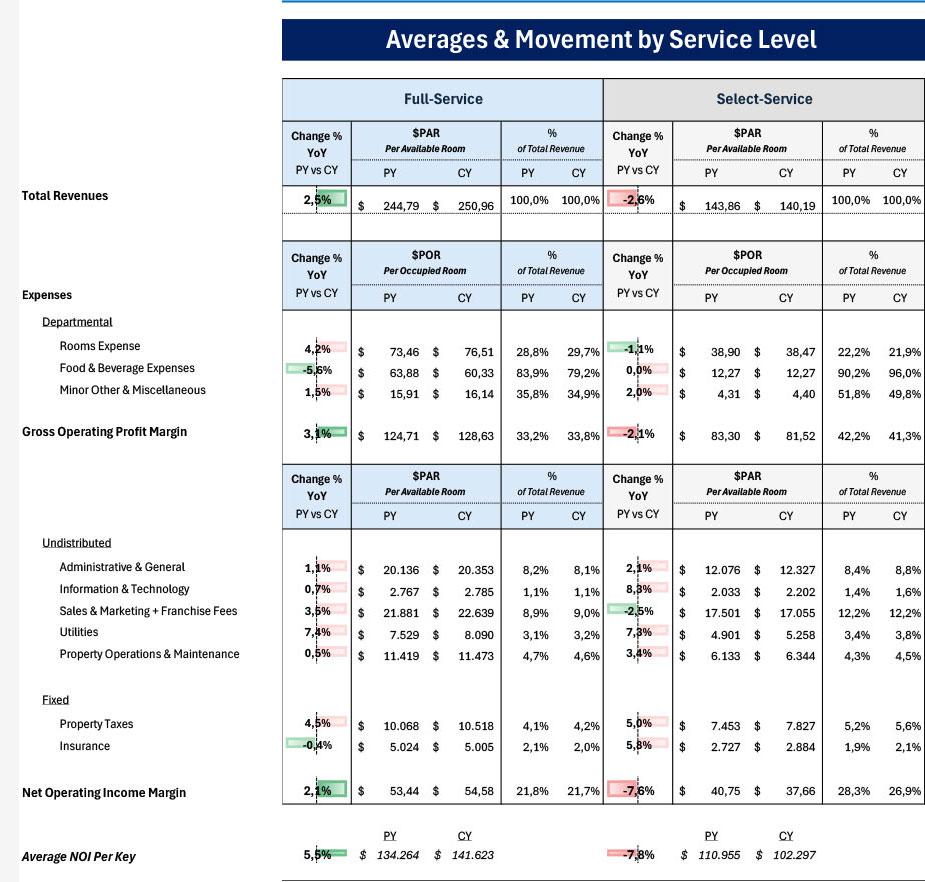
GOP margins were relatively flat YOY 2025 versus 2024, but NOI margins fell by 0.6%, with property tax increases of 5.9% YOY on a per-available-room basis impacting all segments and chain scales, with limited-service and extended-stay hotels seeing their property takes go up more than 10% YOY. They served as the primary driver of margin erosion between GOP and NOI, LWHA noted.
In the Rooms department, full-service hotels saw the biggest leap in expense, up 4.2% YOY on a per-occupied-room basis, which was around 1% higher than the across-segments number. That cut mightily into a total YOY revenue increase of 2.5%. Both select-service and extended-stay saw a decrease. Beyond labor, these costs would include cleaning supplies, contract services, decorations, linen and training.
Though full-service saw the highest increases in both Rooms and F&B expense—which makes sense since full-service hotels have a higher going-in cost basis than select-service and limited-service hotels—they also had the biggest increase in revenue of all segment types. “It’s a little bit of a double-edged sword,” Finn said. “They have the revenue to sometimes offset additional expense, but we also see that that full-service hotels had the least cost discipline.” Conversely, according to Finn, hotels in the lower chain scales exhibited better cost-management tendencies.
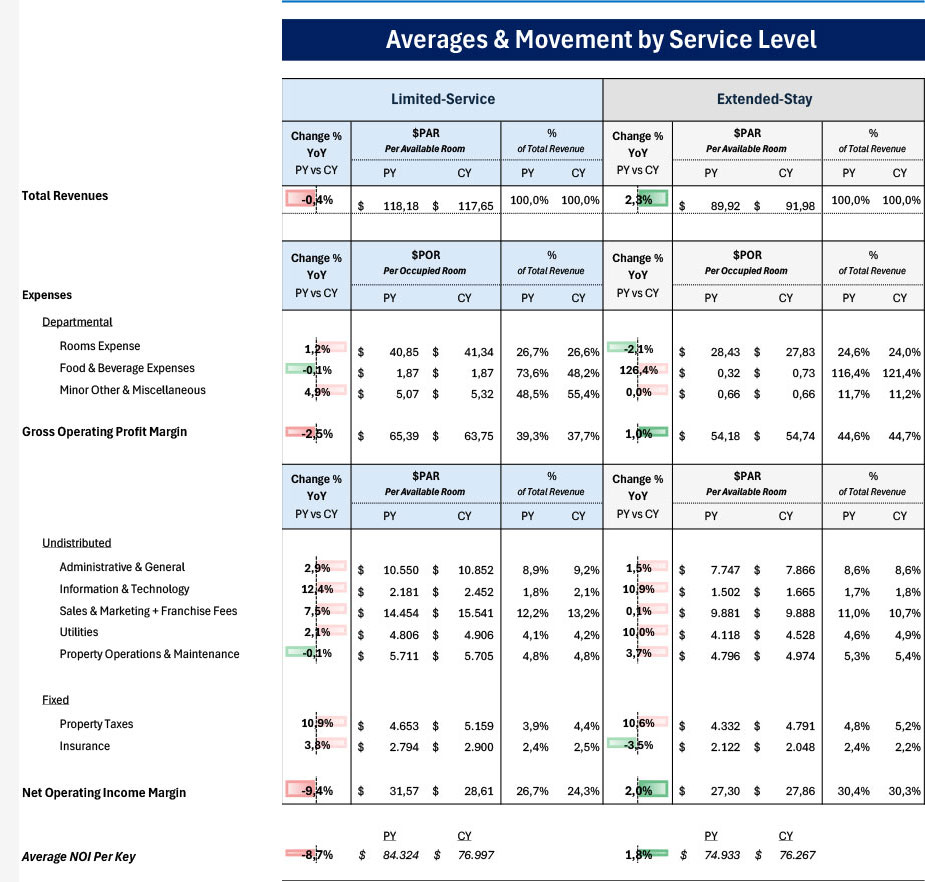
Utilities proved to be another expense needle in the side of hoteliers. Utilities were up 7.4% YOY on a PAR basis, with extended-stay seeing the highest rise at 10%. The expectation is for utilities to be constant or higher due to variables including the war in Iran, which rocketed oil prices up after February and have yet to abate.
Despite the war and a interest-rate environment that remains elevated, the first quarter showed surprised revenue gains as RevPAR was up 3.8% YOY, according to data, primarily driven by average daily rate. “It’s hard to know what that really means in terms of improved flow-through for full-service hotels, but if select-service and limited-service are able to maintain cost discipline, they are best positioned to capitalize,” Finn said.
Total labor costs are not moderating across the board and will only to move higher, especially as union contracts in many U.S. cities get renegotiated. Consider New York, where the hotel workers’ union was able to negotiate a new contract that will pay housekeepers more than $61 an hour by 2034. It will increase the average pay of housekeepers in New York City hotels to more than $100,000 a year.
“Many owners and operators are facing similar challenges, but having a structured benchmark allows us to move beyond anecdotal observations and clearly identify where expenses are trending, how they compare and what actions may be needed,” said Ketcham.