
This summer’s biggest matchup may have played out on the soccer pitch, but across the country, hoteliers played their own ferocious game.
Every day for more than a month, hotels across North America competed for customers, utilizing every available resource to maximize gains during this heady gold rush of a window. Though such an event in scope and size is unique and infrequent, this epic, real-time experiment provided valuable lessons on managing crowds, revenue and expectations.
“If there’s one thing we can learn from these events, it’s that travelers will follow their passions and be willing to pay for the opportunity to attend such memorable experiences,” said Rob Smith, president & CEO of Stonebridge Companies, a third-party hotel management company. “Tapping into these passions, taking a guest-centric approach and positioning our properties as an extension of the events themselves can really directly tie to occupancy and revenue growth.”

Geography Remains Undefeated
Even in the best of economic times, it would be challenging to fulfill hoteliers’ predictions that surging arrivals would raise occupancy and demand for accommodations everywhere. Post-event travel data show that the impact of international visitors was less broad-based than many anticipated, and those who did come preferred shorter stays centered around matches.
“We saw strong rates and occupancy on game days, but not for the days in between,” said Michael D’Amodio, group VP of regional operations for Azul Hospitality Group and a past president of the LAX Coastal Chamber of Commerce. “Most were here [in Los Angeles] for the game and did explore a little on their own, but [regional tourism] was much less than we had anticipated based on the information FIFA shared with us prior to the games beginning.”
Host markets with pre-existing tourist appeal, limited hotel supply or favorable match schedules generally captured stronger benefits than markets relying solely on the event itself. Variations in team schedules made it difficult to anticipate fans’ travel, but regardless of who was playing, average daily rates inevitably increased, said D’Amodio.
“These events are hard to predict as far as business demand is concerned, so you need to be flexible and adapt,” he continued. “Stay close to the metrics every day and adapt rates, length-of-stay restrictions and promotions. Do not assume business will come last minute, especially on the shoulder days leading up to gameday.”
ADR Advantage
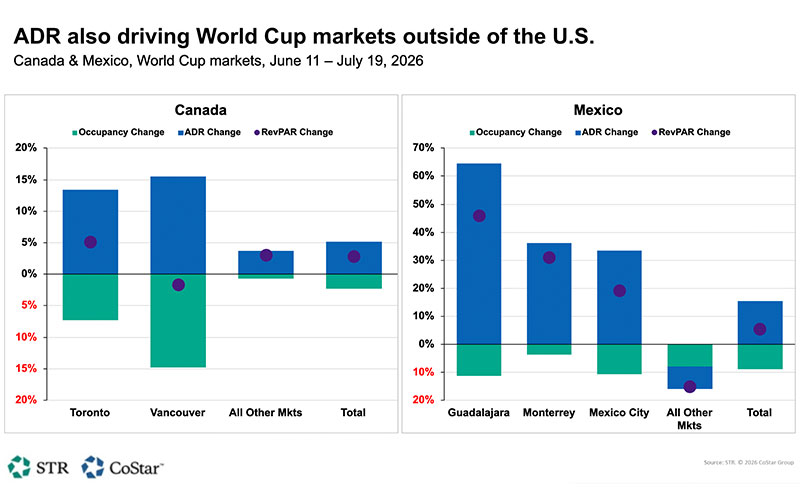
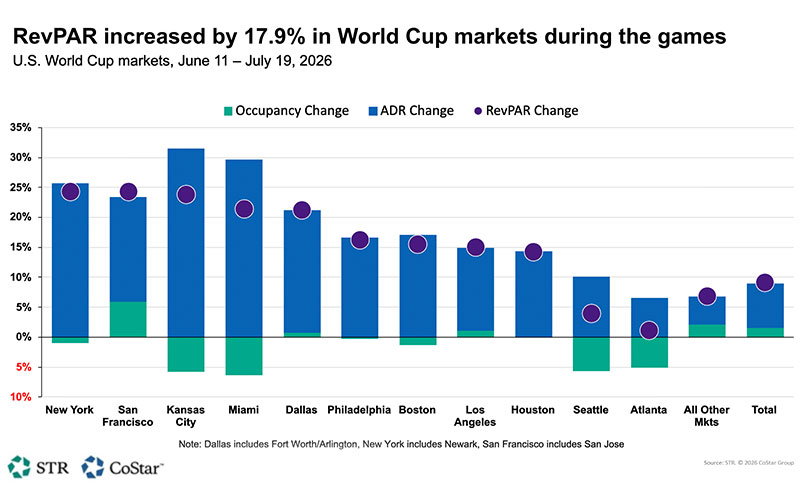
While not every hotel experienced a booking bonanza, properties with specific market characteristics, such as infrastructure and regional tourism, did experience noteworthy gains. It was those who could leverage their inventory and ADR around match days—surge pricing, essentially—that had the biggest boost.
“The World Cup ultimately became more of a pricing story than an occupancy story,” said Jan Freitag, national director of hospitality analytics at CoStar Group. “ADR proved to be the clearest beneficiary of the tournament. Hotels in many host markets were able to command substantially higher rates around matches, generating strong revenue growth even when occupancy increases were modest or zero.”
Major events are proven revenue generators, but hoteliers would do well to understand when to play it safe with vacation-friendly rates, and when to capitalize on the rush—particularly when the price of event tickets is fluid or uncertain. High room rates can sometimes deter price-sensitive travelers and displace traditional demand segments, creating uncertainty around net demand gains, said Freitag.
“The broader lesson is that large events can create meaningful hotel revenue gains, but outcomes depend heavily on market characteristics, infrastructure and visitor behavior,” he said. His advice: align pricing, marketing and distribution efforts with specific event demand patterns, recognizing that booking activity may materialize later than expected.
Adapt to the Unexpected
Few expected smaller countries like Cape Verde and Curaçao to make a splash in the tournament, but their sudden surge became one of many sudden booking bursts throughout the summer. Paying attention to scores and planning for sudden momentum swings could give hotel operators a crucial advantage over others.
“It’s important to get out in front of these events,” said Smith, advising hotels to start strong with rate positioning and then optimize from there.” He also preached nimbleness. “You have to be agile and able to adapt. While having a best-laid plan creates a solid foundation, teams changed venues as the tournament progressed, audiences moved with them and the event continued to grow in momentum as it progressed,” he offered.
Potential tactics include planning for rapid room turnover, checking event schedules early and leaning into on-property brand experiences to activate new demographics. Smith still believes it’s important to “bake your cake” and stick with it for the long run, but appreciates the importance of unpredictability. In the end, sometimes the best method is to think from a fan’s perspective, with all the excitement and uncertainty that comes with it.
“During an event like this, so many people were not just visiting our properties for the first time, but also, in many cases, our cities and our countries,” said Smith. “We took great preparations from a guest service and brand experience perspective to empower all of our team members to be brand ambassadors for our property, our city and our country. I it really shone through.”
The World Cup is played every four years. In 2030, the competition will be played out over Spain, Portugal and Morocco, and in 2034 will be hosted by Saudi Arabia. Under current FIFA rotation rules, the 2038 World Cup must be held in either North America or Oceania.