
The U.S. hotel investment market is finding its footing—and investors are opening their wallets. After years of uncertainty surrounding interest rates, operating costs and property valuations, hotel dealmaking is accelerating, supported by strengthening fundamentals, constrained new supply and an increasingly active lending environment.
According to JLL’s U.S. Hotel Investment Market Update – Q3 2026, hotel transaction volume reached $22.2 billion through September, a 37% increase over the corresponding period last year. The number of transactions climbed an even more pronounced 58% to 928, signaling that the recovery is extending beyond a handful of trophy acquisitions.
Single-asset transaction volume totaled $20.4 billion, up 50% year over year, while 12 hotels traded for more than $1 million per key, triple the four recorded during the comparable 2025 period.
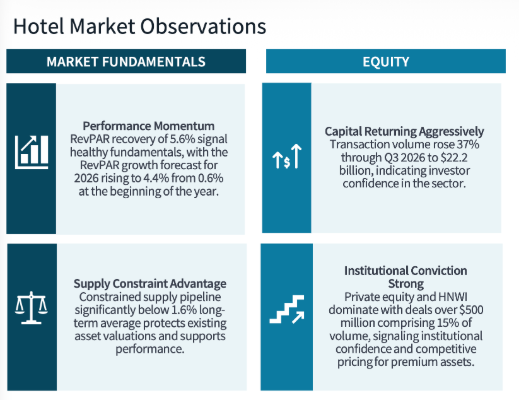
The resurgence is being underpinned by improving hotel performance. Revenue per available room (RevPAR) reached $108 through September, increasing 5.6% year over year as both occupancy and average daily rate advanced. JLL now projects full-year RevPAR growth of 4.4%, a substantial upward revision from the 0.6% forecast at the beginning of 2026.
Yet the recovery is far from uniform.
Luxury leads, but lower tiers gain ground
Luxury hotels continue to command investor attention, particularly in leisure destinations and markets with significant barriers to new development. Luxury RevPAR was 34.3% above its 2019 level through September, compared with increases of 16.4% for upper-midscale and 3.1% for economy hotels.
More recently, however, lower-priced properties have shown signs of improvement. Upper-midscale RevPAR increased 5.8% year over year, while upper-upscale hotels recorded 4.5% growth.
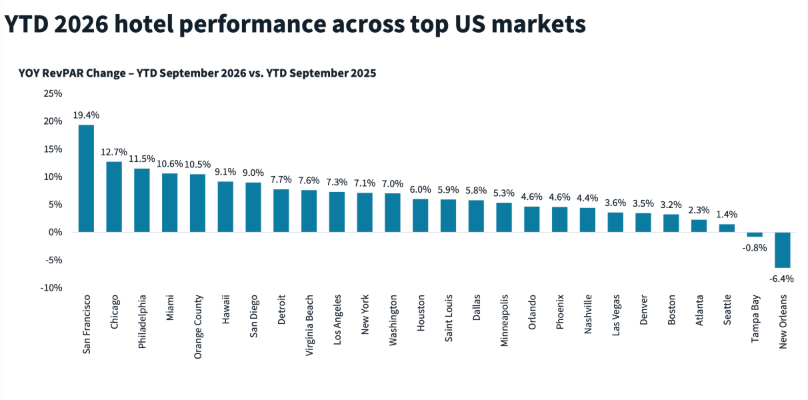
Geography also matters. San Francisco led major U.S. markets with 19.4% RevPAR growth, followed by Chicago at 12.7% and Philadelphia at 11.5%. Conversely, New Orleans experienced a 6.4% decline, while Tampa Bay slipped 0.8%.
A major advantage for existing owners is the scarcity of new competition. U.S. hotel supply growth is projected at just 0.4% in 2026 and 0.6% in 2027, substantially below the long-term annual average of 1.6%.
For investors, limited development activity could support occupancy, pricing power and asset values, even as construction costs and financing challenges continue to constrain new projects.
Capital gravitates toward premium assets
Investor appetite is particularly pronounced for high-quality resorts and full-service properties.
Resort hotels accounted for 30% of single-asset transaction volume through September, reflecting sustained demand for properties in desirable leisure destinations. Full-service hotels traded at an average of $333,854 per key, compared with $107,862 for select-service properties.
Four full-service hotels changed hands for more than $1 million per key during the third quarter alone.
Orlando led U.S. markets in transaction volume with $2.3 billion across 17 deals, followed by New York City with $1.5 billion across 20 transactions and Naples, Florida, with $939 million across five deals.
Private equity firms and high-net-worth individuals have emerged as particularly important buyers, collectively accounting for 42% of transaction volume. Meanwhile, transactions exceeding $500 million represented 15% of total investment activity, illustrating continued appetite for large-scale acquisitions.
The strength of the upper end of the market also underscores a persistent divide: Investors are willing to pay substantial premiums for assets with durable demand, strong locations and limited competitive supply, even as mid-sized transactions remain comparatively subdued.
The $84 billion opportunity
Perhaps the most consequential development for hotel investors lies ahead.
JLL identifies approximately $84 billion in hotel loans scheduled to mature through 2027, including $33.7 billion in 2026 and $50.1 billion next year.
That approaching maturity wall could become a powerful catalyst for additional transactions as owners confront refinancing decisions, capital expenditure requirements and rising operating expenses.
Some borrowers may be able to refinance successfully, particularly as debt liquidity improves. Others could face difficult choices, including selling properties, bringing in new equity partners or restructuring existing obligations.
The lending environment has already shown meaningful improvement. Hotel loan originations reached $44.3 billion during the first half of 2026, compared with $27.3 billion during the corresponding 2025 period. Banks and commercial mortgage-backed securities remain dominant financing sources.
JLL characterizes financing conditions as stable, with active lenders and relatively resilient transaction pricing despite interest-rate fluctuations.
For well-capitalized buyers, however, the combination of maturing loans and mounting property-level expenses could create opportunities to acquire hotels from owners facing financial pressure.
The result could be an unusual convergence: stronger operating fundamentals supporting asset values while debt maturities simultaneously compel some owners to transact.
A more active market ahead
JLL expects transaction momentum to continue through year-end, with full-year hotel investment volume surpassing 2025 levels.
The outlook reflects several reinforcing dynamics: improving demand, limited new supply, growing debt availability and sustained competition among institutional and wealthy private investors.
Still, the market’s recovery remains selective. Premium resorts, gateway-city properties and operationally efficient select-service hotels appear best positioned to attract capital, while assets facing substantial renovation needs or refinancing challenges could encounter greater pressure.
For hotel investors, the next phase may be defined less by whether capital is available than by where it flows—and which owners are positioned to take advantage of it.
With billions in debt approaching maturity and buyers increasingly willing to deploy capital, the U.S. hotel investment market could be entering its most consequential period of dealmaking in years.
Among major U.S. markets, San Francisco recorded the largest RevPAR growth at 19.4%, followed by Chicago at 12.7% and Philadelphia at 11.5%. New Orleans declined 6.4% and Tampa Bay declined 0.8%.
U.S. hotel supply growth is projected at 0.4% in 2026 and 0.6% in 2027, below the long-term annual average of 1.6%. Limited development could support occupancy, pricing power and asset values, while construction costs and financing challenges continue to constrain new projects. Resort hotels accounted for 30% of single-asset transaction volume through September. Full-service hotels traded at an average of $333,854 per key, compared with $107,862 for select-service hotels. Four full-service hotels sold for more than $1 million per key in the third quarter.
Orlando led U.S. markets in transaction volume with $2.3 billion across 17 deals. New York City followed with $1.5 billion across 20 transactions and Naples, Fla., recorded $939 million across five deals.
Private equity firms and high-net-worth individuals together accounted for 42% of transaction volume. Transactions above $500 million represented 15% of total activity.
JLL identified about $84 billion in hotel loans scheduled to mature through 2027, including $33.7 billion in 2026 and $50.1 billion in 2027. Some borrowers may be able to refinance. Others may sell properties, add equity partners or restructure existing obligations.
Hotel loan originations reached $44.3 billion in the first half of 2026, compared with $27.3 billion in the same period of 2025. Banks and commercial mortgage-backed securities remain the dominant financing sources. JLL characterizes financing conditions as stable.
JLL expects transaction momentum to continue through year-end, with full-year hotel investment volume exceeding 2025 levels. The recovery remains selective. Assets with substantial renovation needs or refinancing challenges could face greater pressure.
