
As higher borrowing costs, inflation, labor shortages and volatile construction pricing continue to pressure hotel investment decisions, hotel renovations have evolved into exercises in strategic planning, procurement and operational management.
Industry leaders say success increasingly depends on communication, disciplined execution and a clear understanding of what a property is trying to become— not simply what it will look like. Here are three different takes on what a hotel renovation prioritizes today, from a giant like Hilton to a developer and an operator refreshing an established property.
BEFORE STEPPING IN
“The biggest lesson is that successful renovations begin long before construction starts,” said Seamus Ross, founder & CEO of Castlerock Asset Management, the company behind the recently renovated The Westin Nashville. “Thorough planning, clear expectations and strong communication create the foundation for every good decision that follows.”
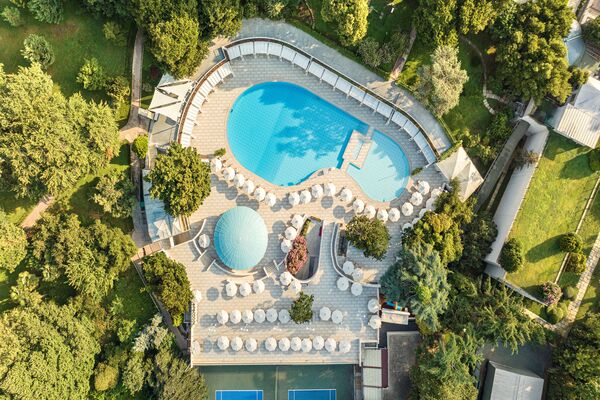
That philosophy echoes Hilton’s recent transformation of the landmark Hilton Istanbul Bosphorus, which opened its doors in 1955. In this hotel, the legendary Muhammad Ali announced his retirement in 1976. Household names Grace Kelly, Louis Armstrong and Sophia Loren were among its renowned guests and probably enjoyed a cup of Turkish coffee behind its doors. A foot-shaped pool—symbolizing Conrad Hilton’s entry into Turkey and the first hotel under the Hilton Hotels & Resorts brand outside the Americas—became one of the most famous pools in the city.
It’s no surprise that 70 years of history would have to be celebrated in grand style, and that preserving the hotel’s history proved just as important as modernizing it. “When you have a hotel that’s 70 years old, you ask yourself whether it’s still relevant today,” said Leonard Gooz, global brand leader, Hilton Hotels & Resorts. “What this renovation accomplished was bringing back the prestige, stature and charisma that made this hotel so special.” For the reopening, the Bosphorus rolled out a blue carpet—in line with its signature colors—and with all the glamour and Hollywood style that represented the optimistic American spirit when it first opened.

BRAND STATEMENTS
Rather than simply replacing furniture or updating finishes, operators increasingly view renovations as opportunities to redefine a property’s position in the market.
For Hilton, that meant using the Istanbul project to showcase the company’s broader brand evolution. “In many ways, this project exemplifies our new positioning for Hilton as the world’s iconic host,” Gooz said. “It’s about bringing together product, food and beverage and our superpower of genuine Hilton hospitality.”
Similarly, The Westin Nashville focused investments on guestrooms, meeting space and public areas that directly support its position as a convention and group hotel. “Our meeting and event spaces also received significant enhancements, including technology upgrades and design improvements that better support the evolving needs of corporate and group business,” Ross added.
Beyond those core areas, they took the opportunity to strengthen the overall guest journey. Key public spaces, including the lobby, were refreshed to better reflect Westin’s wellness-focused brand positioning. They also reimagined the former Westin Club into a more dynamic guest offering and repositioned their signature suites to create a more compelling luxury accommodation experience.
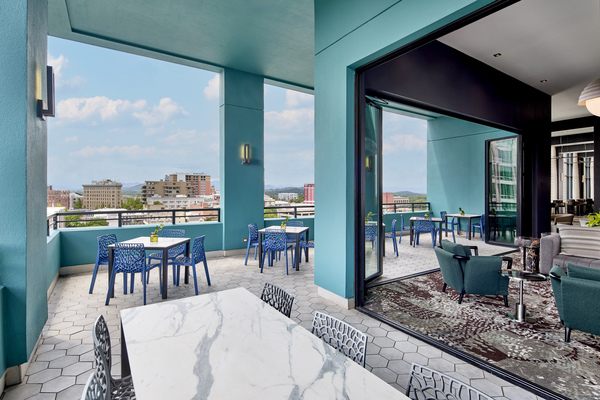
A similar approach is playing out at AC Hotel Asheville Downtown and its rooftop restaurant and bar, Capella on 9. Managed by McKibbon Hospitality, the property completed a renovation in March after work began in late 2025. The project was triggered by Marriott’s seven-year brand requirement and included all public spaces, meeting rooms, guest floors and Capella on 9, with new furnishings, flooring and finishes throughout.
At Capella on 9, warmer colors and smaller, more comfortable furniture were selected to encourage guests to linger over cocktails and tapas while complementing views of the Blue Ridge Mountains. Lighter tones were introduced on guest floors, while local artwork was retained throughout the property. The renovation was aimed not only at modernizing the hotel but also at strengthening its position in Asheville’s competitive hospitality market.

CAN’T STOP, WON’T STOP
At Hilton Istanbul Bosphorus, work was completed in phases, with services temporarily relocated rather than eliminated. “Our goal is always to minimize the impact on guests,” Gooz said. “We’ve learned that communication, setting expectations and taking great care of guests make all the difference.”
The Westin Nashville adopted a similar approach. Floors adjacent to active construction were removed from inventory to reduce noise, guests received advance notifications before arrival and renovated guestrooms were returned to inventory as soon as they were completed. Signature restaurants and amenities remained open throughout the project.
DISCIPLINE REPLACES COST CUTTING
While rising construction costs continue to reshape renovation budgets, both executives emphasized that the solution isn’t simply eliminating features.
“The challenge was less about making difficult cuts and more about remaining disciplined and adaptable,” said Ross. Rather than compromising the vision, the team focused on procurement strategies, alternative sourcing and maintaining flexibility as market conditions changed.
Gooz echoed that sentiment, noting that every renovation requires careful decisions about where investments will generate the greatest impact for guests and the strongest long-term return.
“When you execute a renovation well and support it with Hilton’s commercial engine and marketing, you position the hotel to become the place to be again while generating strong commercial returns,” he said.
POSITIONING COMES FIRST
Perhaps the strongest point of agreement between both leaders is that successful renovations begin with strategy—not design.
“I would advise anyone doing a renovation to start with your positioning,” Gooz said. “You have to know exactly what you stand for as a brand, what you stand for as a hotel and what you’re trying to accomplish.” That strategic clarity, he argued, makes every subsequent design and operational decision easier.
Ross reached a similar conclusion, although from an operational perspective. “Technology and processes can enhance execution,” he said, “but great outcomes still start and end with great people. That’s less a lesson learned and more a principle we continue to reinforce across every project we undertake.”
Together, the projects illustrate how hotel renovations have evolved. The physical transformation may be what guests notice first, but operators increasingly measure success by something much less visible: whether careful planning, disciplined execution and a clear brand vision can turn a renovation into a long-term competitive advantage.
