
Following its recent ownership shakeup, Radisson Hotel Group’s focus is now threefold – a major technology update, a plan to court the Chinese traveler and a push toward increasing its Americas portfolio, all with its five-year growth plan – aiming to make Radisson one of the world’s top three hotel companies – still on target, according to executives.
“Our acquisition by Jin Jiang … marks yet another incredible milestone in our company’s storied history and will elevate the Radisson Hotel Group to a new level of strength as a global leader in the hospitality industry,” Radisson CEO John Kidd said Tuesday morning.
In November, a consortium led by Shanghai-based Jin Jiang International took over the majority stake in Radisson from China-based HNA Group, which had acquired Radisson in 2016. Jin Jiang owns 100% of the North American company and a majority stake of the European company, Radisson Hospitality AB.
At its company conference this week in Miami Beach, company executives revealed that Radisson is making a US$200 million investment in “Emma” (shorthand for Every Moment Matters), an operations software that emphasizes personalized upselling and tracking guest preferences and which will also aid in streamlining payment systems to target global travelers, including the coveted and burgeoning Chinese traveler.
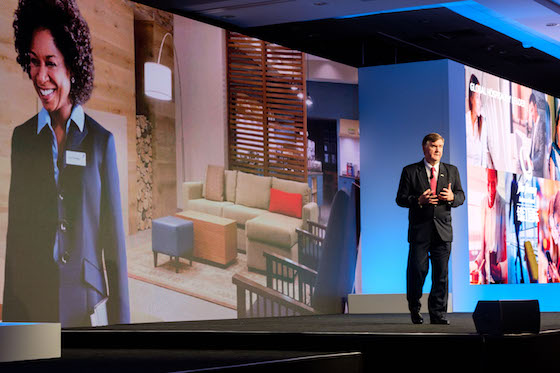
According to Kidd, who has a solid background in China as the former president and COO of HNA, Jin Jiang is a “tremendous company, very stable.” A merging of the two companies’ loyalty programs (Radisson with some 22 million members and Jin Jiang’s massive 150 million members) is already in the works and is expected to be completed as early as this summer, according to Radisson executive Eric De Neef. On the distribution side, Radisson signed a partnership with Chinese travel agency Ctrip three months ago, De Neef said, adding that the Jin Jiang ownership had “opened new doors, new opportunities for us.”
The new Emma system will also act as a gateway payment solution, paving the way for “frictionless” transactions via popular Chinese mobile payment methods like Alipay and WeChat Pay.
“Loyalty is a science and it’s very technical,” Kidd said at an executive roundtable Tuesday. “So right now, we’re in the process of discussing very deeply how we could marry the programs together in a very efficient way.”
Overall takeaways
Relationship with Jin Jiang: Jin Jiang’s ownership is perceived as a huge opportunity to tap into the ever-growing number of Chinese travelers, according to Radisson President of the Americas Ken Greene. Jin Jiang’s loyalty program clocks in at 150 million members, and Radisson is hoping to leverage those members into its recently rebranded Radisson Rewards program, which Greene referred to as “a global powerhouse,” adding that Radisson invested US$8.1 million in the program in 2018 by waiving the first stay free option.
Ken Greene of @Radisson –> “Just imagine what we’ll be able to do w/the 150M members of the Jin Jiang loyalty program. Wow, amazing.” @RadissonABC
— HOTELS magazine (@HOTELSmagazine) April 9, 2019
Tech matters: With more than US$200 million invested, there’s big money backing the company’s big move toward technology. In addition to investing just north of US$18 million in an updated website, RadisssonHotels.com, the company is investing the aforementioned US$200 million in Emma. Nine hotels will begin piloting Emma at the end of this year, with a goal of generally releasing the software in 2020. The cost to owners was not disclosed but Radisson says it will be manageable. It’s a definitive move for the company, which has historically lagged when it comes to technology. In a recent interview, Kidd said that when HNA had the majority stake in the company, “we were lagging in just about everything. I don’t mean it as a denigration of Carlson. You can imagine a company that’s owned for 60 years, in the final years before a sale there’s not going to be a lot of investment. We had multiple websites. No mobile capability. Couldn’t process online payments.”
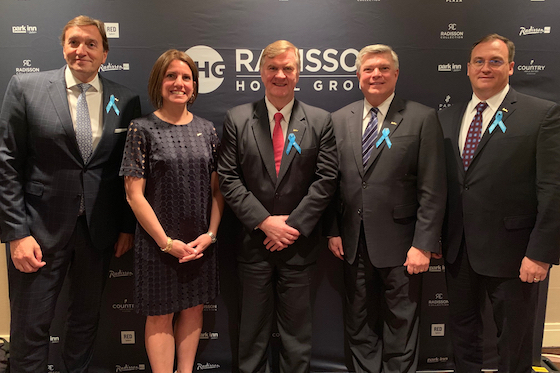
The larger outlook: The plan last year was to clean up the brand portfolio and improve existing properties. So far so good, to the tune of 18% of rooms (specifically Radisson) being removed from the company’s portfolio to date. The company also unveiled new prototypes for Park Inn by Radisson and Radisson Red. (Think max space in a compact footprint on the former and an open closet design on the latter). In terms of operations: In 2017, RevPAR for the Americas (where Radisson is looking to grow) was a cumulative +.07%. In 2018, it was +1.6%. As for the five-year goal of being “one of the world’s top three hotel companies,” Kidd says it’s a matter of perspective, not necessarily rooms. “Our parent (company) by size and scale is certainly number two in the world today. We really truly honestly believe, and want to be, the first choice, or at least one of the top three choices for any owner, guest, or talent looking for a future in the hospitality industry.
Key openings/conversions: The 130-room new-build Radisson Red San Francisco Airport will open toward the end of 2020. Radisson Blu’s first Caribbean property will be a conversion: The 229-room Radisson Blu Grenada Beach Resort set to open in December 2020. And the 151-room Radisson Blu Hotel Fargo, another conversion, will open at the beginning of 2020.