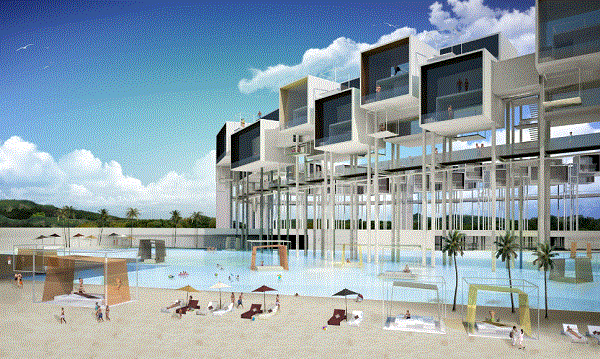
BINTAN, INDONESIA Landmarks Bhd., a Kuala Lumpur-based luxury developer, has commenced construction of an 835-acre site on the coast of Bintan that aims to convert Treasure Bay into a world-class resort that could eventually rival neighboring Bali.
Also known as Pesona Lagoi Bintan, Treasure Bay will be developed in phases, with the first phase—about 222 acres with a development price tag of US$334 million—will open in 2014 with “an iconic luxury resort and serviced villas,” with a branding announcement forthcoming. Phase One will also include a marina, transportation terminal and several entertainment, retail and F&B outlets.
Landmarks is willing to release land within Treasure Bay for third-party investment and development, so long as the master plan is followed. “The developments that we are planning for our water resort city will set new benchmarks in the region, redefining what it means to be a world-class tourism destination,” says Paul Leong, chief operating officer for Treasure Bay. “In terms of scale and what we aim to achieve, this is one of the largest and most ambitious tourism developments to be announced in the region in recent years.”
Department of Architecture Co. Ltd. is responsible for the architectural design of the resort. Treasure Bay will be comprised of a series of interlocking cubes that are strung together to form floating loops, creating double volume space with no apparent sides and eliminating boundaries between the front and back. Guests staying in any of its 119 guestrooms will be able to enjoy vistas of the sea and the crystal-clear lagoon. The resort will also have 30 villas that are separate from the main hotel block, connected by the lagoon. In all, the resort will have 149 guestrooms available for guests.
The interior design concept for the rooms as well as the public areas such as the lobby and restaurants has been inspired by the ancient Chinese concept of “Wu Xing,” This is based on the belief that the five elements of earth, metal, water, wood and fire are essential for existence. The interiors take on the personality and characteristics of the element that they represent.
Treasure Bay will also have another 160 serviced villas, on private land ranging from 200 to 1,100 sq. m. For long-term stay or as investment property, these luxury villas of one to three bedrooms include landscaped gardens and are fringed by the crystal-clear lagoon. They will be serviced by an undisclosed international luxury hotel chain.
Treasure Bay will target both regional and international leisure tourists, and the destination will be positioned as an attractive venue for weddings, honeymoons and special celebratory events. “We see Treasure Bay as enhancing the diversity of tourism offerings in the region,” Leong says. “For example, visitors to Singapore can stay in the country for a few days to experience its unique culture and the excitement of a vibrant, cosmopolitan and urban city-state. They can then go over to Bintan, which is only a 45-minute ferry ride away from Singapore, for a different holiday experience, adding to their total enjoyment of the region. For visitors from Peninsula Malaysia, they can travel to Stulang Laut, Johor Bahru, and take a ferry to reach Bintan, too.
The travel time to Treasure Bay is expected to be eased eventually, as the developers plan to include daily shuttle services on seaplanes, helicopters, luxury yachts and fast ferries.