
There’s a strong chance that your home contains a Kohler-made product. Maybe a toilet, a faucet, a sink or a bathtub—maybe all. Kohler is an American success story with a rich and riveting history; an immigrant story about a man who plumbed the depths of manufacturing only to build a plumbing empire.
It eventually would become even more.
Midway through the 19th century, a nine-year-old John Michael Kohler emigrated with his family from Austria to the American Midwest. He toiled in his teenage years as an itinerant salesman, but it was a trip to Sheboygan, Wis., that altered the trajectory of his life. There, 55 miles north of Milwaukee, in a town that would later gain the moniker of “Bratwurst Capital of the World,” Kohler called on a local industrialist named Jacob Vollrath, fell in love with and married the businessman’s daughter, and settled down.
Kohler worked at the steel-and-iron factory his father-in-law owned and took over the business around the Panic of 1873, the post-Civil War financial crisis prompted by distress in the railroad industry. The company began dabbling in iron and enamelware products and, in 1883, as the story goes, Kohler put ornamental feet on a cast-iron water trough and sold it as a bathtub. The move proved to be a seminal moment: Four years later, more than two-thirds of the company’s business was in plumbing products and enamelware.
Around the turn of the century, Kohler bought 21 acres of farmland just west of Sheboygan and a new factory was built. Regrettably, Kohler would never see the sheer magnitude of the business he conceived. In 1900, at the age of 56, he passed away, likely of heart failure. Walter, his son, took over the reins of what would be designated the Kohler Company and the property surrounding the plant became a model company town known as the Village of Kohler. Talk about a home-field advantage.
Beyond Pipes
Kohler is a global name in plumbing products. (Kohler is a private company, but Forbes estimated its 2025 revenue at approximately $7 billion.) What many don’t know is that it’s also a travel and hospitality company. And that’s thanks to a third-generation Kohler, Herb Kohler, a grandson of founder John Michael, who became CEO of Kohler Co. in 1972.
Often referred to as HVK, or Mr. Kohler by those more formal, Kohler was known as an innovator who above all championed the excellence of Kohler products. He expanded the company’s kitchen and bath offerings far beyond functional plumbing products to decorative and sophisticated works of art. Ironically, perhaps his biggest contribution had nothing to do with household functionality. Herb Kohler transformed Kohler from a plumbing fixtures company into a diversified luxury lifestyle brand through a singular idea: If Kohler could create beautiful, premium products for the home, it could also create premium experiences.
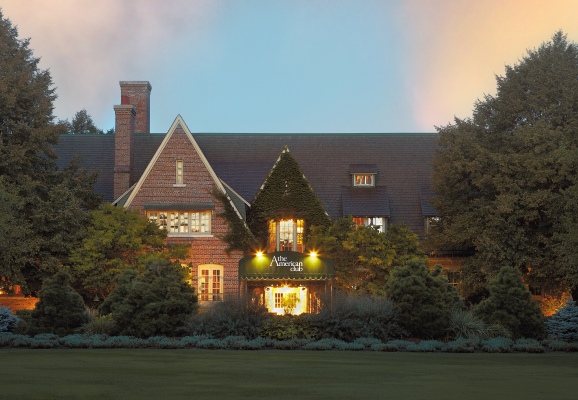
Kohler’s experiences were centered on three pillars: hospitality, golf, wellness. One of his boldest moves was transforming The American Club, which opened in 1918 to house immigrant employees, into a hotel in 1981. His gamble paid off: It collected its first AAA Five-Diamond Award in 1985 and garnered the distinction for decades after. The Tudor-style, 240-room hotel also houses three restaurants, including The Immigrant Restaurant, where the tasting-menu experience can last up to three hours. (For a quicker alternative, the gastropub Horse & Plow fries up some of the best cheese curds in the state.)
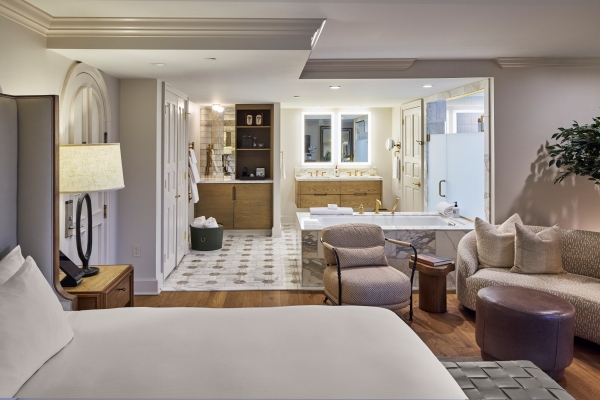
Next door to The American Club is the Carriage House, which opened as a 50-plus-room annex in 1986. It closed in 2025 for a comprehensive renovation and reopened the next year with 55 refreshed rooms and updated public spaces that immediately gave it a rate bump. (Average daily rates at Carriage House reach well above $1,000 per night during high season.) The renovation, led internally by Kohler’s design team and Nina Kohler, the wife of current Kohler Co. CEO David Kohler, brought about a lighter and more refined residential aesthetic. Naturally, bathrooms were a focal point, redesigned as an extension of the ground-level Kohler Waters Spa and featuring Kohler products, such as soaking tubs, multi-port showers and refined finishes such as Robern vanities, Ann Sacks tile and fixtures from the Castia line by Studio McGee.

The Maverick
Kohler’s approach to modernization and growth begins with understanding what makes Kohler unique. And it was all the brainchild of HVK. Someone who understands that better than most is Stephen Beaumont, president of hospitality for Kohler Co. He worked with Herb Kohler for a decade in the early 2000s and returned to lead Kohler’s hospitality division in 2025. He, among others, called Kohler, who passed away in 2022, a maverick and a visionary. “He recognized the cultural significance and the potential of Kohler to be this destination and to become something more than simply a village for the people working in the factory,” Beaumont said. “He always stretched things. He never liked the idea of being told he couldn’t do something.”
His most audacious idea was Whistling Straits. In the 1980s, Kohler befriended another iconoclast, the famed golf course architect Pete Dye, whose previous work included the Stadium Course at TPC Sawgrass in Ponte Vedra Beach, Fla., and The Ocean Course at Kiawah Island in South Carolina, both considered among the elite golf courses in the U.S. Dye courses are distinct: small, undulating greens, deep pot bunkers, deceptive shot angles. His handiwork includes the iconic island green of the 17th hole at TPC Sawgrass.
Kohler and Dye became quick friends. Together, they developed Blackwolf Run in 1988, which boasts two golf courses, River and Meadow Valleys. The former twice hosted the U.S. Women’s Open. Kohler wasn’t through; he wanted to attract more championship events, which meant building another course. It proved to be his magnum opus and, possibly, Dye’s, too.
The vision was a course along the shoreline of Lake Michigan that mimicked Ballybunion Golf Club, a links course in Ireland. Accomplishing this proved no easy feat, but mavericks aren’t often discouraged. So, Kohler acquired an abandoned airfield that once served as an Army anti-aircraft training facility about nine miles northeast of The American Club. More than 7,000 truckloads of sand were hauled in to create the jagged landscape of a links-style course replete with vertiginous dunes, fescue-ringed fairways and some 1,000 bunkers (though no one really knows the actual number; there are so many).
By 1998, Kohler had his championship course: Playing almost 7,800 yards from the back tees and defenseless to attacking lake winds, the Straits Course at Whistling Straits has hosted three PGA Championships, the 2007 U.S. Senior Open and the 2021 Ryder Cup. A sister course, The Irish, opened in 2000 and is known as much for being a stern test of golf as the sheep that roam its grounds. A statue of Kohler and Dye off the 18th hole at Straits overlooks the duo’s creation.
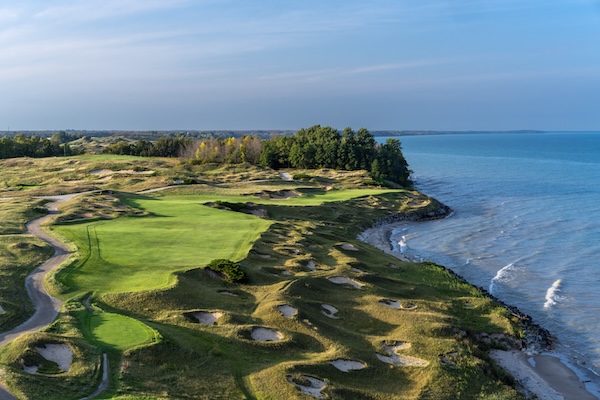
Golf is an integral part of the Kohler experience. All four courses are listed in Golf Digest’s top 100 and the Straits Course is often recognized as a top-five course in the U.S. you can play since it’s open to the public. Beaumont, who is not a golfer, recognizes the prescience of Herb Kohler to make the sport such an integral part of the Kohler experience, and not just as another activity. “One part of the resort supports the other,” he said. Put another way, golf and lodging have a symbiotic relationship: golf as an attraction helps fill rooms; rooms, then, support the golf. “They don’t sit independently,” Beaumont said.
Here’s the thing: Playing Whistling Straits is a bucket-list experience. It also costs a pretty penny. Eighteen holes of golf runs close to $900 when you factor in caddie fees. And that’s before raiding the pro shop for merch. “Clearly, the Straits Course is the center of attention. It is the one that everybody wants to play,” Beaumont said. (Next year, Kohler will open the “shortie” 14-hole Purebred Farm golf course.)
Here’s the other thing: Many don’t connect the dots between Kohler and Whistling Straits. Here’s another wrinkle: Kohler also owns and operates the Old Course Hotel in St. Andrews, Scotland, which is adjacent to the famous 17th hole of the Old Course, known colloquially as the “Road Hole.” (Players are forced to hit a nerve-wracking blind tee shot over a corner of the property.) Beyond The American Club, Carriage House and Old Course Hotel, Kohler also operates the Inn on Woodlake, also in the Village of Kohler, and where an additional 66 rooms are in the process of being added, and the 144-room Lodge Kohler, an out-of-route away from Lambeau Field in Green Bay, Wisc. Good luck trying to get a room on gameday. Kohler also operates a small cabin collection.
Threading the Needle
Better defining the Kohler throughline is something Beaumont is keenly aware of. He is looking to thread it through more cohesive marketing that promotes the holistic Kohler experience; one that also includes a very important pillar: wellness. In 2000, the Kohler Waters Spa opened within the Carriage House. Four more Kohler Waters Spas ensued; two in Chicago and one each at the Old Course Hotel and Lodge Kohler. The argument could be made that Herb Kohler was in on wellness well before it became a constant theme within the hospitality landscape. Kohler Waters Spas emphasize hydrotherapy, which makes sense since Kohler knows a thing or two about water. “Wellness is a central focus,” Beaumont said.
Herb Kohler planted the seeds that would germinate into the Kohler experience. As Beaumont tells it, Kohler’s son, David, the fourth generation of the Kohler family, carries those creations forward, and is doing it through a meticulous and sharpened financial lens, one built on combining each element of the Kohler brand, from fixtures to fun. David Kohler, who also sits on the Green Bay Packers’ board of directors, holds an MBA from the Kellogg School of Management at Northwestern University. He climbed up the Kohler Co. ranks by cutting his teeth as a business analyst. He also had a stint as a foreman in the cast iron foundry. Where Herb Kohler believed that every business unit should be financially viable on its own, under David Kohler’s direction, Beaumont said, the focus is on the total revenue derived and generated throughout the entire resort, inclusive of lodging, F&B, wellness and golf. “We know that there are bigger margins in certain areas, but they all contribute to the overall experience and financial success,” Beaumont said.
A short walk down Highland Drive from The American Club is the Kohler Design Center, a 36,000-square-foot showcase space of Kohler products, where prospective home fillers can check out the latest in smart toilet technology or shower systems. Down a flight of steps is a museum, a massive curio cabinet of sorts showcasing the more than 150-year history of Kohler, from early-on cast iron tubs to its vitreous china product lines. It’s not just tactile fixtures; it shares the story of a family that built a town.
“It’s the name of the company; it’s the name of the family; it’s the name of the village,” Beaumont said. “It sets the standard for everything that we do.”
