
Orascom Development Holding might be one the most prolific hospitality real estate companies you’ve never heard of—yet. The developer has 10 fully integrated destinations across seven countries in Europe, the Middle East and Africa, totaling more than 7,000 rooms in 33 hotels and 15,000 residential units. It works with such brand partners as Rotana, Steigenberger, Sheraton, Movenpick, Radisson.
Its CEO, Omar El Hamamsy, was a career consultant: 19 years with McKinsey & Company. He’s also an intrepid man: he joined Orascom during the height of the COVID pandemic, in the autumn of 2020. He guided the company through the gauntlet and turned losses into profitability—$10 million in year one and $60 million in year two.
In this far-reaching interview with HOTELS, he explains how an electrical engineering degree paved the way for his career, how Orascom is able to transform vast tracts of land and how he navigated Orascom through a challenging 2023 with sights set on a better 2024.
HOTEL: How does someone with an electrical engineering degree become head of one of the largest hospitality developers in EMEA?
Hamamsy: It’s certainly an unconventional journey. While my electrical engineering background laid the foundation for inquisitive and analytical thinking, I spent nearly 20 years at McKinsey before joining Orascom Development in 2020. As a senior partner, my experience in strategy, sales, marketing, operations and private equity across diverse industries equipped me with a unique perspective.
With Orascom Development operating at the intersection of hospitality and real estate development, I view these as sectors where the best customer experiences meet meticulous technical skills to create meaningful trust and connections with people. This is at the heart of our mission to create integrated destinations across Europe, Middle East and Africa and build vibrant communities where people are inspired to live, play and work, with passion and purpose.
HOTELS: 2023 was a challenging year. How do you plan hospitality investment now and going forward?
Hamamsy: Navigating the challenges of 2023 was undoubtedly complex but Orascom does have a track record of resiliency. I came into this role in the midst of the pandemic; we were able to use the time to redirect some of our hospitality efforts. This led us to renovate several of our hotels, expand into new customer segments and build new partnerships for our hotel assets that represent more strategic, long-term joint ventures in our destinations.
To complement our drive to enhance our premium to luxury hospitality offerings, we have also been investing in our people. Last year, we welcomed a new CEO of Orascom Hotels Management, Stuart Leven, and he has hit the ground running to transform and expand our hotels business in line with Orascom Development’s journey to reach new heights as a destination developer.

HOTELS: Orascom Development is known for not just developing hotels but entire communities—residential, retail, golf courses, marina and other infrastructure. 1) What is the mindset when you are developing these types of expansive projects? 2) How does hospitality fit into the fabric of a community?
Hamamsy: Our business model can appear complex but is quite straightforward: We take expansive plots of land in picturesque locations and transform them into vibrant hubs of life. We’ve developed nearly 40% of our landbank, which spans just over 100 million square meters, establishing integrated towns with more than 20,000 homes, 33 hotels with 7,000 rooms, and a plethora of amenities.
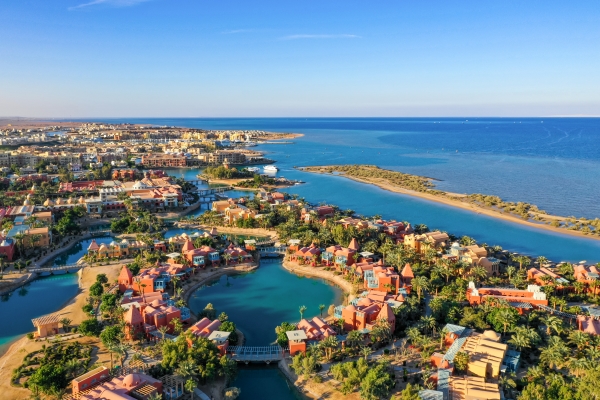
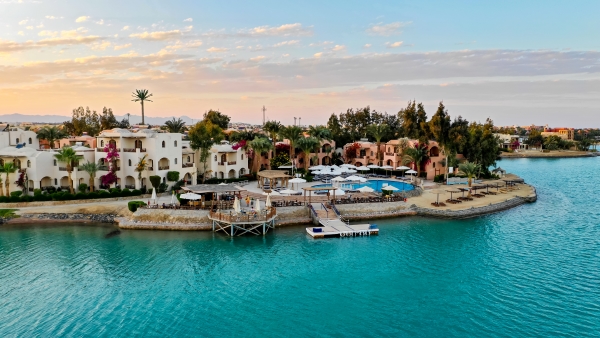
Consider El Gouna. It grew from a desolate area in 1989 to become a prime example of a world-class destination development. We have expanded that success with Makadi Heights, O West, Taba Heights and Byoum in Egypt; The Cove in the U.A.E.; Jebel Sifah and Hawana Salalah in Oman; Andermatt Swiss Alps in Switzerland, West Carclaze Garden Village in the U.K. and Luštica Bay in Montenegro. What we do is aim to set a new standard for living through planned communities that enrich lives, foster a sense of belonging and create enduring memories. One avenue through which we fulfill this commitment is by providing what we think to be outstanding service and experiences for both homeowners and guests. For instance, we have seven marinas capable of accommodating more than 1,200 yachts and five golf courses crafted by some of the most renowned players and designers.
Our hotels play a pivotal role in shaping experiences that resonate with our guests, encouraging them to come back for more. Whether it’s a return stay or an investment in a home, our hotels often serve as the initial introduction to our towns. Hence, it is imperative that we consistently seek ways to delight our customers.
HOTELS: What is your take on hotel brands, and what do brands allow you to do that you wouldn’t be able to do otherwise?
Hamamsy: Hotel brands play a crucial role, providing quality assurance and global recognition to our properties. Partnering with renowned brands allows us to attract a broader audience and enhance the overall guest experience. This instills confidence in our guests and ensures a consistent level of quality across our properties.
HOTELS: Post-pandemic work has changed, and we’ve seen the rise of both the nomadic traveler and the work-from-anywhere traveler. How does this trend impact the way communities and hotels are built out today in regard to design and programming?
Hamamsy: In the post-pandemic era, we’ve witnessed the rise of digital nomads and work-from-anywhere travelers. To cater to this demand, our approach integrates co-working facilities and tech equipped amenities within our destinations. Vibrant communal spaces that foster connectivity, along with adaptable designs embracing the fusion of work and leisure, are pivotal.
Additionally, incorporating sustainable practices that align with evolving preferences for eco-friendly and wellness focused environments is essential to remain leaders in crafting communities and hotels aligned with the changing nature of work and travel.
HOTELS: A recent Wall Street Journal article noted that many CEOs are now downplaying ESG or focusing mainly on sustainability. How do you view ESG and how important is sustainability when you are developing projects?
Hamamsy: We are committed to developing sustainable, integrated towns that harmonize with nature. Our projects prioritize environmental stewardship and preserving architectural authenticity. For instance, in Luštica Bay, Montenegro, we preserve cultural heritage against the UNESCO-protected Boka Bay mountains. Environmental sustainability, like achieving 100% CO2-neutral electricity in Andermatt Swiss Alps, remains integral to our development strategy.
HOTELS: How do you see 2024 playing out vis-à-vis the travel and hospitality industry? What are the opportunities?
Hamamsy: As you can imagine, there are many opportunities in 2024, but one in particular is experiential travel and the demand for more meaningful, engaging activities that go beyond the gates of the hotel, to enjoy local experiences. For us, this is a growth opportunity and one in which we pride ourselves on as we operate fully integrated destinations and will continue to do so. Whether it is skiing in Andermatt Swiss Alps, diving in the Red Sea or authentic local dining, we want to ensure visitors are able to enjoy a fully immersive travel experience.
