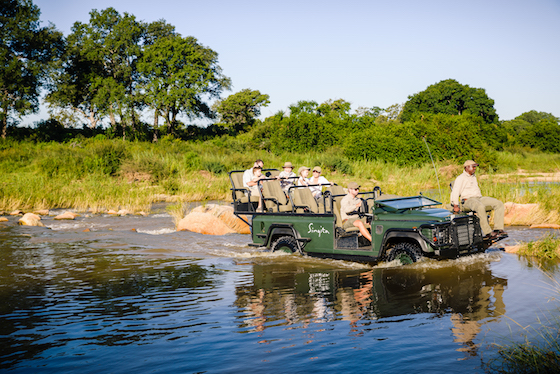
As a child, Inge Kotze and her family moved around South Africa quite a bit, from rural towns to the coast, thanks to her father’s job in the forestry business. But for many years, Kotze was a regular visitor to the sweeping Kruger National Park, in the northeast of South Africa, one of the largest game reserves on the continent, where leopards and elephants are routinely spotted.
Leopards have long been one of her personal passions, but today, her passion is a part of her daily duties. Kotze, through her job as general manager of conservation at Singita, along with the brand’s local conservation partners, is responsible for protecting leopards and preserving the nearly 8,000 square miles of Kruger’s wilderness, along with other sacred spaces in Africa.
She’s only been working for the luxury safari lodging company for six months, but with two decades of working in various conservation and biodiversity programs within South Africa, most recently with the World Wide Fund for Nature, she’s well-equipped to handle one of Singita’s most important company purposes: low-volume ecotourism that ultimately funds long-term conservation.

“The Singita model has been a very fascinating model and its revenue stream has been well-studied in both tourism and conservation circles,” Kotze says of Singita’s purpose – which is what actually attracted to her to the job.
Singita, which means “Places of Miracles” in the Shangaan language, was started over 25 years ago in South Africa’s Sabi Sand Reserve by Luke Bailes. His grandfather first purchased a piece of land there in 1925, before the reserve had been created.
Over the years, the property, located in a remote corner of the Lowveld region, evolved from a hunting ground to a strict conservation reserve where all animals are protected. Now Singita has 15 lodges across four countries in Africa including the newest camps, Singita Kwitonda Lodge and Kataza House, on the edge of Volcanoes National Park in Rwanda.
At the heart of everything Singita does is its 100-year vision, a carefully laid out and closely followed mission to preserve and protect Africa’s wilderness. It’s anchored by three major tenets: biodiversity, sustainability and community. This is done largely through partnerships and initiatives to stop poaching, study wildlife, minimize impact and empower the local communities.
For Kotze, 45, it means she’s managing private conservation projects and partnerships in different regions and countries. With 2020 an “environmental super year” full of global commitments made by organizations to protect the earth’s wildlife, oceans and habitats, Singita’s current priority is to grow and scale its conservation partnerships across Africa. Some of the partners include Malilangwe Trust in Zimbabwe, the Grumeti Fund in Tanzania and Singita Lowveld Trust in South Africa.
“If one looks at Africa, most of our nature reserves and protected areas are under immense pressure because they’re just so largely unfunded,” Kotze explains. “Although they, on paper, are protected, we simply don’t have the resources, financial or human capacity to be able to manage them.”
Additionally, Kotze says Singita is working on several initiatives to minimize its environmental impact by 2025, including powering 80% of its off-grid lodges with renewable energy, reducing water use by 30% and using 100 % electric game viewer vehicles. The company already has reduced single-use plastic by 90% and converted 50% of its lodges to solar power. And Singita will continue to support local communities living near its wilderness areas, often through education and career development.
Kotze is also working on refining messaging to include more information and opportunities to get involved with conservation, especially as guests arrive seeking meaningful connections with the land.
“They are traveling around with such knowledgeable guides and they are exposed to so much,” Kotze says. “We find almost the majority of guests are deeply, deeply interested in these areas, their own connection and their own missions attached to the conservation efforts behind keeping these areas alive and well, well beyond our lifetime.”
While protecting the earth may feel as if it’s all doomsday and tipping points, Kotze says there actually is a lot of good that can be done in a relatively short time frame, pointing to the Singita Grumeti in Tanzania, where in 15 years the Grumeti Fund has helped restore the ecosystem.
That’s something Kotze, based in Cape Town, takes seriously – she often is exploring South Africa’s remote areas with her husband and two teenaged children.
“That’s probably what excites me the most,” she says. “How quickly we can scale and restore some of the landscapes that we thought were lost.”