
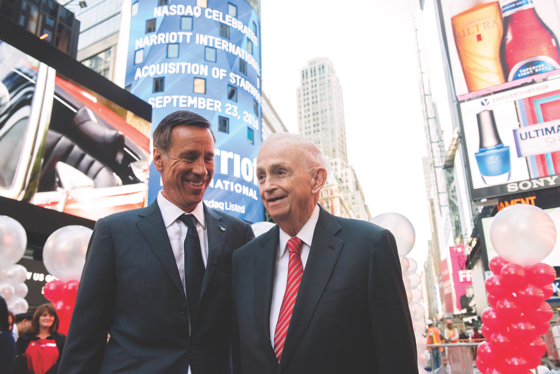
The enormity of Marriott International’s US$13.3 billion acquisition of Starwood Hotels & Resorts in September leaves the lead architect, Marriott President and CEO Arne Sorenson, with equal parts extraordinary excitement and apprehension.
He recently recalled sitting across from Bill Marriott at a company meeting in Dubai, where the conversation focused on the newly combined company’s growth in the region, and with a look Mr. Marriott conveyed what he was thinking, which was, this was unbelievable.
Indeed, today, the new Marriott is 50% bigger, dwarfing all competitors with more than 5,700 properties and 1.1 million rooms, representing 30 brands in over 110 countries. The global pipeline will add approximately 330,000 more rooms. But in a frenetic distribution marketplace that no one could have imagined a dozen years ago when Sorenson joined Marriott, the acquisition of Starwood gives the once-staid company more leverage and opportunities to compete on a battlefield that is being redefined almost daily by disruptors like Expedia and Airbnb.
On the evening of September 23 when the deal closed, Sorenson had dinner with about a dozen members of the Marriott leadership team, including Bill Marriott, where they retold the story of the drawn-out deal (with never a moment’s remorse, Sorenson adds) as well as stories about the company’s history. “As we sat there and talked it through, we realized how momentous this was in the history of Marriott,” Sorenson reflected. “We did some toasting; I made a big, long toast to the team and to Mr. Marriott at such a significant moment in the history of Marriott.”
While the hotel deal for the ages allows Marriott to delve deeper into markets such as China and the UAE, create more jobs and deliver more profitable room nights for its owners, Sorenson understands that the heavy lifting is just beginning. “It’s an enormous thing that we must do here over the next few years, and while we can be gratified that we closed the deal, we have not yet proven anything…We must make sure that we drive results not only as quickly as we can, but as substantively as we can.”
Perhaps the most important first steps include asset sales, which may prove more difficult based on economic conditions, integration of the two loyalty programs, marrying disparate operating systems and improving developer perception of key brands such as Sheraton, which represents 13% of the combined company’s system by room count. It also includes recognizing the potential of newer brands like Aloft and Element.
“I’m sure we’ll talk more about owners and franchisees and get their points of view,” Sorenson said, “but I think, broadly, there is a sense that this transaction makes sense and we can deliver things which are of value to our partners, shareholders and associates. That piece is extraordinarily exciting.”
Heavy lifting
The day after the acquisition closed, the first move was to link the loyalty programs. Sorenson continually says loyalty, the ability to offer more choices – including property types and locations – and building a direct relationship with customers is key to the deal’s success.
“The more we can give them choice, from luxury to economy or from lifestyle to traditional, the more the program is strengthened,” he added. “So that tells us that we needn’t be worried about having the number of hotels we have or the number of hotel rooms we have or the number of brands that we have.”

Sorenson said in November that more than 3.3 billion points had been transferred among all three programs – Marriott’s, Starwood’s and the Ritz-Carlton’s – within the first month of the acquisition alone. Among the combined 85 million members, only 16% belonged to both Marriott/Ritz-Carlton and Starwood programs. Since Marriott’s “members only” direct booking program launched in April, close to 900,000 incremental Marriott Rewards members signed up. During Q3 earning reports, Sorenson said that while the discounted loyalty member rates have had a “modest” adverse impact on RevPAR (about 30 basis points), owners remain supportive of the move.
Equally important to the loyalty program is the technology that supports loyalty, ranging from WiFi and keyless entry to mobile services and member direct rates, all of which emphasize the advantages of the program to customers. “I think that will continue to be a strong principle for us going forward,” Sorenson said.
Another big question is whether all 30 brands will remain or if properties will change flags inside or outside the organization. To date, the party line about keeping all 30 brands has not changed; in late November Marriott Global Brand Officer Tina Edmundson revealed new brand categories, “classic” and “distinctive,” for luxury, premium and select brands.
“It will be important for us over time to make sure that we are giving each of these brands a swim lane and some distinct features,” Sorenson said. “As that happens, I think we will see hotels, particularly in the full-service space, that have existed for decades, perhaps more easily fit in one of the other brands. That might play out as an alternative associated to renovation costs, influenced a little bit by a property’s present distribution in a given market, and to some extent maybe driven a little bit by a particular owner’s bias toward one brand or another. Again, I wouldn’t expect shifts to be significant.”
Sorenson added that it is also very important that owners, franchisees and brand teams with established full-service brands like Marriott, Sheraton and Westin work in concert to make them strong, relevant and well positioned. “There is a lot of work underway and it is a project which is going to take some years to get resolved,” he said.
While absorbing and managing so many brands has some industry watchers concerned, Patrick Scholes, an analyst at SunTrust Robinson Humphrey, pointed to Marriott’s long-standing ability to buy and integrate existing brands, including Residence Inn, Ritz-Carlton and AC Hotels.
Scholes also has pointed out that Sheraton, despite its mediocre reputation and historical underperformance, has among the most potential due to its distribution. “However, it is not going to get turned around overnight. The potential hiccups: Some of Starwood’s brands have legacy issues that make brand absorption and pipeline growth expectations complex,” he wrote.
Conversely, under-penetrated brands with huge potential upside are Starwood creations Aloft and Element, Sorenson said. “They each have pretty compelling starting points in terms of design and market positioning,” he says. “We can bring some refinement that makes them that more efficient from a cost perspective and deliver both top-line and bottom-line improvement, which should make them much more attractive to our owning partners… I think now that we’re closed we’re going to see those brands move quite quickly.”
Owner issues
Driving savings and growing revenue are top of mind with owners and their asset managers. Potential impact issues have already resulted in lawsuits filed by owners of the Sheraton Grand in Chicago and the Westin Times Square in New York.
“The positives include Marriott’s share size, which will favorably impact pricing across all vendors,” said Michelle Russo, principal at asset management firm hotelAVE. “A consolidated sales center will make cost of acquisition cheaper and units will see reductions… Marriott should also see a lot of savings direct to brands with more centralized control, whereas Starwood was more decentralized.”
While the publically stated US$250 million in savings will mostly come from corporate redundancies and overhead, Sorenson is confident that owners will see cost reductions in areas like OTA fees and purchasing. “I think [owners] believe that we can do it, but until we do it they’re not going to simply take it on faith,” he said. “To do that means delivering both top-line performance [greater sales conversion rate] and margin performance [cheaper tomatoes] for hotels, and for hotels that are managed as well as hotels that are franchised.”
During the Q3 earnings call, Marriott leadership said owners could expect to see significant savings in the coming year with OTA fees, and even more in 2018. They also said all Starwood-managed hotels are adopting Marriott’s purchasing platform, Avendra, with Sorenson adding that sales teams from both companies have shared more than 1,000 leads for group business through the end of October.
Owners also worry that the cost of integrating Starwood and Marriott systems will be passed along to them. “Development, installation and training costs historically are passed to owners,” Russo said. “It may impact only Starwood hotels, or will it impact both portfolios?”
Sorenson’s response: “I think our working assumption is we’ve got to make sure that the costs paid by the hotels do not increase – even during the transition time – and that they decrease as quickly as we possibly can get them to decrease.”
Analysts have stated they expect the new Marriott to have greater bargaining power with owners, which could mean increased royalty rates over time. Russo added that while multi-unit owners cut their sweetheart deals, the rest of the owner community might need to band together to create a concerned-owner group and address fees in a more business-like way.
But Sorenson was quick to point out that Marriott must continue to be mindful of its competition. “I don’t think that we have become so big that we can somehow make decisions in a way that ignores the dynamic in the industry as a whole,” he said. “Our share in the United States is only about 14% of all rooms, which hardly puts us in a position where we can price in a way that is not influenced by what’s happening in the industry more broadly.”
Still, owners may be disappointed to find themselves surrounded by “new cousins,” particularly in markets with competing Marriotts, Westins or Sheratons. “We don’t expect too see impact litigation in the near term, but that doesn’t mean that business impact is not a heavy concern and on the minds of owners and the asset managers that represent them,” said Chad Crandell, CEO of another asset management firm, CHMWarnick. “Owners will likely need to gather evidence of impact where the legality surrounding areas of protection under a merger situation may be blurred. The full effects of impact will not be realized for 12 to 18 months, as merger logistics continue to roll out.” He noted that the loyalty programs won’t officially be combined until 2018, and group share may not be fully felt until late 2017 or early 2018 due to booking windows and other factors.
There could be expense implications as well, Crandell added. “While Marriott has promised that there will be no costs allocated as a direct result of the merger, hotels may find they need additional resources, marketing, sales, etc., to effectively compete in this new environment,” he said. “Even so, it will be difficult to isolate what will be impact resulting from the merger versus market issues as the economic conditions change. Impact is hard to quantify and isolate.”
Sorenson sayid that if Marriott can drive the top line for owners, impact issues will be manageable. “That doesn’t mean, obviously, that there won’t be hotel owners that say I don’t want another hotel in my market. That has always been the case… Those hotels were competing tooth and nail yesterday. Today, they can, on some measures, still compete, but they can, on some measures, also collaborate.”
“If Marriott comes out of gate strong, creates cost efficiencies and top-line erosion is nominal, then life continues on,” Russo said.
One Marriott
Starwood has been viewed for years as being focused on innovation, brands and marketing, whereas Marriott has been known for its efficiencies and taking care of its employees who feel empowered to better care for guests. Combining the best of both worlds into a cohesive culture is the sweet spot.
“I do think what Marriott has been doing the last number of years has also been evolving toward a more innovative and faster-changing company,” Sorenson said. “We’ve got to make sure that we continue to move in that direction and embrace Starwood’s DNA.”
That also means, however, preserving features of Marriott’s culture that deliver. “We think, actually, in many respects, Starwood’s teams around the world share this or aspects of our culture,” he continued. “We sense, already, from Starwood people around the world, this appreciation for the opportunity that the larger platform is going to deliver to them.”
Change will surround innovation. “This evolution toward innovation and speed of change is a key and will accelerate, and that, too, is about empowering people above property,” Sorenson said. “How do you make sure that the organization, broadly, feels like they have the ability to experiment, to make decisions, to risk? Obviously, if you’re going to fail, you want to fail fast, but if you don’t fail at all, it probably means you’re not taking enough risks.”
At the end of the day, Sorenson cited three communities keenly invested in the merged company’s success: associates, guests and owners. Associates must see the breadth of opportunities; guests must see a linked loyalty program with the promise of continued strength and new features going forward; and owners must see that the success of the first two constituencies grows top-line performance. For everyone, including Sorenson, that is all about building momentum.