
The days of double-digit performance growth may be in the rearview mirror for lodging companies, but it doesn’t mean that the travel industry is waning, it’s just getting back to normal patterns.
Everyone, breathe.
On Tuesday, Marriott International delivered its fourth-quarter and full-year performance numbers, with CEO Tony Capuano referring to “fantastic results” that were led by a strong surge in group business, which is pacing up nearly 13% globally and 11% in the U.S. and Canada on a year-over-year basis driven by “robust increases in both room nights and average daily rate,” Capuano said.
“This segment has by far grown the fastest coming out of COVID with global leisure transient revenues in the fourth quarter nearly 50% above the same quarter in 2019.
In the fourth quarter, Marriott’s systemwide RevPAR increased 7.2% globally, with the highest growth rate in international markets, at 17.4% compared to the fourth quarter 2022. U.S.and Canada RevPAR, by comparison, grew at a much lower clip of 3.3%.
Fourth quarter reported net income totaled $848 million, compared to reported net income of $673 million in the year-ago quarter.
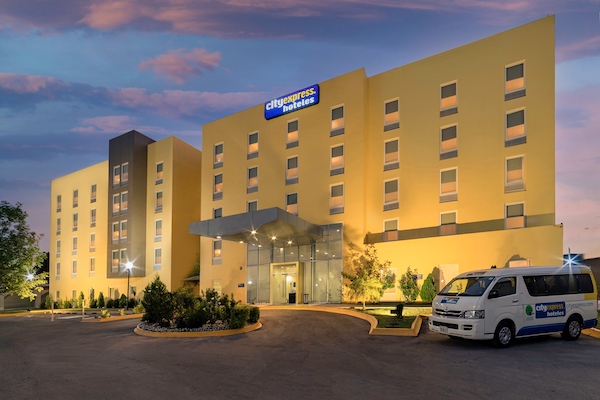
Full-year global RevPAR rose 15%, while net rooms grew 4.7%. Marriott added nearly 81,300 rooms globally during 2023, including approximately 17,500 rooms associated with the City Express transaction and more than 43,000 other rooms in international markets.
“With normalizing RevPAR growth around the world,” Capuano said in prepared remarks, Marriott anticipates a worldwide full-year RevPAR increase of 3% to 5% for 2024 with net rooms growth of 5.5% to 6%.
“Even as the rebound impact from the pandemic has waned, the fundamentals for our industry are outstanding,” Capuano said.
He also underscored Marriott’s loyalty program, Marriott Bonvoy, which he said contributed 22% more room nights in 2023 than in the prior year.
Marriott signed a record 891 organic management, franchise and license agreements in 2023. Additionally, it ended the year with a new high of roughly 573,000 rooms in its global pipeline. “We expect another year of strong global signings in 2024,” Capuano said, adding what he called “a meaningful acceleration” in net rooms growth last year of 4.7—the highest growth since 2019.
Conversions, similarly across the lodging industry, played a meaningful role in 2023 for Marriott, accounting for 25% of the organic room additions and 40% of organic rooms signed for 2024.
“In terms of deal volume, through the first month of the year, we are encouraged,” Capuano said. “We’re seeing strong momentum both on submissions for new-build projects around the world and momentum on the conversion side.”
He added further color that he said he gleaned during the ALIS conference in Los Angeles last month—both positive and negative, as he alluded to it. “On the positive side of the ledger, there is a sense that there will be continued relief on the interest rate side, particularly in the back half of 2024,” he said. “There is an expectation maybe in parallel to the hotel transaction market. And while there is still admittedly some gap in the the ask between sellers and buyers, it feels like that gap is continuing to narrow, which will likely lead to a more active transaction environment, which has always historically been good news for us on the conversion front.”
Conversely, the more challenging issue continues to be on the debt side, Capuano said. “You still have lenders thinking about compliance with proposed regulatory environment that will perhaps impact their ability to really open the faucet in terms of the amount of debt that they make available for new construction,” he said, but adding that Marriott’s fulsome foray into midscale is a hedge.
“When we talk to our franchise partners on the midscale front, they feel like the size of those commitments is something that they’re going to have a decent measure of success in procuring debt.” He added that the availability of debt in Asia Pacific and the Middle East is less of an obstacle than in North America.
Still, he said, “The availability of debt is the one that I think we’re most focused on.”
Capuano said expectations were for net rooms growth of 5.5% to 6% for 2024. This includes around 37,000 rooms from its MGM Resorts International partnership, the first of these rooms became available at New York-New York Hotel & Casino at the end of January with the remaining properties expected to be available by the middle of March.
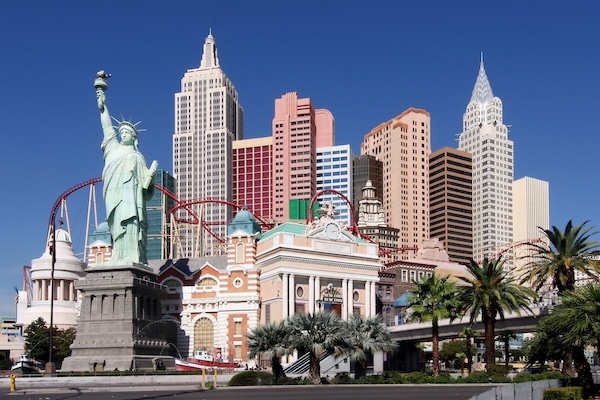
“We’re excited about adding these properties to our portfolio and enhancing our distribution in Las Vegas and other cities across the U.S.,” Capuano said.
Capuano continued to emphasize Marriott’s midscale business, even teasing an upcoming new brand. “We’re working on a new U.S. transient midscale brand for both new builds and conversions,” he said.
Marriott is in “numerous deal discussions” for its City Express brand in the Caribbean and Latin America and for Four Points Express in EMEA. In the U.S., Marriott had its first groundbreaking in partnership with Concord Hospitality on StudioRes, it’s new lower midscale extended-stay brand, in Fort Myers, Fla.
Speed to opening is a huge benefit to mining the midscale segments, Capuano said. Shovels in the ground to opening can take as little as 12 months,” Capuano added, referring to StudioRes
On the M&A front, both Capuano and Leeny Oberg, CEO and EVP of development, agreed that they would always entertain potential deals, but with close scrutiny. “We also are going to stay very price disciplined in terms of looking at both the price paid for the existing distribution, as well as for the growth opportunities,” Oberg said.
Capuano said Marriott looks at potential acquisitions through the lens of an opportunity or gap in its current brand architecture or accelerating growth in a geography “where we’re not happy with our pace of organic growth.” He alluded to Autograph Collection, a soft brand it organically launched in 2009, which between launch and now has 400 hotels open or in the pipeline. Similarly, for AC by Marriott, a Spanish brand it acquired in 2011, there were around 90 hotels when the brand was acquired to today where there are nearly 400 open or in the pipeline.
“There are a variety of strategies to add compelling platforms to the portfolio and we’ll continue to look at both,” he said.