
The U.S. hospitality market recorded renewed but uneven momentum in the first half of 2026, with luxury and upper-upscale hotel brands posting stronger performance while midscale and economy segments continued to face pressure, according to Colliers’ U.S. Hospitality Brand Performance Comparison Report H1 2026.
The shift follows a nearly flat 2025, when overall U.S. revenue per available room (RevPAR) declined 0.2% alongside a 1.2% decrease in occupancy. By midyear 2026, trailing 12-month RevPAR had increased 1.8%, its strongest mark since May 2025. June contributed to the acceleration, with RevPAR increasing 8.4%, supported by 6.7% growth in average daily rate (ADR) and a 1.6% increase in occupancy.
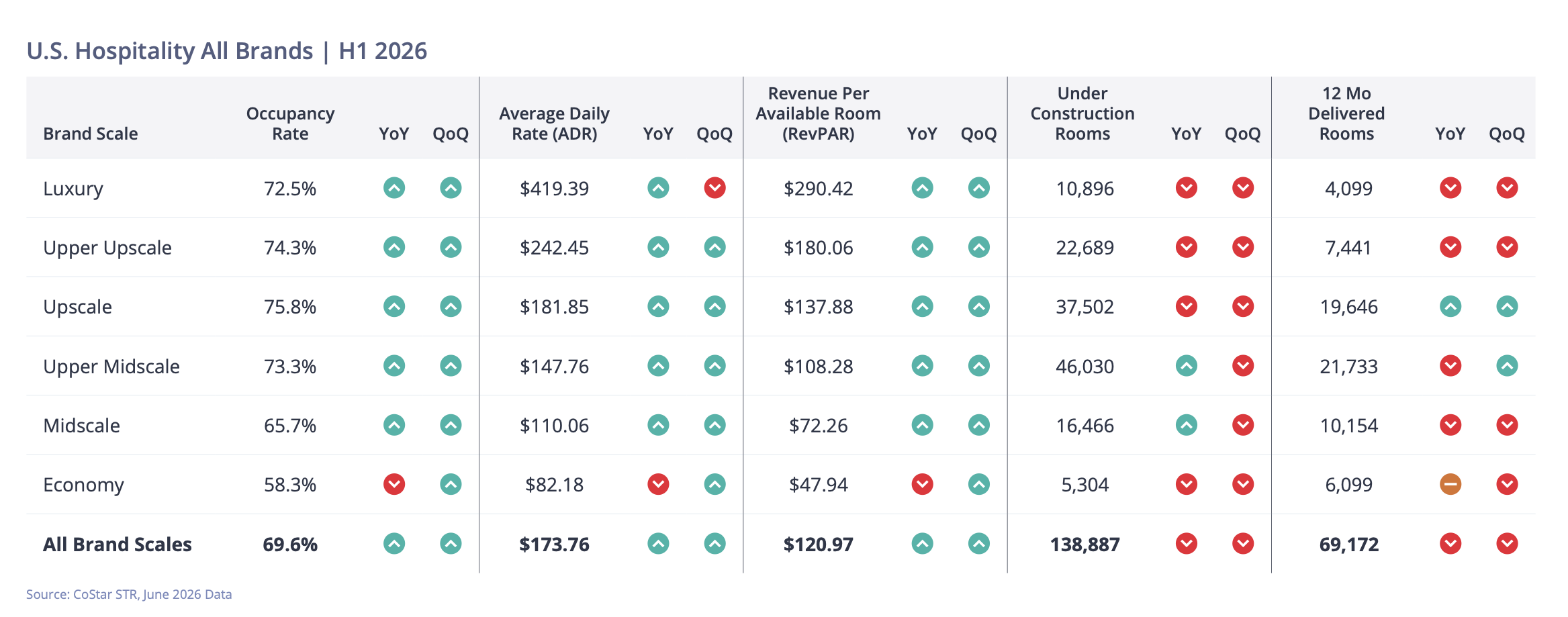
The luxury segment recorded a 13.3% year-over-year increase in RevPAR. Colliers said localized demand during the FIFA World Cup helped drive average RevPAR growth of approximately 13% across the 10 U.S. host city markets. At the same time, the economy segment was the only class in the first half of 2026 to record year-over-year declines in occupancy, ADR and RevPAR.
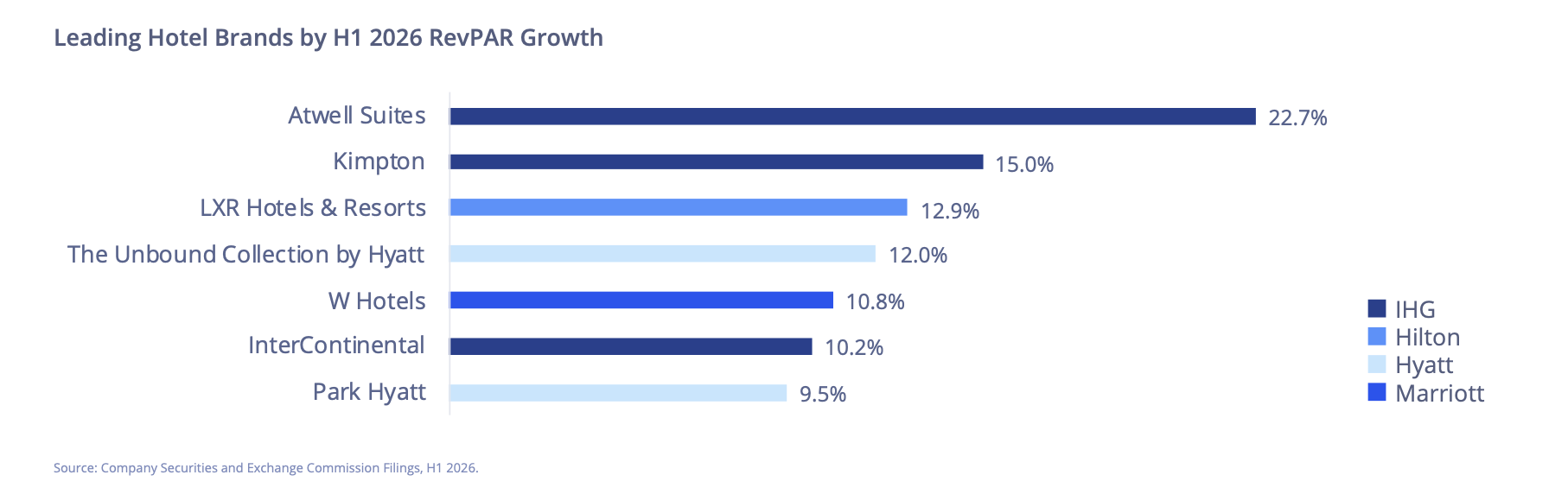
Across Hilton, Hyatt, Marriott and IHG, luxury portfolios recorded at least one brand with double-digit RevPAR growth during the period, largely driven by ADR gains. Experience-led brands also recorded strong results, with LXR Hotels & Resorts, The Unbound Collection by Hyatt, W Hotels and Atwell Suites by IHG each posting double-digit RevPAR growth.
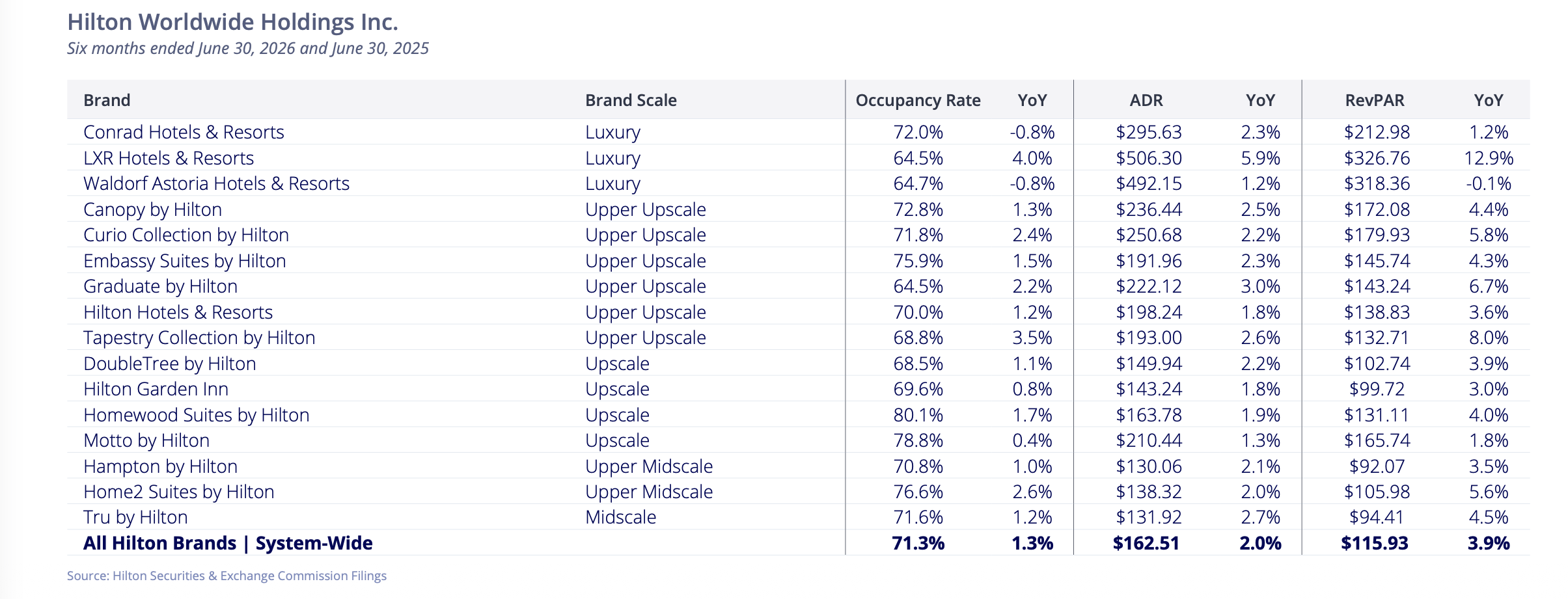
Hilton reported 4.7% RevPAR growth in its U.S. operations during the first half of 2026. LXR Hotels & Resorts recorded 12.9% RevPAR growth, supported by a 4% increase in occupancy and 5.9% ADR growth. Its ADR reached $506.30, compared with $492.15 at Waldorf Astoria Hotels & Resorts. Conrad Hotels & Resorts recorded a 1.2% increase in RevPAR, while Waldorf Astoria declined 0.1%.
Hilton’s upper-upscale and midscale brands also recorded increases. Tapestry Collection by Hilton posted 8.0% RevPAR growth, while Graduate by Hilton increased 6.7%. Home2 Suites by Hilton recorded 5.6% growth and Tru by Hilton increased 4.5%. System-wide, Hilton reported 3.9% RevPAR growth, with occupancy up 1.3% and ADR up 2.0%.
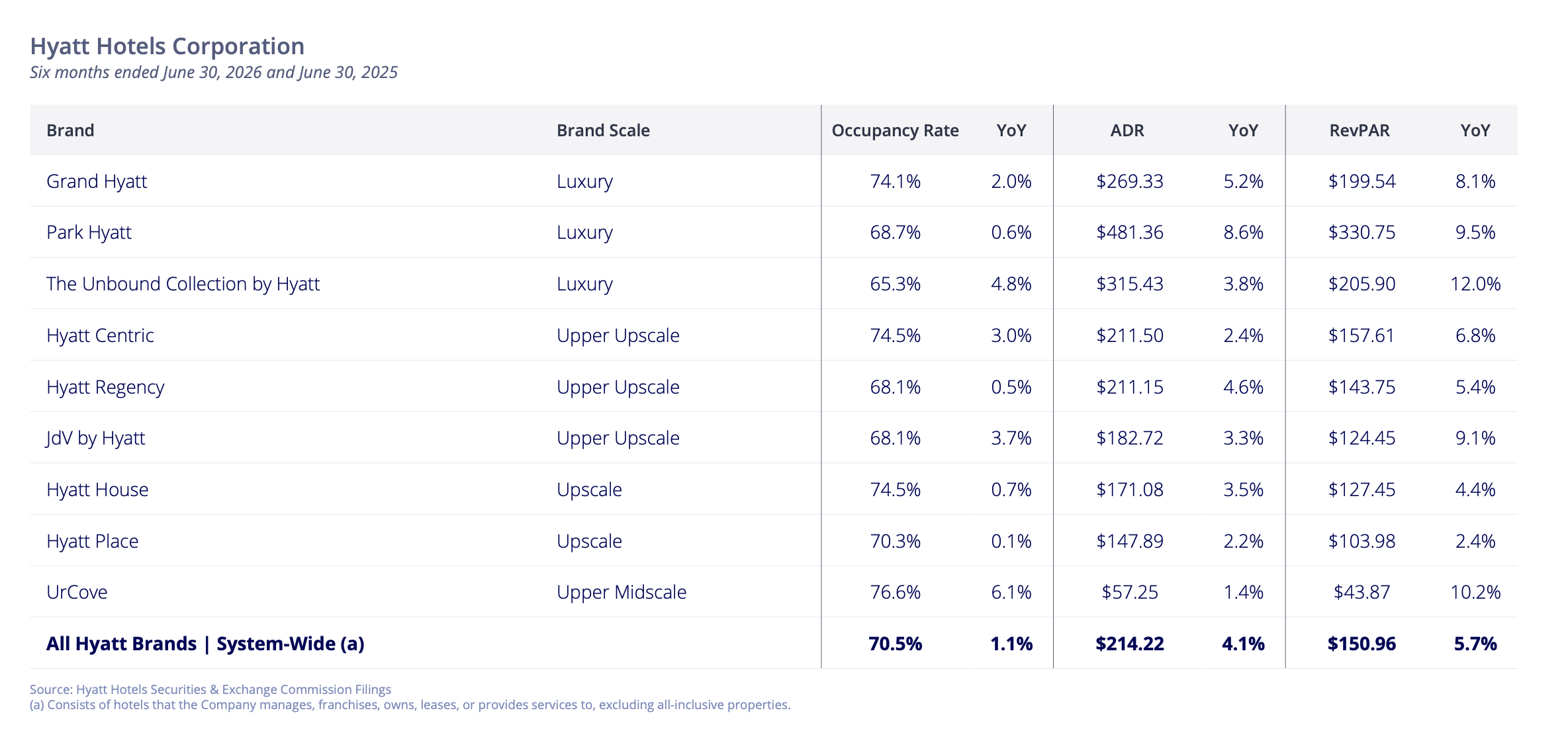
Hyatt reported 5.7% system-wide RevPAR growth in H1 2026, led by its high-end lifestyle and leisure brands. The Unbound Collection by Hyatt recorded 12.0% RevPAR growth, with occupancy increasing 4.8%. Park Hyatt posted 9.5% RevPAR growth and ADR of $481.36. Grand Hyatt increased RevPAR 8.1%, while JdV by Hyatt recorded a 9.1% increase. Hyatt Place and Hyatt House maintained occupancy at 70.3% and 74.5%, respectively.
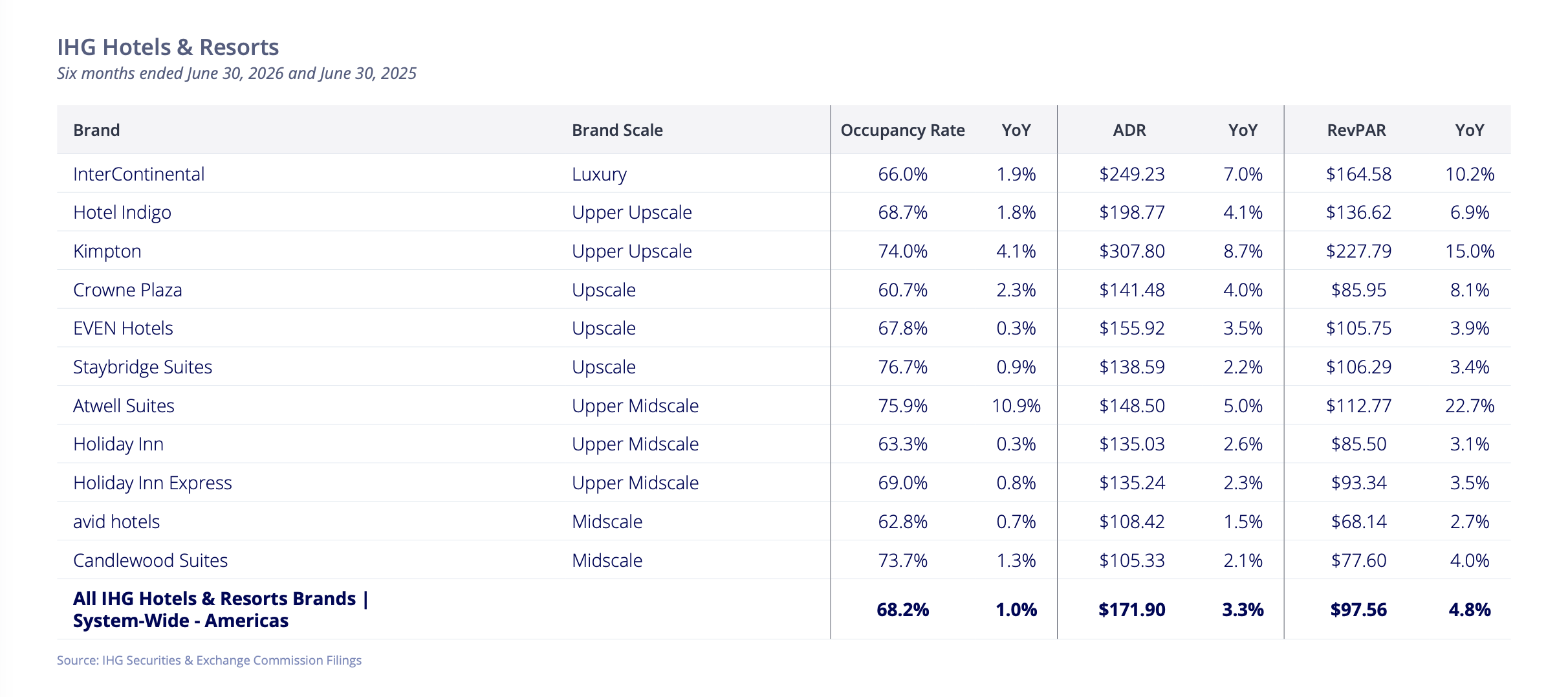
IHG Hotels & Resorts recorded 4.8% RevPAR growth across its Americas fee business. Atwell Suites posted the highest RevPAR growth among the brands covered in the report at 22.7%, driven by a 10.9% increase in occupancy. Kimpton recorded 15.0% RevPAR growth, supported by 8.7% ADR growth. InterContinental increased RevPAR 10.2%, while Hotel Indigo rose 6.9%.
IHG’s midscale brands also showed signs of stabilization. The report said occupancy stabilized across Holiday Inn, Holiday Inn Express and Candlewood Suites following earlier supply pressure and softer demand. Candlewood Suites recorded 4.0% RevPAR growth, while Holiday Inn Express increased 3.5%.
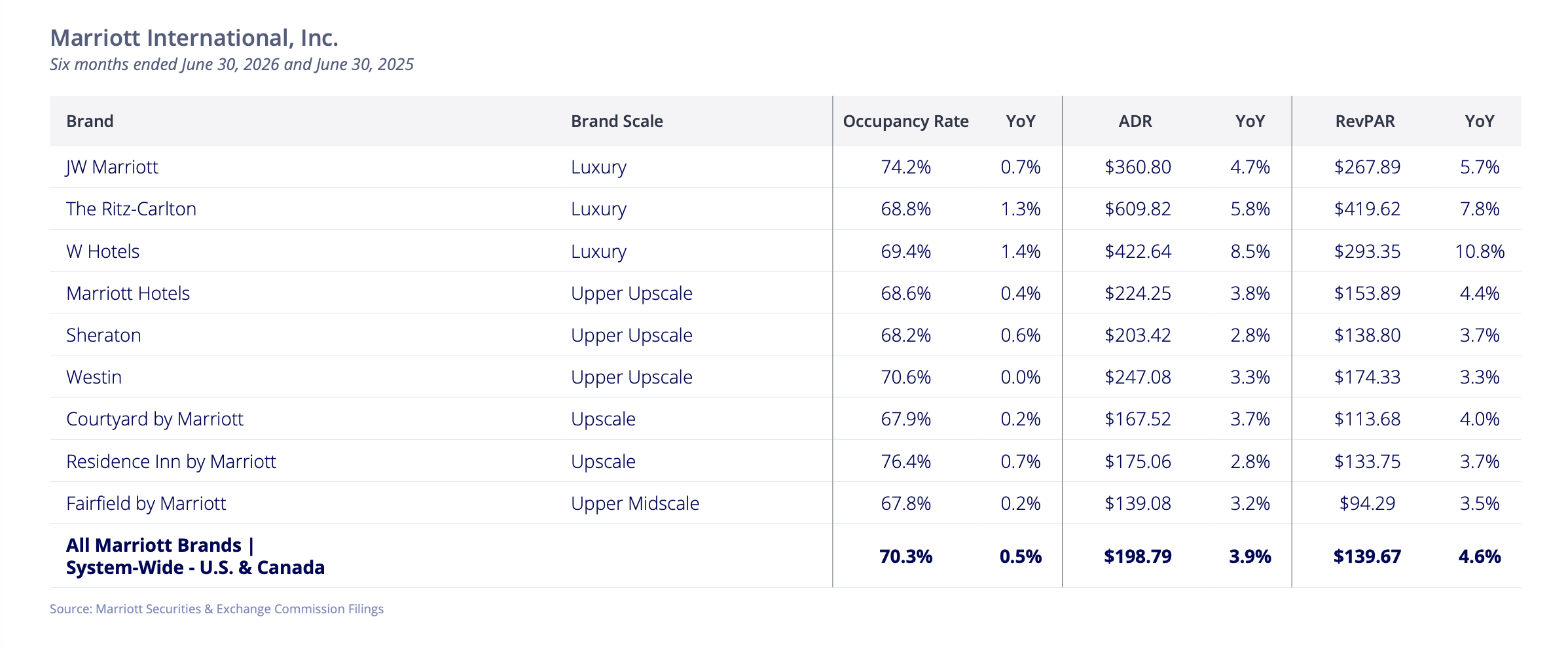
Marriott International reported 4.6% RevPAR growth across its U.S. and Canada system during the first half of 2026. The Ritz-Carlton recorded ADR of $609.82, up 5.8%, while RevPAR increased 7.8%. W Hotels posted the strongest RevPAR growth within Marriott’s portfolio at 10.8%, supported by an 8.5% increase in ADR to $422.64. JW Marriott recorded 5.7% RevPAR growth.
Select-service brands recorded more moderate growth. Courtyard by Marriott posted 4.0% RevPAR growth and Fairfield by Marriott increased 3.5%. The report said easing supply growth contributed to stronger performance across the middle-market segment, although occupancy gains remained slower than those recorded among luxury brands.
Across all brand scales, U.S. hospitality recorded 69.6% occupancy, an ADR of $173.76 and RevPAR of $120.97 in H1 2026. The report recorded 138,887 rooms under construction and 69,172 rooms delivered during the 12 months. Luxury properties had 72.5% occupancy, $419.39 ADR and $290.42 RevPAR, while economy properties recorded 58.3% occupancy, $82.18 ADR and $47.94 RevPAR.
Colliers attributed continued pressure on mid-market segments to limited pricing power, softer demand from budget-conscious travelers and the lingering effects of recent supply growth. Deliveries peaked in mid-2025 for economy and upper-midscale classes, while midscale deliveries peaked at the start of 2026 as new inventory continued to be absorbed.