
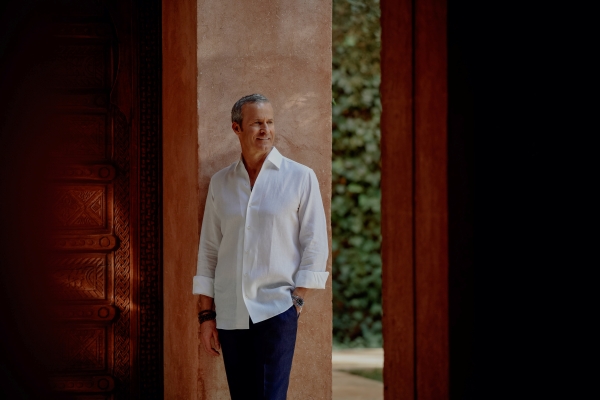
Vladislav Doronin, the billionaire chairman and CEO of Aman Group, appeared on screen wearing a crisp white dress shirt open to the third button. His dirty blond hair neatly parted on the left side and swept back, revealing no signs of recession in the hairline. A bracelet stack obscured his right wrist. It was a look that exuded boho beach luxury. He was in Miami, after all, visiting what is to become an Aman in Miami Beach.
Behind him, an impressive high-ceiling living room was sparsely furnished with modern, geometric furniture. Equally tall horizontal windows offering ocean views lined the perimeter.
The thing is, in an era where video conversations allow for artificial background settings, one can never be sure if the backdrop is genuine or spurious. Like Doronin himself, there is more than meets the eye.
As we fell into a comfortable cadence of conversation, what could have become a mechanical discussion between writer and subject often was interrupted by mirthful tangents. Doronin is a health nut—a serious one who knows his stuff, which makes sense since much of the Aman brand is built around wellness—and before long conveyed his lessons for a long life: “It’s very important to start your morning with hot water and saffron; it cleans your blood… don’t drink turmeric in the morning; it’s hard on your stomach; eat first, then take some mixed with ginger and black pepper… are you stretching…?” In response to what I shared as a predilection for additive-free tequila, Doronin showed tolerance: “You can be a bad boy one day, then come to Aman and get a cleaning.” Maybe that is the unalloyed essence of Aman: the sybaritic and the salubrious.
THE DRAW
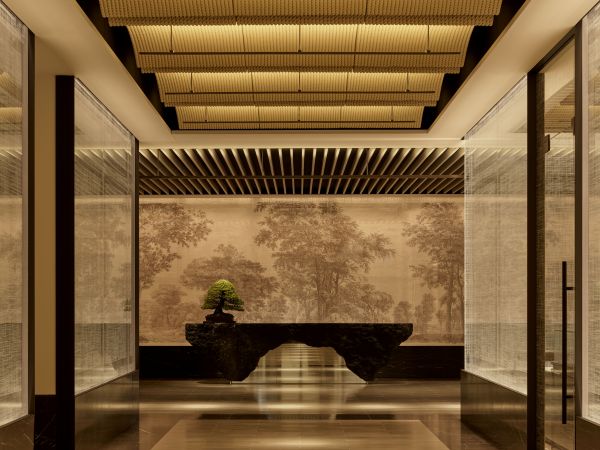
Mention Aman and expressions turn serene, placid; people marvel, drawn to its promise, astral projecting to a location even if they’ve never had the fortunate opportunity to stay in one before. (Nightly rates at Aman outposts are steep—and that’s kind of the point.) Aman is quite possibly the world’s most exclusive ultra-luxury hospitality brand, known for understated design, exceptional privacy and highly personalized service in locations that range from the streets of New York to a forest garden in Japan. Shhh luxury at its finest.
One of Aman’s most fervent guests was Vladislav Doronin. Long before he acquired a controlling stake in the company in 2014, he was a patron, an “Amanjunkie,” the endearing self-appellation for the brand’s loyalists. “I was one of them,” said Doronin, recognized this year as HOTELS Magazine’s “Hotelier of the World.”
Like baseball or Pokémon cards, there’s an affluent band of travelers who collect Amans, from Amanpuri in Phuket, which opened in 1988 as the brand’s first destination, to Amanvari, which opened this year on the East Cape of Baja California Sur in Mexico. It’s a pricey hobby. “I call it the addiction,” Doronin said.
Aman has a legacy built on silence, space and escape. Guests don’t check into an Aman; they disappear into one. Doronin, like his guests, tries to keep a low profile, but playboy good looks, a string of high-profile relationships and a once public wrangling over legal ownership of Aman (spoiler alert, he won), make flying under the radar a herculean task. Despite a lofty persona, Doronin, it turns out, is about as down-to-earth as one can be with a net worth as considerable as his and the trappings that follow. Consider Capital Hill Residence, a home of his that can only be described as a sci-fi residence made more striking in its placement, carved into the Barvikha Forest outside Moscow. The home was designed by the late Iraqi-British architect Zaha Hadid, her only completed private residence. Hadid purportedly referred to Doronin as the Russian James Bond, not only for his exquisite taste and wealth, but for his desire to create something extraordinary.
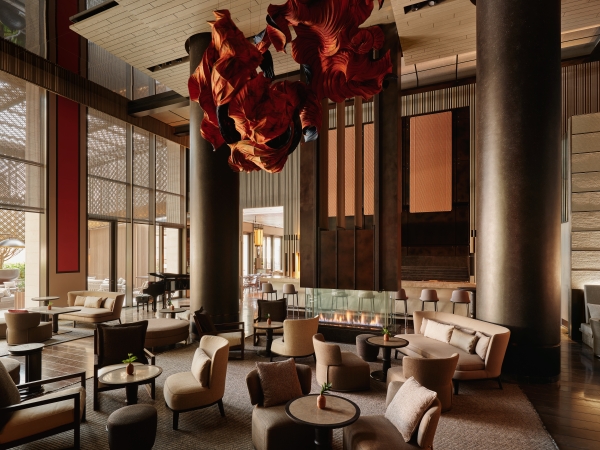
Capital Hill Residence is only one example of Doronin’s preternatural ability to design and build places that become more than just venues to visit. Aman resorts have an almost monastic quality: guests pay large sums to slow down, harmonize with nature and receive the kind of intuitive, impeccable service that comes when staff outnumbers guests. As many as half of Aman’s locations sit within or adjacent to UNESCO World Heritage sites. While developers often try and cram as many rooms into a location to extract as much revenue, Aman properties feature smaller room counts amid public spaces where unhurried guests may feel as if they are the only ones there. In a world of loud luxury, Aman opts for quiet solace.
Aman is deliberate in its growth. There are currently 36 Aman properties with 12 under development, including locations as unique and distinct as Texas Hill Country to Hokkaido, Japan, where low-slung buildings will blend into a hillside lying contiguous to the ski slopes of Mount Moiwa.
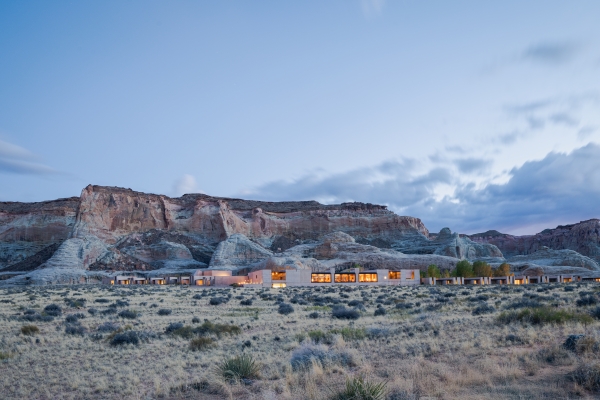
“We’re very picky,” Doronin said, an understatement, but one that illustrates the prominence and preeminence of the brand. George Clooney married his wife, Amal, at Aman Venice. Lady Gaga purportedly danced in the kitchen of Amangiri in Canyon Point, Utah, a monolithic masterpiece carved into a sandstone rock formation and encircled by a desert landscape. It could be a stand-in for Tatooine in “Star Wars.”
Doronin is an emphatic, assertive, dogmatic developer. Each project he takes on, he takes on with gusto, married to the details. Like a father, he treats his real estate like children, doting on their every move. “I create projects like I’m raising a child,” he said. “I dress them because I’m involved in the design. I’m proud. They are like my children because each of them takes time to grow.” He jokes that he has 84 children worldwide, one for every building he’s developed.
BORN FOR THIS
Real estate is not where Doronin got his start in business. Born in Leningrad, Russia— now Saint Petersburg after the fall of the Soviet Union—Doronin’s parents were war survivors and instilled in him values shaped around family, commitment and work ethic. “They were my motivation to work hard and succeed,” he said. His father was a teacher, and as the only son, Doronin was his biggest pupil. He taught him about the world; he took him to the Hermitage Museum as a young boy. Doronin is a keen art collector, a lover of the arts; growing up, he was drawn to Russian Suprematism, which focused on the idea of artistic feeling over realism or figurative depiction of the physical world. (It’s a credo that unmistakably shows up in the development of Aman.) He was drawn to the works of such luminaries as Kazimir Malevich and Lyubov Popova. Doronin is one of the largest collectors of Jean-Michel Basquiat in the world.
Around 1985, Doronin left Russia for Geneva, Switzerland, where he traded commodities, and resumed the same in Hong Kong in the short while after. He returned to Russia in the early 1990s and started a new track: commercial real estate. Doronin was focused on mixed-use developments and managed to build more than 80 buildings around the world.
Some around him initially questioned his foray into real estate, a business that takes patience and a long view, much different than the volatility of trading commodities. “They’d say, ‘You want to get money fast, right?’ But I like it because I’m deeply involved from the beginning.”
In 2015, he founded OKO Group, a real estate development company based in Miami that focuses on ultra-luxury residential towers, high-end hospitality and class-A commercial office buildings. Key projects include 830 Brickell, in Miami’s Brickell Financial District and one of the tallest buildings in the city, and Missoni Baia in Edgewater, the first luxury residential project by Italian fashion house Missoni.
CITY LIFE
When Doronin acquired Aman, he quickly identified potential for the brand extending beyond resort and out-of-the-way locations. “I saw what was missing,” as he said. What was absent, he gathered, was a city concept. But for a brand as tethered to its natural environs, translating the concept to an urban locale couldn’t be simple or turnkey. “It’s very difficult to try and keep the same vibe, the same energy, but in a cityscape,” Doronin said. Most Aman resorts are squat, low to the ground. Cities don’t afford that luxury where buildings are normally constructed to vertiginous heights. One other thing of note he mentioned: “It costs a lot of money.”
Aman Tokyo, which opened in 2014 and occupies the top six floors of the 38-story Otemachi Tower, is the blueprint. The hotel is perpetually on “Best of Tokyo Hotels” lists and has rooms featuring deep basalt stone soaking tubs and tatami-inspired elements. Sliding shoji screens reveal views of the Imperial Palace Gardens or Mount Fuji. A Sky Wellness Floor houses a 27,000-square-foot wellness center featuring a 100-foot lap pool.
Doronin’s magnum opus (up to now, that is) is Aman New York, an ambitious hotel-and-residence property set into the Crown Building on 57th and Fifth Ave., a property acquired in 2015 by a group including Doronin for close to $1.8 billion. The hotel opened in 2022. Doronin owns the penthouse, which he paid $135 million for.
He refers to Aman New York as the hardest and most expensive project he’s ever done. In a city as regulated as New York, certain elements that figure verboten in a hotel are not, like the working fireplaces in every one of the 83 suites. The 7,000-square-foot garden terrace has heated outdoor tiling and a retractable glass partition and ceiling so guests can enjoy the outdoors even in the depths of a New York freeze. Keeping in the secluded spirit of Aman, lattice walls allow guests to spy the city without neighboring eyes peering in. Aman Spa New York spreads over 25,000 square feet, making it one of the largest spaces dedicated to wellbeing in the city. Meanwhile, membership at the private Aman Club costs $200,000 upfront, plus $15,000 annually; expensive to be sure, but with nightly room rates starting at $3,000, who is in a position to argue?
More city locations are set to follow, including Miami, Beverly Hills, Singapore and Seoul. “We’re growing this part of the portfolio dramatically,” Doronin said, reckoning that as many as half of the entire Aman portfolio could one day be city-driven.
AND BEYOND
There is more to Aman. Not metaphorically, but actually. In 2020, Aman announced Janu, a sister brand, which, while keeping within the luxury lane, is conceived as a more energetic and social counterpart to Aman’s signature quiet privacy—think buzzier public spaces, vibrant colorways and higher room counts. The first Janu, which means “soul” in Sanskrit (Aman translates to “peace”), opened in Tokyo in 2024 with 122 rooms and suites, and while rates are below what an Aman charges, they are well above $1,000 per night.
The idea behind Janu, Doronin said, was to create a brand that didn’t conflict or cannibalize Aman. It also originated from loyal Aman guest feedback. “They wanted an Aman experience, but with a little more of a playful spirit,” he said. Guests and locals can also expect more dining options: Janu Tokyo, for instance, has five restaurants, while a typical Aman may have two. There are currently six more under development in locations including the UAE, Montenegro and Turks & Caicos.
Aman has become a full-fledged, 360-degree lifestyle brand under the auspices of Doronin. Beyond resorts and hotels is Aman Essentials, the brand’s retail line of skincare and apparel that is run by Doronin’s long-term partner, Kristina Romanova. They have two children together. Essentials was a natural extension, according to Doronin, born out of guests wanting to not only stay with Aman but live immersed in it and take it away. “They want to leave with Aman,” he said. He should know: The first time Doronin visited Amanpuri, he wanted to buy the resort’s furniture. It was not for sale. Men’s cashmere jackets, however, are, and can be purchased on shop.aman.com for $1,725. Last year, Aman Essentials launched a collab with British designer Kim Jones, a friend of Doronin’s and former director of Dior Men.
Next year, Aman will launch Amangati, which, though it sounds like one of Aman’s newest luxury land locations, is not; rather, it’s Aman’s entry onto the high seas, a 47-suite sailing yacht with eight bar and dining venues and guided by Aman’s philosophy of simplicity and balance. Doronin is particularly smitten by the 3,810-square-foot Aman Suite with its own private elevator. Amangati will also have an expansive, two-floor, 12,000-square-foot spa designed in a Japanese ryokan aesthetic that would make even Ozu’s camera move. Wellness is core to the Aman ethos; it’s “foundational,” as Doronin said, and goes well beyond hopping on a treadmill for some morning cardio. In 2024, Aman welcomed 24-time Grand Slam-titles-winner Novak Djokovic as its global ambassador and wellness advisor. Doronin calls the 39-year-old “Djoker” a “beast.” His daughters sometimes hit balls with him. “They adore him,” he said.
Doronin likens wellness to a chain of interconnected links that consist of various elements like nourishment, like exercise, like recovery—a full regimen that Aman properties guide guests through. It’s a serious and exhaustive process. “I can’t explain it all in one minute,” he told me.
I was allotted 30 minutes with Doronin. It turned into about an hour of both focused and desultory conversation that paints the picture of a man whose life successes and wealth are a byproduct of an unquenchable curiosity and thirst for betterment. On this morning, he was fresh off a trip from Japan and feeling the effects of jet lag. “I’m a little bit like a zombie,” he said.
Rising from the dead has never been an issue for someone as full of life as Doronin. “My life is very rich, trust me,” he promised. “I’m lucky to be doing something I like.”
Finally, he had to leave, off to his Miami Beach project, in the Faena District, and scheduled to open in 2028. The hotel and residences are a redevelopment of the famed Versailles Hotel alongside the Atlantic Ocean.
He bid me farewell. “Take care,” he said. “And stay healthy—that’s most important.”
