
Back in 2010, the year that Apple launched the iPad and millennials first laid their scrolling finger on Instagram, the famed theoretical physicist Stephen Hawking appeared in a brief Q&A. Not with Scientific American, not with Popular Science, but with Parade, mainstreaming the influencer scientist.
At one point during the discussion, Hawking was asked a question about human space exploration and the potential of it being replaced by robots. His response proved more idealistic than pragmatic. “Science,” he said, “is not only a disciple of reason but, also, one of romance and passion.” Put differently, science is fact; it is data; it’s also deeply emotional and creative, driven by the thrill of discovery.
More than two decades before Hawking’s love line to science, two Indian students serendipitously crossed paths on a train, a Hitchcockian encounter that would lead to them putting Hawking’s quixotic notion to the test, into action and, ultimately, stamping a pricing-strategy legacy.
The strangers on a train were Ravi Mehrotra and Sanjay Nagalia and both were headed to the same place—the prestigious Indian Institute of Technology—to pursue engineering degrees. The similarities—aside from Nagalia being three years Mehrotra’s junior—were evident; it made eminent, almost preordained sense that the two might find success together. Mehrotra and Nagalia alighted the train that day, but it wasn’t until years later that the two would connect again. This time, in the United States.
After graduation, both went their separate ways to American universities. Fate intervened again: a mutual friend became a conduit for the two to reconnect. Only this time, it was for good.
BACK IN THE DAY
The practice of revenue management was still primitive in the 1970s and 1980s, governed by analog systems and gut instinct. This began to change in 1978 when the airlines were deregulated, which ended years of strict federal control over pricing. Airlines suddenly had more freedom to set their own fares and compete on price. It wasn’t that simple: Merely lowering fares to fill planes could result in selling too many seats cheaply and having nothing left for passengers willing to pay more closer to departure. New methods were needed in a practice ripe for elevation and experimentation.
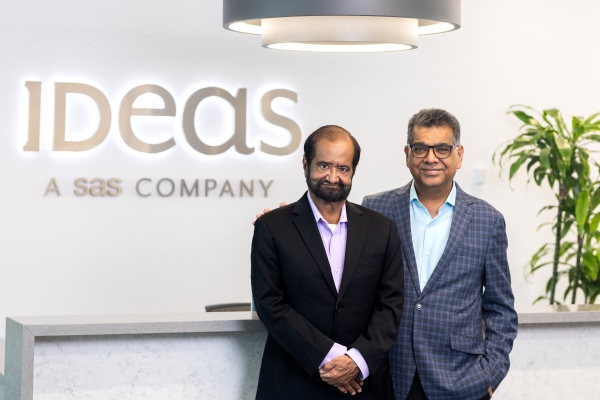
In 1989, Mehrotra and Nagalia launched IDeaS, a fanciful and fortuitous acronym for Integrated Decisions and Systems. Despite similar educational pedigrees, the two are more different than alike, according to Nagalia, but as scientists with electrical engineering backgrounds, they think similarly, which allows them to solve similar sets of problems. “We complement each other,” Nagalia said.
As Nagalia recalls, the startup was indeterminate at the jump, but the rationale was not: create a business that concentrated on the field of decision systems.
That direction was logical. As a professor at North Carolina State University, Mehrotra studied forecasting, optimization and decision-making under uncertainty. In short, how to make the best possible decision when the future is unpredictable. “There was no concept of forecasting; there was no concept of understanding demand as a function of price and trying to optimize,” Mehrotra said of the early days of revenue management.
It was in those early days that IDeaS pioneered an approach called “Opportunity Cost,” which dealt with length-of-stay effects. This meant that a hotel, for instance, needed to consider not simply the price of a room, but how long that room was being booked for and displacement, which is the acceptance of a lower-yielding reservation (business on the books) that prevents the hotel from selling those same rooms later at a higher-yielding rate. Other ideas IDeaS championed included hurdle rates and last room value or what a hotel would expect to sell its last room at based upon demand and price sensitivity.
It was radical, and much of it became the basis for modern-day hotel revenue management. As it happened, airlines, not hotels, were where IDeaS got its first shot. Northwest Airlines was a thriving U.S. carrier prior to its merger with Delta in 2010. Twenty years before, it approached IDeaS to create a network optimizer for airline revenue management. The idea was simple if its implementation was less so: airlines shouldn’t optimize each flight or seat independently.
Consider a flight from Minneapolis to Tokyo. One passenger occupies a seat on the flight, but the economics of that seat depend on the entire flight network. Another passenger might want the same seat but is traveling from Minneapolis to Detroit. Yet another traveler might be connecting onward to Tokyo. The question becomes: What’s the economic value of keeping the seat available for a potentially higher-value itinerary rather than selling it now? Applying IDeaS’ Opportunity Cost postulate and it becomes clear: A seat isn’t worth what the next passenger will pay for it; it’s worth what you might lose by giving it to that passenger instead of someone else. Leg-based optimization was conceived.
To this day, Delta uses some version of a solution IDeaS designed years ago.
CHANNELING HOTELS
Many of IDeaS’ airline applications are relevant to the hotel industry because, as Nagalia observes, both products are similar. “You have fixed capacity, different types of paying customers and inconsistent demand,” he said. “When you have a combination of these things, there’s opportunity to give different people different prices and for different products based on their willingness to buy.” As Nagalia recalls, the biggest challenge facing IDeaS at the outset was resistance. “It was making them realize that they were leaving money on the table,” he said.
Northwest Airlines was a bridge to hotels and built on a similar concept: perishable inventory. A hotel has a fixed number of rooms and once a room isn’t sold, it disappears forever. “Revenue management has always been about making better decisions under uncertainty,” said Mehrotra. “The goal was never higher prices. The goal was to match the right customer with the right product at the right time and at the right price. What mattered was making the best possible decision based on the information available.”
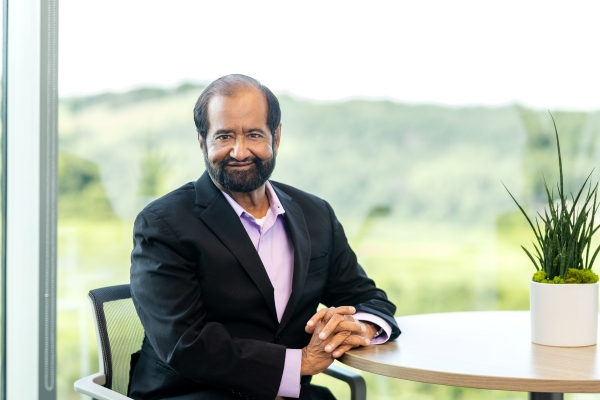
On the leadership page of IDeaS’ website, there is a picture of Mehrotra. He’s holding what appears to be a wooden block with the inscription: “Imagination Will Take You Everywhere.” It’s the kind of bromide one might pass off as trifling, but for Mehrotra, it’s material. On that same page, Mehrotra’s bio characterizes him as “Einstein-inspired.” For anyone who has spent time with him, it’s spot on. Like Einstein, Mehrotra challenges assumptions. And while both were and are certainly brilliant, one of their biggest gifts was not just mastery of science and numbers, but the ability to reduce the esoteric to the comprehensible.
“I view my job not as, ‘I have to provide a solution,’ but, rather, ‘I have to provide a means for further success,’” Mehrotra said. And like a teacher, he boils room pricing down to its core. “You start with high prices only to realize that the demand you anticipated didn’t flow up,” he said. Now, you are left with empty rooms (perishable inventory, remember) and will forcibly take every booking that comes along. “Conversely,” he said, “when you think you’re going to be empty, and you sell rooms very cheaply, and the hotel fills up.” Then, you are left with no wiggle room if you wanted to sell rooms to prospective guests willing to pay more for them. “[Hoteliers] don’t have to be rocket scientists. They don’t have to understand the laws of mathematics and physics to understand these unfavorable situations,” he said in true Mehrotra fashion. “That is how we were able to convince them to trust the technology.”
And like Einstein, there is a humanistic quality about Mehrotra that oftentimes makes him sound less like a scientist and more like a philosopher. Despite the successes, there is humility. “Pride goes before a fall,” he said, when asked about milestones and achievements. “Our intent has always been how to introduce more rationality into the way we do things. It did not exist. Nobody thought that this would become a necessity where, without revenue management, the businesses would not be able to function the way they need to function.”

A BIG FISH
Hilton caught on. It became IDeaS’ first big hotel client back in the 1990s, well before it was a 9,000-plus-hotel behemoth. In fact, in those days, Hilton was two separate entities, a U.S arm and an international one. Chris Silcock, who is president of global brands and commercial services for Hilton, is retiring next year. He has fond memories of Hilton’s initial tie-in with IDeaS, like the time he and Mehrotra hammered out a deal in a small hotel room somewhere in Ithaca, N.Y.
Part of Silcock’s 30 years with Hilton included heading up revenue management. Back then, Silcock affectionately thought of Mehrotra as a sort of sane mad scientist. “He understood the hotel business so deeply and how to solve problems analytically,” he said. “What you don’t traditionally get with a mad scientist is the capability to make it understandable. I’ve never seen anything like it since. That’s what’s unique about him.”
The commendations don’t end there. Hyatt has been a customer of IDeaS for some time. Michael Klein, SVP of global revenue management at Hyatt, first met Mehrotra in the late 2000s when he was revenue managing hotels on the West Coast and Hawaii for Fairmont Hotels & Resorts. Back then, the tyro Klein saw revenue management through a prism of human intuition and art mixed with some math. He leaves no doubt of Mehrotra’s impact on his career. “Ravi helped me see that revenue management could be something even more rigorous: a science for making better decisions in the face of uncertainty,” he said. “He always approached the next idea with the mind of a scientist: Does it solve a real problem? Does the science hold up? Will it make the decision better? And will it create lasting value for the people who depend on it?”
It’s not hyperbole to say that Mehrotra and Nagalia never could have imagined that one day the world’s largest hotel companies would essentially outsource their most important commercial decisions to them. That is the faith Hilton had and still does. “Most systems were trying to build a recommendation system; we were looking for something different, which is exactly their belief: a decision system,” Silcock said.
HARDCODE TO AI
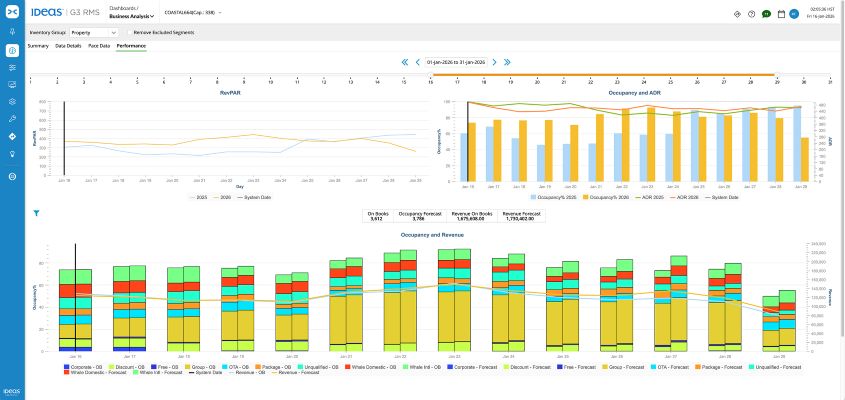
When Hilton first approached IDeaS, revenue management looked more Stone Age than Digital Age. Back then, the focus, even the goal, was around understanding what happened. Today, it’s about decision intelligence that influences all commercial aspects. Klaus Kohlmayr is chief evangelist and development officer for IDeaS. He’s been with the company for a combined 15 years. Years ago, he held property-level positions and painfully remembers the early days of revenue management when it wasn’t automated. “I had to make every pricing decision based on a huge Excel spreadsheet, using data that I manually imported. Then, whatever pricing guess I made had to be manually typed back into the selling systems,” he said. He first interacted with IDeaS at a hotel in 1998. The installation, he remembers, necessitated the purchase of a server and 30 floppy disks. But it was an inflection point. “Not only was the entire process automated, but it worked 24/7 and with a level of sophistication I could never achieve on my own,” he said. One big turning point was the shift to the cloud in 2003, which opened up a range of data sets hotel owners and operators could leverage.
IDeaS was acquired by data company SAS in 2008. Leadership didn’t change. The mission didn’t change. The only thing that did shift was IDeaS’ access to greater analytical power that has allowed it to accelerate innovation. A day doesn’t go by that Mehrotra isn’t queried about artificial intelligence and its impact on revenue management. It turns out, AI is not new to IDeaS. For decades, it’s employed machine learning, forecasting models and optimization techniques. “What’s changing today is not the existence of AI, but its accessibility,” Mehrotra said. Before ChatGPT and Claude became household names, sophisticated analytical systems required specialized expertise to interpret and apply. “Generative AI allows people to interact with those systems more naturally and intuitively,” he said. In only his way, the pedagogic Mehrotra offers three degrees of AI: predictive, which posits what is likely to happen; optimization, which instructs what to do about it; and generative AI, which helps understand why. “When those three capabilities work together, we move beyond reporting and recommendations toward true decision intelligence,” Mehrotra said.
AND BEYOND
Framing IDeaS as a supplier of revenue management capabilities to the hotel industry is only part right. There is nuance: decision intelligence extends far beyond the reach of the hotel lobby. In recent years, IDeaS has ventured into complementary verticals, including cruises, working with lines like Virgin Voyages and Windstar Cruises. For years, IDeaS’ tools have been used in car parks, such as those found at Heathrow Airport in England and LaGuardia Airport in New York. It’s also beginning to dabble in events and adjacent experiences, like waterparks. To Nagalia, it represents the further acceptance and prominence of revenue management as an integral part of a commercial operation.
Mehrotra isn’t keen to talk legacy. Not yet at least, especially when his passion for the work is still as palpable as it was when he and Nagalia set IDeaS into motion 37 years ago. Legacy has a starting line: Over the course of more than three decades, IDeaS has shaped and molded modern-day revenue management, evolving it from hunch and instinct to a practice grounded in science and scholarship. The work doesn’t have a finish line.
For Mehrotra, humbleness, not hubris, wins the day. “One of the things science teaches is humility. Every breakthrough builds on the work of others and every generation inherits ideas that it has a responsibility to advance,” he said. “If I’m remembered for anything, I hope it’s for helping establish a discipline that made better business decisions possible.”