
Despite living in a hyper-connected world, many argue that people feel more isolated than ever. Emotional health has become one of the defining challenges of our time, and perhaps traditional luxury wasn’t designed to answer it. In this context, a hotel company like Nômade People seeks to establish itself as an alternative for those who expect hospitality to deliver not only what they want from life, but what they truly need.
Nômade People was built around the idea of bringing people closer to themselves, one another and nature. The company has evolved from a small collection of properties in Mexico into a vertically integrated hospitality platform spanning architecture, food and beverage, culture and operations.
In this Q&A, Miguel Isla, CEO of Nômade People, discusses the changing expectations of luxury travelers, the balance between global expansion and local authenticity and why the company sees emotional health as the next frontier of hospitality.
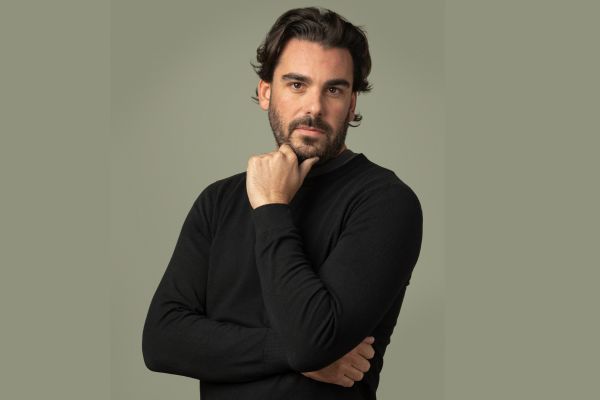
HOTELS: How has Nômade People’s original vision evolved since its beginnings?
Miguel Isla: Nômade People started with an encounter more than a business plan. Sebastián Sas had built Be Tulum, and later Nômade Tulum with Antonio de la Rúa. Bjarke Ingels and Barry Sternlicht came in, and then me. Together we saw something bigger than a hotel: what Barry called “3D hospitality.” It rests on three things: the physical product, personal service and community, meaning the human bonds, culture and emotional content of a stay.
The vision then was to create spaces for connection with yourself, with others, with nature. It hasn’t changed. What has changed is the scale and the structure. We grew from a couple of properties in the Mexican jungle into a horizontally integrated company. We also stopped seeing ourselves as a hotel company. We see ourselves as a cultural movement, one that isn’t built around a single founder’s personality and is designed to keep evolving, guided by the mission to “terraform hospitality.”
HOTELS: What are luxury travelers looking for today, and how does Nômade People respond to those expectations?
Isla: Many of our guests come from ultra-luxury brands and they aren’t missing comfort: they’re missing meaning. They want a luxury that is less pretentious and more human. They don’t just want to visit a destination; they want to live it.
We say that, at a Nômade Temple, the room is almost another amenity. The real value is in everything that happens beyond it: a breathwork session at sunrise, a shared dinner, a DJ set at night. We call it meaningful hedonism: pleasure and rest, but with something that stays with you after you leave.
HOTELS: How do you maintain a consistent brand identity while ensuring each property reflects its destination?
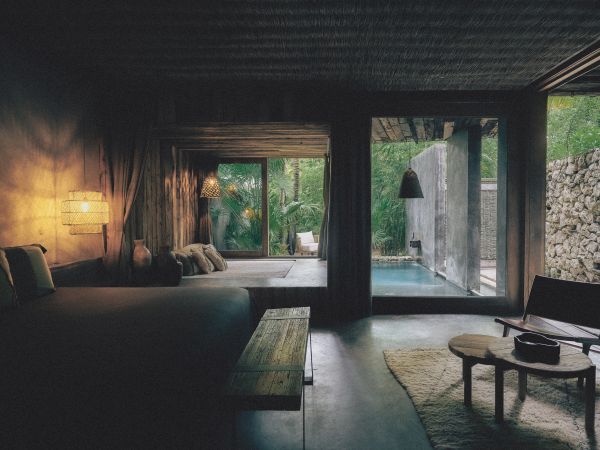
Isla: We don’t have a manual, and that’s intentional. Every property is designed in-house by our architecture studio, Oneness, starting with the place itself. Our principle is to “occupy without possessing”: build something new with the past rather than erase it.
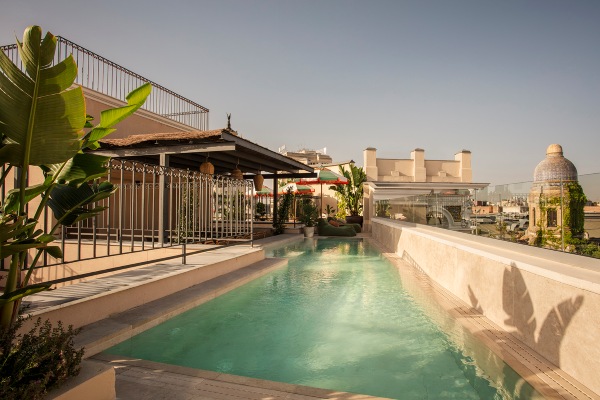
Our Latin-rooted spirit, approach to hosting and emphasis on emotional healing travel with us. Materials, food, music, craft and collaborators change. In nature, we lead with the landscape; in cities, with heritage. Madrid’s Temple occupies a historic building on Gran Vía, while Marrakech will be a village of connected riads in the Medina. Same soul, completely different bodies.
HOTELS: How selective are you when choosing new destinations?
Isla: We’re not trying to be the biggest. Our goal is 20 to 25 properties that truly matter. We look for an existing cultural pulse—a community, counterculture or pool of creative talent. We want to host a community, not invent one.
The destination must also bring something meaningful through nature, history or both. And the project has to work for our owners and teams. We only grow where we can build strong local teams and do it well.
HOTELS: What connects the four Temples, and how does the experience differ between beach and urban properties?
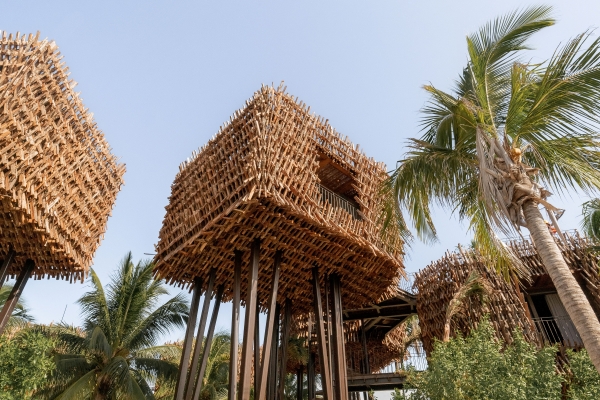
Isla: The thread is the Temple itself: a contemporary space where creativity, community, celebration and wellness come together. Beach Temples like Tulum, Holbox and Ibiza are about connecting with the surroundings. Nature leads, days follow the rhythm of the sea, and guests can live the whole experience within the property. Holbox is quiet restoration at the edge of an island. Ibiza goes back to the original Ibiza spirit, in the north, far from the crowds.
Madrid, our first urban Temple, works the other way around. It’s a bohemian refuge in the middle of the noise, open to the city. It has a spa, a restaurant, a café, a bazaar, a rooftop, a cultural space and a hidden listening bar.
We believe urban Temples will matter even more in the future, because of their power to generate community, talent and cultural programming.
HOTELS: Where do you see the greatest growth opportunities over the next five years?
Isla: We have more than ten projects in development. Geographically, the natural next chapter is Latin America and the Pacific: Trancoso in Brazil, Guanacaste in Costa Rica, and two projects in Todos Santos, Baja California. In Europe and North Africa, we are working on Marrakech, and we are exploring cities like Lisbon and Los Angeles.
In terms of concepts, the opportunity is in the ecosystem around the hotel. There’s GÖN House of Healing, our spa brand rooted in local healing traditions. There’s Monopol of the People, our creative platform for artists and thinkers. And there are formats like TownFarm in Todos Santos, where agriculture, artist studios and hospitality share the same landscape. We’re also seeing partnerships in music and wellness.
HOTELS: How do you prevent growth from undermining the discovery and authenticity that define the brand?
Isla: When you start copying. The moment a property becomes a template, something magical disappears. That’s why we talk about “scale without saturation.” We grow carefully, without putting at risk the success of what already exists.
HOTELS: How do you see lifestyle and experiential hospitality evolving?
Isla: We’ve been part of this movement since it was a niche in Tulum. Now it shows up in every industry report. I think the next step goes deeper than “experiences.”
Wellness is moving towards emotional health. Community is moving from a lobby design idea to real co-creation between guests, locals, artists and teams. Hotels are becoming an extension of people’s lives: places where they work, socialize, train, rest and connect.
Technology will be part of it too, but in service of the human. Physical spaces are becoming one of the few places where genuine human interaction still happens. That’s where hospitality can lead.
HOTELS: What is the biggest risk facing Nômade People as it expands, and what will you refuse to compromise?
Isla: The biggest risk is becoming what we set out to challenge: a formula, a brand that repeats itself, a company that depends on one personality.
What we won’t compromise on is the human side. That means the warmth of our service, the depth of our programming, and the respect for every place and community we arrive in. If a guest leaves more connected with themselves, with others and with their emotions, we did our job. If not, no amount of design will fix it.
HOTELS: What would you like Nômade People to be known for in five to 10 years, and how large do you expect the company to become?
Isla: Today people know us for our hotels. In ten years, I’d like us to be known for what those hotels do to people. I’d like Nômade People to be known as the company that proved emotional health belongs at the heart of hospitality. I’d also like us to be known for showing that Latin culture and luxury are not a contradiction, but a more human way to host.
