
No perfectly straight line exists in nature, and it doesn’t exist at the Fairmont Maldives Sirru Fen Fushi, either. That’s by design.
“We didn’t want anything to be completely straight,” says Hirsch Bedner Associates’ Robbyn Carter, lead designer of the resort, which opened in April. The name means Secret Water, and the island property draws on the visuals of the local environment. “Everything’s a little bit organic.”

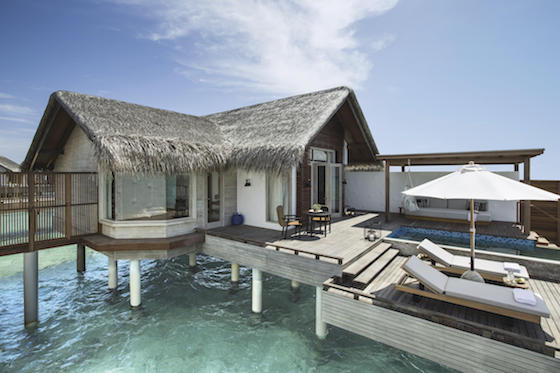
Taking as inspiration the tools of a fisherman’s trade, rope and other materials show up frequently in the public buildings and the 120 overwater and beach villas, including five semi-open jungle tents. Rope hangs from the ceilings, with airy light fixtures featuring glass fishing net floats; headboards are among the many woven elements, along with crocheted poufs and mats patterning the floors.
The wall textures are hand-troweled, with hand-carved wood details throughout; bamboo makes an occasional appearance as well. The palette is natural, with an occasional bright burst from turquoise and polished metals.
There’s even an occasional surfboard, a nod to Carter’s roots and evidence that her own career has very much not been a straight line: From the coast of California, her work took her to Amsterdam and a stint with designer Marcel Wanders. For a few years she ran her own studio, and then headed to Southeast Asia. She was named an HBA partner in December.
Carter visited the resort most recently a few months ago to fine-tune the design “down to the pillows” – and it was quite a difference seeing it in use versus her first visit more than three years earlier: A previous attempt to build a resort had left some construction in place for about seven years, including pilings that were kept to support the current overwater villas. But flora and fauna, in the form of tiny sand crabs, had overtaken the place (the patterns she saw on the sand, left by the crabs, inspired the wall textures).
She knew from the start that the resort should aim more for barefoot luxury than the formality of other Maldives resorts. “We knew that we wanted it to have a little bit of a twist,” she says. “We didn’t want it to be that picturesque infinity pool, palm tree — you know, very simplistic. We wanted a bit of personality in there.” AccorHotels’ Fairmont brand came in as operator after development.
Coral controversy
The northerly island has the largest lagoon in the Maldives; its reef stretches for 9 kilometers. It’s that reef, and an artwork commissioned by owner SC Capital of Singapore, that got the property some unexpected press. The Coralarium, by artist Jason deCaires Taylor, sits in the resort’s lagoon and featured human figures standing on and around a semi-submerged, marine-grade steel framework intended to encourage coral growth. But the country’s official religion of Islam forbids the depiction of human figures. Amid mounting pressure and up for re-election, the country’s president ordered the figures demolished.
Left standing, though, is the framework, where coral is being planted. “The Coralarium will be restored into an evolving art gallery,” says Simmi Pai, the hotel’s director of sales and marketing. The property says it will share more information once the new concept is finalized.

“I thought it was a beautiful idea that they had,” Carter says. “To create artwork that really brought awareness to the corals itself, but unfortunately it was overshadowed by political (events).”
From sunrise to sunset
Bisecting the island and pointing to the sculpture, which will eventually be engulfed in coral, is a 200-meter pool anchoring the island and running from the spa on the sunrise side to the Onu Onu bar on the west. Along the way, guests are guided to public buildings, including the resort center, kids club, restaurants and retail area.
Keeping things natural, Carter says, enhances the guests’ journey through the island. Appreciation of the design, which incorporates teak, Sri Lankan travertine and handmade Javanese copper bathtubs, occurs as more of a revelation. “We wanted it to be well done, with beautiful finishes… There’s a slow discovery of other objects,” she says.
Differentiators are important in the increasingly competitive Maldives, particularly among the luxury set, which includes Shangri-La, Four Seasons and Jumeirah. Besides limited airlift, “new properties opening both in our immediate atoll and throughout the Maldives present a challenge as they are offering very attractive opening specials and tactical campaigns,” Pai says.
The design details specific to the Sirru Fen Fushi were created in service of what Carter considers the ultimate luxury — time to enjoy the natural beauty of the island. “Everything we did was about gazing up at the stars, the pathways walking the trees, being able to have beautiful villas that were adjacent right to the reef. Everything was about this beautiful island that we’re on, but to experience it in the most comfortable way possible.”
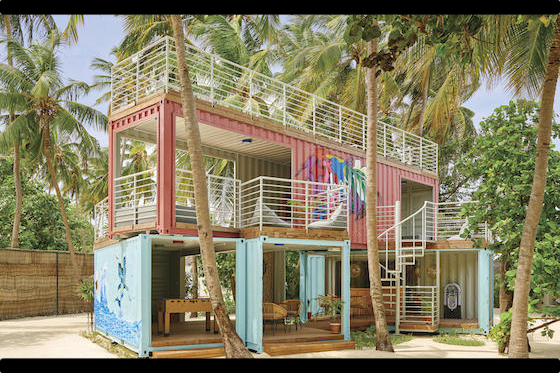
The design extends playfully to the kids’ center, which has slides and a bouncy woven net; Azure, the seafood restaurant, features a dramatic woven sculpture; the teen center is created out of shipping containers.

Guests can get in on the designing themselves – the resort has an art studio where they can paint, sculpt or draw on coconut, canvas or wood, or even make a piece of jewelry to take home.
“We wanted to feel a little bit like an eclectic tropical collection of artwork,” Carter says.