
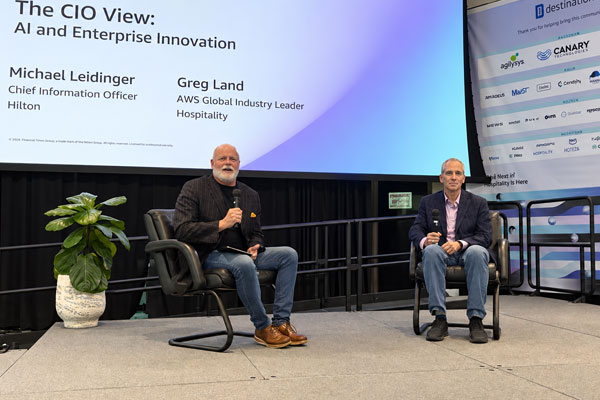
WASHINGTON, D.C. — Artificial intelligence is quickly moving beyond the experimental stage in hospitality, reshaping how travelers discover hotels, make bookings and interact with hotel companies. According to Amazon Web Services’ global leader of hospitality Greg Land and Hilton SVP and CIO Michael Leidinger, the pace of change is giving hotels little time to adapt.
More than half of U.S. leisure travelers are already using AI channels to plan trips, said Land. Increasingly, those travelers are moving from broad trip-planning prompts to acting on the recommendations they receive.
“That’s incredible information we can tap into now as long as we work these processes correctly and communicate with these foundation models,” Land said, speaking with Leidinger during a panel session at the Destination AI summit, here at the National Housing Center.
The shift also exposes weaknesses in traditional hotel websites and apps. Land pointed to research showing an 88% improvement in customer satisfaction among travelers using AI channels for trip planning, as well as a 45% lower bounce rate.
“That’s not good news for us,” Land said. “Our websites and our mobile apps—we’re not doing a good job putting all this information out there.”
For hotels, the implication is straightforward: They need to make their properties more discoverable to AI systems while ensuring their own digital channels are ready when those highly qualified shoppers arrive.
Rethinking Distribution
Leidinger said Hilton is focusing heavily on the content it controls, arguing that hotel companies need to make property descriptions, imagery and other information easily accessible to the large language models that increasingly influence travelers.
“Content is a space that hoteliers and hotel companies should own,” Leidinger said. “By having that content out there, you’re feeding the LLMs, the crawlers. You are helping to influence those recommendations.”
That strategy is already extending into Hilton’s own AI-powered tools. The company has launched an AI Planner that combines Hilton’s property content with information about destinations, attractions and activities. Leidinger said the tool allows travelers to begin with an idea rather than a traditional hotel search.
For example, as an avid cyclist, Leidinger tested the planner by asking for a challenging cycling route in Oregon’s Cascades, complete with climbs and scenic views. The system could then recommend routes and Hilton properties nearby. “That’s what helps drive that higher conversion,” he said.
The development could also alter one of hospitality’s most entrenched relationships: the one between hotel companies and online travel agencies.
The OTA Dilemma
AI platforms can increasingly provide the aggregation and comparison that travelers historically relied on OTAs to deliver. Land pointed to data that suggests travelers who begin their journey on AI platforms are often moving directly to hotel websites, mobile apps or contact centers to complete the booking.
“That could be a very good thing for us,” Land said. “You’ve got to make sure you’re ready to catch these very qualified leads.”
Leidinger believes the evolution will become even more complicated as AI agents begin acting on behalf of travelers. Personal agents can already search properties, evaluate options and, increasingly, facilitate transactions. In some cases, travelers may eventually give agents authority to make decisions and payments within predefined parameters.
“”You’re going to see more and more consumers that are just going to be turning over some of these final decisions to the agents,” Leidinger said.
That creates both an opportunity and a challenge for hotel companies. Land said the industry needs to ensure AI platforms do not simply recreate the existing OTA model, with hotels losing valuable customer information and paying intermediaries for bookings.
“Everybody’s got to completely rethink this because it’s just blown up everybody’s distribution strategies,” he said.
More Ambition
The next opportunity is even more ambitious: using AI agents to manage the entire travel journey. Land envisions a traveler telling an AI system to book an itinerary and having it arrange the air, hotel and car while responding to disruptions along the way.
Both executives pointed to proactive trip care as an important emerging use case. If an airline delay occurs, for example, an agent could potentially identify the disruption, rebook transportation, notify a hotel of a late arrival and ensure the room is held.
Leidinger sees significant potential in that scenario, particularly as AI makes it easier to connect previously fragmented systems.
But the technology ultimately has to serve the hospitality experience rather than replace it. Hilton already uses messaging bots across its properties to handle routine guest questions. Leidinger said those systems now handle roughly 40% to 45% of incoming messages, allowing hotel employees to focus on issues requiring human intervention.
“It’s not just about technology for the sake of technology,” Leidinger said. “It’s how you’re implementing technology to further augment and enhance the human hospitality that we all provide.”
For Land, the message to hotel companies is urgent. AI adoption among consumers is accelerating, and companies that wait risk allowing new intermediaries to define the next generation of hotel distribution.
“Be prepared. The consumer is there. We’ve got to meet them there,” Land said. “If you haven’t already rethought your distribution strategy, start tomorrow.”
