Data is everywhere, but making it actionable is what makes data matter. In the hotel industry, data is key: helping properties not only know their guests better but also understand how to run their hotels at an optimized level. Better data enables better revenue management by analyzing demand patterns, allowing hotels to optimize pricing and maximize occupancy. Operational efficiency also improves when data is used to forecast staffing needs, manage inventory and streamline services. Additionally, data-driven insights support targeted marketing campaigns, helping hotels reach the right customers at the right time.
In the end, it should translate into better profit.
HOTELS Magazine highlights five companies that are unlocking the data door and making hotels smarter.
Duetto
Find them @: duettocloud.com
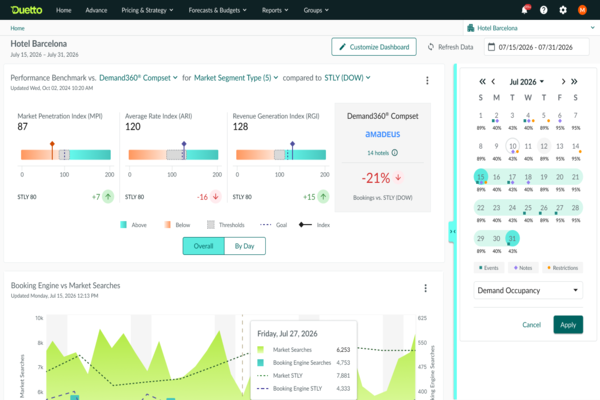
Imagine a room full of data points, where, like a middle-school dance, no one talks to one another. That is one of the challenges when it comes to data, explains Robert Matsuoka, chief technology officer at Duetto, which, through its tools, helps hotels drive revenue and maximize profitability. “Every hotel sits on a mountain of data—booking pace, market demand, guest segmentation, competitive pricing—but most of that data lives in disconnected systems that don’t talk to each other,” he said. “The result is that revenue decisions still get made on gut feel or stale spreadsheets.” Without data, you are just another person with an opinion. “Data matters because it replaces guesswork with precision,” Matsuoka said. Duetto takes an open-platform approach in order to achieve this, integrating with over 40 property management systems, channel managers and BI tools, “so that revenue strategy is built on a hotel’s complete data picture, not a partial one,” Matsuoka said. Consider its GameChanger tool: It sets real-time rates based on room types, booking channels and customer segments, rather than rigid BAR-based models. Greater revenue is complemented by cost savings through automation. “The net effect is more revenue captured per available room, less labor spent on low-value tasks, and pricing decisions grounded in real-time market signals rather than yesterday’s numbers,” Matsuoka said.
Otelier
Find them @: otelier.io
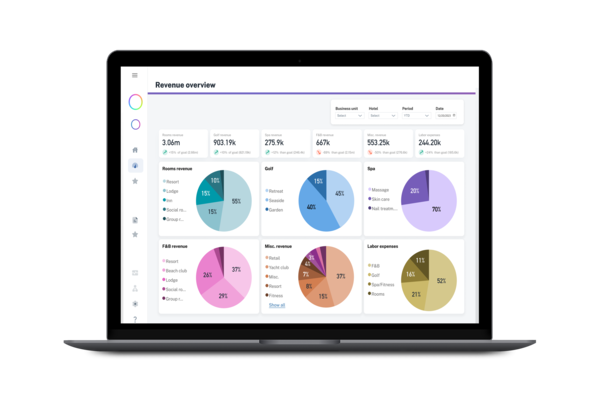
If data were an element, it would be gold, according to Jason Freed, hospitality data evangelist at Otelier, a data platform that gives hoteliers a 360-degree portfolio view. “It should power every decision across hotel operations and ownership,” he said. In “Any Given Sunday,” Al Pacino’s character gives the iconic “Game of Inches” speech, emphasizing that success comes down to fighting for small margins. Each day, hotels fight for those margins, which data can help expand. “Data helps keep a hotel business sustainable for the long term by continually improving the guest experience and protecting profitability,” Freed said. “It gives teams a clear understanding of their business and the ability to adjust operations accordingly across every department.” Otelier centralizes and normalizes data from disparate systems, giving hoteliers a full view of their business. In Freed’s estimation, it comes down to visibility. With clean, accurate data, teams can operate more efficiently by automating back-office tasks, building more reliable budgets and forecasts and turning data insights into operational enhancements,” he said. “With visibility across [departments], hoteliers can make incremental improvements across operations that ultimately drive both revenue and profit.” Otelier is also leveraging AI in its BI. Within IntelliSight, AI enables hoteliers to query their data and build charts and dashboards using natural, conversational language.
Actabl
Find them @: actabl.com
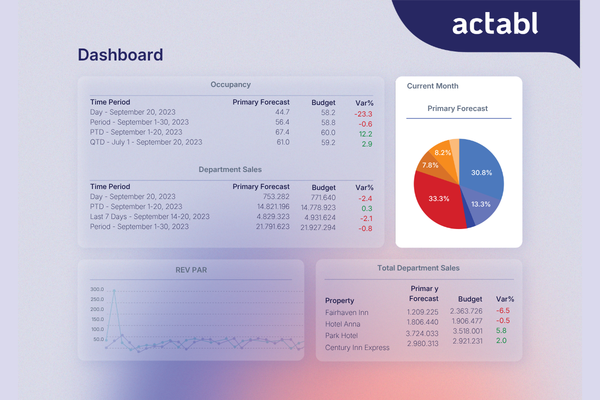
At Actabl, profitability is the end-all goal. Its four products, then, serve as the roadmap, labor optimization, business intelligence, operations management, asset and CapEx management. All of these tools depend on data. “It is the foundation for every decision a hotel makes,” said Steven Moore, CEO of Actabl. The difference, he continued, comes down to adoption and behavior. “If teams are not consistently using systems that create the data they need, the data becomes incomplete or unreliable,” he said. Enter AI, which, he argued, has raised the stakes; still, AI is only as good as the data that feeds it. “When you get that sequence right, adoption leads to better data, which in turn leads to clearer insights, and those insights drive measurable performance,” he said, adding that Actabl is using AI to help operators get to insights faster and make those insights easier to act on within the daily workflow. Actabl’s approach focuses on turning data into action and on the areas that most directly impact profitability, which include operational efficiency and labor, the latter a hotel’s largest expense line. “What ties this together is execution,” Moore said. “Insights alone do not improve performance.” Data, alone, is ineffective if it’s not put into action, which leads to sustained gains in both revenue and profitability. “That is where data becomes powerful,” Moore said.
CoStar Group
Find them @: costar.com
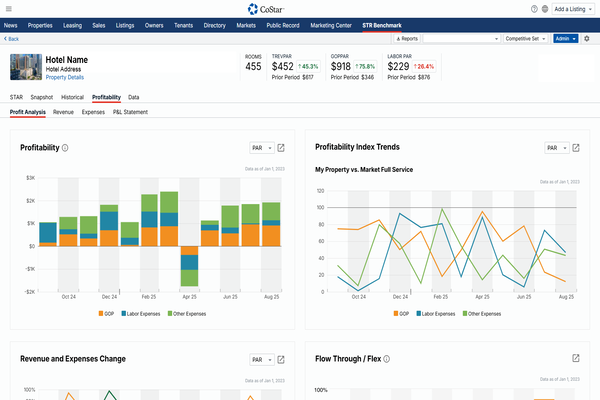
Not long after Randy Smith and his wife, Carolyn, launched STR (née Smith Travel Research) in 1985, did the data they produced become essential for hoteliers to compare a hotel’s performance against a competitive set across three main KPIs: occupancy, ADR and RevPAR. In 2019, CoStar Group acquired STR for $450 million, illustrating the value attached to data. It’s something Amanda Hite, president of STR, knows all too well. She’s made a career out of it. “Data matters because it transforms uncertainty into insight,” she said. “Across the hotel industry—whether managing one property or a global portfolio—data provides the clarity required to make confident, informed decisions.” STR, now under the aegis of CoStar, a global provider of commercial real estate information, made its mark in benchmarking—the method of comparing one organization’s performance against another, allowing for insight into strengths and weaknesses, ultimately identifying areas of improvement. “Benchmarking performance against budgets and the competitive landscape allows owners and operators to optimize development, acquisition, operations, revenue strategy and asset disposition,” Hite said. While STR made its name providing top-line metrics, it added, of late, profitability benchmarking that delivers full profit-and-loss performance, giving hoteliers visibility into each operating department. On the AI front, STR will look to borrow from CoStar, which owns the residential listing portal Homes.com. “The introduction of Homes AI, which brings real-time, voice-enabled guidance into the home search experience, reflects our focus on applying AI where it genuinely improves decision-making,” Hite said. “We see that same opportunity within STR.”
Kalibri
Find them @: kalibrilabs.com
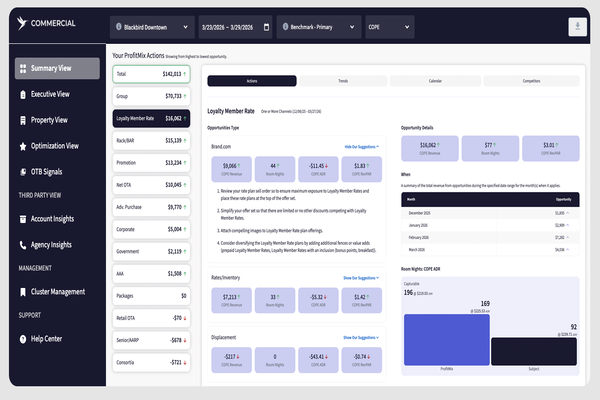
Cindy Estis Green, the co-founder and CEO of Kalibri, built a business focused on a crucial challenge facing hoteliers: cost of customer acquisition. In the age of intermediaries, that cost can be high. By most accounts, hotel customer acquisition costs can typically range from 15% to 25% of gross room revenue, with some properties spending up to 40%. This cost includes commissions to online travel agencies (OTAs), marketing spend and loyalty program expenses. Kalibri’s ProfitFirst platform helps hoteliers identify the most profitable opportunities in their market, already net of acquisition costs, “so time and resources are focused on what is truly accretive to profit,” Estis Green said. In her pursuit, data is key because it allows hoteliers to identify opportunities, diagnose problems and evaluate performance. The difference today is the velocity of it. “It is not just the volume of data available, but how quickly it can be delivered in an actionable form,” she said. “Today, teams don’t have to wait for end-of-month reporting. They can see what’s happening in real time and act on it immediately.” It’s that speed that separates reactive operators from proactive ones, who can achieve superior commercial results focused on profit. Kalibri also uses AI to allow hoteliers a clearer look into their current business and future. Its ProfitMix tool gives hoteliers a clear view of demand, including its value, how it books, the channels it flows through, when it materializes, how much is tied to loyalty programs and which hotels currently have that business today. “Instead of searching across multiple reports, teams can immediately identify, target and convert the most profitable mix of business,” Estis Green said.