
Airport hotels live somewhere between stasis and flurry—temporary limbo for travelers inconvenienced by forces out of their control; namely, the caprice of air travel.
Or that’s how they used to be.
They are an asset class all their own because of their locations and how their business is so directly tied to the whims of air travel. It is not a symbiotic relationship, to be sure: airport and airline success or failure does not hinge on the success or failure of hotels.
Operational performance at airline hotels generally performs differently from traditional city-center or resort hotels because their demand is so heavily anchored to travel patterns, airline operations and corporate transient business. As an asset class, they are often considered relatively resilient, but operationally specialized.
“Running an airport hotel requires a hybrid mindset,” said Jeff Ragonese, GM of Hilton Los Angeles Airport. He refers to it as an equal show of operational precision and destination storytelling. “Unlike resorts, where guests plan months ahead, or downtown hotels driven by leisure and corporate patterns, airport hotels operate in a constant state of motion,” he went on to say, pointing to fluctuating demand shifts based on airline schedules, global events and unforeseen disruptions.
Performance is typically strongest when airports have large international traffic, strong business routes, limited adjacent hotel inventory and airline hub status. Less seasonal volatility also is a driver of performance, but the sheer volatility of air travel makes running airport hotels a test of mettle.
The unpredictability of airport hotels impacts the pace of arrivals and departures in a manner that is very different from traditional properties. Operational discipline is critical: Many travelers do not depart at a traditional checkout time, so housekeeping teams, for instance, oftentimes have staggered schedules throughout the late morning and early afternoon to ensure rooms are serviced.
In that way, airport hotels operate as an almost extension of the aviation ecosystem, where operations—from staffing to F&B—are oftentimes synchronized with flight activity, which, by its very nature, is indeterminate. “Irregular operations are where airport hotels truly demonstrate their value,” Ragonese said. Consider widespread flight cancellations: “That’s when our priority shifts immediately from standard operations to guest-care logistics,” he said. For example, to avoid longer wait times, the hotel will create flexible check-in processes to move guests quickly from anxiety to ahh.

Air Up There
Since airport hotels are a place of constant flux that service an itinerant guest profile (think airline crews, delayed or cancelled passengers), planning and executing a full-scale renovation is a prodigious task. It’s exactly what the 1,234-room Hilton Los Angeles Airport accomplished when it wrapped up a $50-million renovation in April, in time for the 2026 FIFA World Cup, with matches being played at nearby SoFi Stadium. The redesign executed on a more minimalist design schematic featuring neutral tones and contemporary furnishings. And while guestrooms were also upgraded—new layouts, better lighting, upgraded bathrooms—the biggest improvement had nothing to do with aesthetic.
Hotels contiguous to airports are prone to noise pollution; soundproofing is crucial toward ensuring a healthy guest experience. At the Hilton, many rooms have vista views of the airport runways, which, though it makes for an awesome visual, also produces high-density jet noise that is no match for a normal window. Guestrooms now feature anti-aircraft-noise-reducing window technology.
The hotel remained fully operational throughout construction.
Ragonese called it a “once-in-a-generation moment for Los Angeles,” which, beyond the World Cup, will be the host city for the Super Bowl in 2027 and the Summer Olympics in 2028.
The renovation of Hilton Los Angeles Airport proves a larger point: just because a hotel is near an airport doesn’t necessarily mean it’s an airport hotel. “The renovation positions us differently within our competitive set,” Ragonese said. “Rather than competing solely on proximity to [the airport], we’re competing on experience, design and connection to the city’s cultural energy. Guests aren’t just staying near the airport; they’re staying at a gateway to Los Angeles.”
There is no shortage of capital going into airport hotel upgrades. Beyond the Hilton, Grand Hyatt DFW Airport, located inside Terminal D at the Dallas Fort Worth International Airport, completed a comprehensive $34-million renovation of guestrooms, F&B spaces and meeting and event spaces in February. The upgrade points to a larger trend in airport hotels—hotels that are literally inside the airport. Some—call them capsule hotels with sleeping pods—are purpose-built for fatigued travelers to recharge and relax. Consider YOTELAIR Singapore Changi Airport located on the fourth level of Jewel Changi Airport. There, travelers can book rooms by the hour. Aerotel Kuala Lumpur is an in-terminal transit hotel located within Terminal 2 of Kuala Lumpur International Airport. It caters specifically to travelers seeking to recharge between flights.

An Asset of Their Own
Like Liam Neeson’s character in “Taken,” operating airport hotels requires a particular set of skills. One management company with the requisite skill set is Waterford Hotel Group, based in Connecticut. It operates several properties serving major airport markets, including the Sheraton Hartford Hotel at Bradley Airport in Connecticut, the Hyatt Place at Rhode Island T. F. Green International Airport and the dual-branded Aloft Arundel Mills BWI Airport and Element Arundel Mills BWI Airport.
Airport hotels, according to Duane Schroder, chief growth officer at Waterford Hotel Group, have a rhythm all their own, where, because demand is fluid on account of weather, flight delays or cancellations, hotel staff must remain agile and vigilant. General managers work in tandem with airport operations and airlines to get ahead of disruptions.
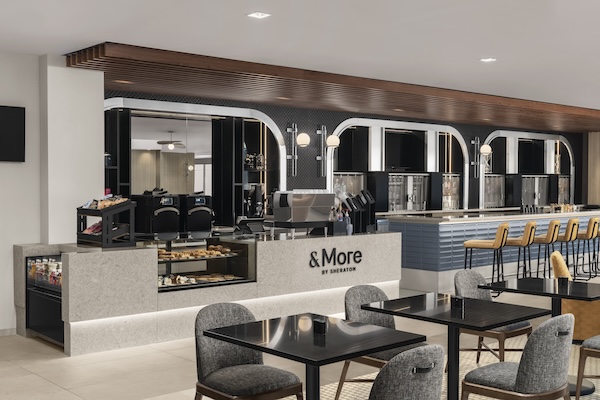
Like the Hilton Los Angeles Airport, the Sheraton Hartford Hotel at Bradley Airport recently completed a renovation of its public spaces, transforming the lobby, meeting and event spaces, executive lounge and fitness center at the hotel, which is directly connected to Bradley International Airport. The project was completed in phases to minimize disruption during peak travel periods. As Schroder explained, the renovation was a necessary step not only to upgrade the hotel but to improve one of its key ancillary revenue drivers: meetings business. “It adds a whole other layer of strategy,” Schroder said.
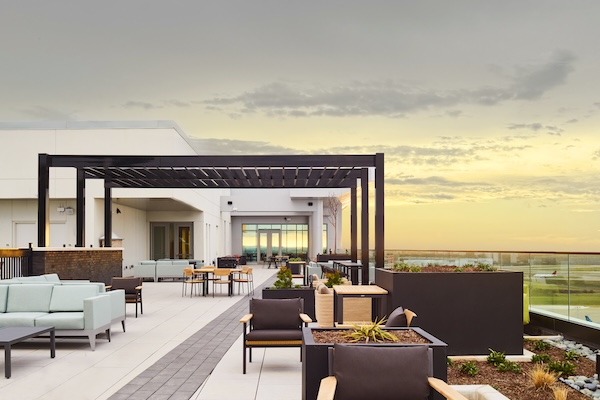
The Sheraton Hartford is not alone; increasingly, airport hotels are becoming more than just stopovers for weary travelers. And it starts with meetings. “The idea of meetings at the airport is part of the new business model,” said Jan Freitag, national director of hospitality analytics for CoStar Group. Living in Nashville gives him an intimate understanding of this trend. Hilton BNA Nashville Airport Terminal, which opened in 2024, is directly connected to the airport’s main terminal lobby by a pedestrian bridge. It’s not your grandfather’s airport hotel: Guests are afforded runway and downtown views from a rooftop pool and top-floor fitness center. The Sky Pavilion doles out handcrafted cocktails. On a recent visit to the hotel, Freitag huddled with the hotel’s GM, who conveyed to him the hotel’s strong first quarter, bolstered by its meetings business. “We have so much meeting space that medical companies seek us out,” the GM told him, as an example. “They come and they never want to leave.” (They do want to take excursions: The hotel has had such success with some of its meetings business that it’s offered free downtown transportation as part of deals.)
On the Money
Jittery markets have had a whipsaw effect on the airline industry with the daily ebb and flow of oil prices caused by turmoil in the Middle East. To no surprise, airline prices are going up on account of it, which makes travelers think twice about purchasing a plane ticket. Domestic airfares are trending roughly 15% higher than last year, according to data. Fluidity makes revenue managing airport hotels that more challenging. “Revenue management can be extremely dynamic because demand can change quickly with travel disruptions,” Schroder said. Beyond geopolitical tensions, a storm in another part of the country or a series of cancellations can suddenly shift inventory and make forecasting more complex. “We focus on constant monitoring—looking at airline activity, weather patterns and group demand—while maintaining close communication between revenue management, operations and sales,” Schroder added.
The same fluidity is a constant test at Hilton Los Angeles Airport—a push and pull between competing forces. “Airport hotel revenue management is uniquely dynamic because demand is driven by both predictable patterns and sudden spikes,” said Ragonese. “You’re balancing contracted airline business, group demand, transient travelers and irregular operations all at once.” Having a cohesive strategy is crucial. “The key is segmentation discipline,” he continued. The hotel layers business segments to maintain base occupancy while preserving flexibility for higher yielding opportunities that might come along ad hoc that are typically tied to citywide events, sports and entertainment demand.
Do airport hotels have a rate ceiling? Some might, especially older properties that though call themselves airport hotels are located some distance from the airport. As Ragonese pointed out, historically, airport hotels were perceived to have a price maximum. “Today, that ceiling is evolving,” he said, especially those airport properties that can successfully reposition as more lifestyle-driven and experience-oriented. “When the product and programming justify it, pricing power follows,” Ragonese said.
CoStar’s Freitag is more analytical. “You want to outpace inflation, right?” he offered, a task more daunting as inflation continues to creep upward. Raising rates effectively is contingent on whether travelers will pay them. According to CoStar data, airport hotels in the U.S. reached an average daily rate of $139.54 in March YTD 2026, $3 higher than over the same period a year ago and an increase of 2.2%. In March 2026, the annual headline inflation rate in the U.S. was 3.3%. It rose to 3.8% in April.
At the same time, YTD March RevPAR at airport hotels was 5.4% higher than at the same period a year ago. As comparison, suburban hotels, the closest comparable asset class to airport hotels, recorded ADR of $126 in the same period, according to CoStar, with a RevPAR increase of 3.9%.
Airport hotels in no uncertain terms play a specific role within the hotel ecosystem—they made not be the lead, but as a supporting cast member, they are integral. “Airport hotels play as emotional transition spaces,” Ragonese said. “Guests arrive at pivotal moments, before major business meetings, after international journeys or ahead of milestone vacations. We sit at the intersection between departure and arrival, anticipation and recovery.”