
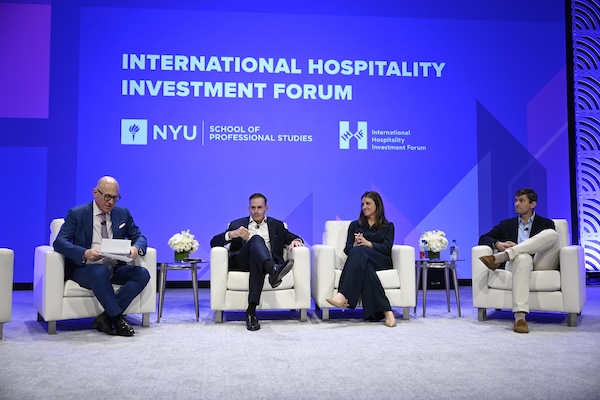
NEW YORK — Consumer sentiment fell for the third straight month in May, according to the University of Michigan Surveys of Consumers. Sentiment is now just below the previous historical trough seen in June 2022, as high prices at the pump weigh on American households. But despite the unease and worry, hotel executives, here at the NYU IHIF conference at the Marriott Marquis, continued to strike a buoyant chord that was supported by prognosticators who raised forecasts on the strength of travel.
“We are at the lowest consumer sentiment, inflation is still high, but there appears to be a decoupling of how people feel and how they act and how they spend,” said Adam Sack, president of Tourism Economics.
The U.S. Consumer Price Index (CPI) increased by 0.6% in April 2026 and rose 3.8% year-over-year.
Still, CoStar revised its forecast up, “a lot,” said Jan Freitag, national director of hospitality analytics for CoStar Group. It now forecasts revenue per available room (RevPAR) up 2.8% year-over-year, led by average daily rate growth of 2%. “Supply is not a big issue,” Freitag said, with only a trickle of new ground-up hotel development due to variables including stubbornly high interest rates and high cost of construction. Both have conspired to stymie new development as more brands grow through conversion opportunities of existing assets. The good news is that hotel demand has outweighed new hotel supply at around a 1x clip.
“Luxury,” he continued, “continues to win,” as the so-called K-shaped economy proves to be holding up with the affluent continuing to spend heavy on travel. “There is no price resistance at the high end.” CoStar forecasts luxury RevPAR to be up 5.3% YOY in 2026.
In recent days, hoteliers say they are recognizing a thaw in travel toward the center of the chain scales, a sentiment shared by Freitag. “There is widespread demand growth for the middle of the chain scales, a reversal from last year,” he said.

An Expense Vice
Some are a bit more leery, especially hotel owners who continue to be squeezed by line-item expenses that have made it challenging to record monthly profits. Last year was particularly tough: Gross operating profit per available room, or GOPPAR, was negative in 2025, according to CoStar, but it should swing back to positive in 2026, if CoStar is right. “The level of flow through has helped margins,” offered Michael Grove, CEO of HotStats, a profitability benchmarking firm. “F&B has been strong as has conference and events, wellness and golf. Guest spend on property has offset some costs.”
The benchmarkers aren’t the only ones sanguine over the prospects of travel and hospitality, including hotel owners and operators, but they still see warning signs flashing. “We came into the year with momentum after a Q4 pick up in deal volumes,” said Emily Feenet, VP of capital markets and transactions for Noble Investment Group. “There was positivity around 2026. Then ICE, then war in the Middle East. There is a lot of noise in the macro.”
As Michael Bluhm, managing director, global head of real estate, gaming and lodging at Jefferies, sees it, capital continues to chase the sector. “The drive for experiences has never been bigger. Capital formation continues around the space.” He cited recent examples of M&A, including Tilman Fertitta’s nearly $30-billion bid to acquire Caesars Entertainment in cash and assumption of debt, and Barry Diller’s $18-billion play for MGM Resorts. “There is a momentum shift around capital and willingness to take risk. These are big bets,” he said.
CEO Cheer
Travel momentum carrying through 2026 was supposed to reach apogee during FIFA World Cup, but as the AHLA recently wrote, World Cup demand has not materialized into strong hotel bookings: Eighty percent of hoteliers across all 11 U.S. host cities report bookings below initial forecasts, with visa barriers and geopolitical concerns suppressing international demand in 65-70% of markets. Block cancellations and rising costs are also identified as key drivers of softened demand.
Not even a red card can sap the enthusiasm and optimism out of a hotel company CEO. “We are in a good mood,” declared Chris Nassetta, president & CEO of Hilton. He, too, referenced the K-shape economy as a driver of travel success, but over the last several weeks, Nassetta has been championing what he calls the C-shaped economy, or a convergence economy, where mid- and lower-tier hotels make a comeback on the backs of those segments’ cohort travelers. “It is shifting,” he said, a trend that began in Q4 of last year and has carried over, driven by a business-friendly and tax-friendly environment, he posited.
For Hyatt Hotels Corp., a company with a much smaller footprint than the likes of Marriott International or Hilton, but whose portfolio skews higher end, strong leisure travel has guided it through 2026, its president & CEO, Mark Hoplamazian, said. He remains cautious still over war in the Middle East and its effects even after or if it ends soon and the restart of oil and liquified natural gas flow.
In a diverse but interconnected world, evading trouble altogether is not probable. “If you have a globally diversified business, every year there is going to be something,” said Elie Maalouf, president & CEO of IHG Hotels & Resorts. “But if you have a diverse business, you can more readily absorb and move on. It covers for significant bumps like in the Middle East,” which accounts for still a small percentage of IHG’s hotels.

Sebastien Bazin, who recently announced he will be departing Accor as chairman & CEO in 2028, is equally cognizant of the global pitfalls that endure for a global hospitality company. “Every year there is something not going our way,” he said. “We need to adapt.” Bazin noted that as travel to the Middle East and Dubai has been down for Accor’s hotels, it is seeing a shift to countries such as Morocco and Egypt. “It shows the resiliency of the traveler,” he said.
Travel adaptation is also showing up in Hilton’s hotels, Nassetta said. Though he recognizes the struggle for many at the gas pump, where the national average for a gallon of gas is currently $4.26, according to AAA, it is not stopping spending altogether, just changing spending habits. And despite higher gas prices, Nassetta shared that 70% of Hilton’s business in the U.S. is of the drive-to variety, something that has been trending consistently for several years post-COVID, a Hilton spokesperson said.
One thing hotel CEOs agree on is where hotel investment and development is migrating—eastward, especially India. While Accor’s Bazin said he expected India to be the largest market by 2045—“bigger than China,” in fact—others were a bit less bullish on the timeline, but equally optimistic over the state of the country. “It’s all happening there,” said Nassetta, pointing to a spate of infrastructure improvements that include airport, railways and highways. “There is a significant amount of inbound money interested in investing there,” he added.
India is already in the throes of a massive wave of aviation expansion, aiming to add 50 new airports over the next five years as part of its goal to reach up to 400 by 2047, up from its current count of 163.
No panel discussion is complete without conversation on artificial intelligence. Bazin made the grim declaration that 40% of his corporate jobs will be replaced by AI—2,000 people altogether, he noted. “I need to warn them: What you do today, you won’t be doing 18 months from now,” he said. “You can’t fight against it.”
Hoplamazian said that AI has already made impactful inroads at the property level. “Administrative stuff should be automated,” he said, offering that it frees up time for staff to better engage with guests. “That’s powerful. AI should amplify humanity,” he said.