
For decades, public hotel companies have grown their brands on an asset-light model fueled by outside capital.
Owners and developers bought, built and funded the real estate. Brands supplied distribution systems, reservations and loyalty platforms, collecting fees without carrying physical assets on their balance sheets.
As development capital gets harder to secure, the cost of continued growth has risen. According to SEC filings across Marriott International, Hilton, Hyatt Hotels Corporation and IHG Hotels & Resorts, combined contract acquisition costs rose from $325 million in 2019 to $1.41 billion in 2025, a 334% increase. Over the same period, average net unit growth (NUG) declined 0.4 percentage points.
At the same time, ground-up development has slowed under elevated interest rates, high construction costs and tight commercial credit, which have conspired to make conversions a preferred method of growth. Across the four major brand families, conversions grew from 12% to 22% of new room openings in 2019 to 36% to 52% by 2025.
When the music quiets, here are three ways to make sure the tune isn’t extinguished.
1. Incentivize to Close
Key money and fee waivers have traditionally helped secure trophy assets. As ground-up development slows, brands are increasingly using these incentives to offset PIP obligations, improve debt service coverage or bridge funding gaps that would otherwise prevent a deal from closing.
Zach Demuth is head of strategic growth and asset management at Eight Form, an owner-operator and developer of branded hotels across the U.S. He previously headed global hotel research at LLL. A brand, he notes, can be the difference between obtaining financing or not. “If you don’t have a massive institutional track record, rates go up without a brand, easily by 300 to 400 basis points,” he said. This makes even relatively unproven brands within a larger brand family preferable to no brand at all. “The [parent] brand will push new brands as much as possible and offer much higher incentives,” he continued. “It’s hard to say no because what’s the other option?”
Under this model, it can take years to assemble hundreds or thousands of rooms through individual transactions, while deferring or even forgoing future fee streams. “The brands are outlaying more key money, but it’s a slow way to grow,” said Demuth. Or a brand can write a substantially larger check and acquire an established platform with existing hotels, development relationships and a pipeline already in place.
2. Partner for Endurance
To reduce the time and cost of negotiating single-asset deals, major hotel brands are increasingly using programmatic agreements and joint ventures with developers and sponsors to roll out an entire pipeline. Examples include IHG’s 30-year programmatic agreement with NOVUM Hospitality to absorb 108 open hotels across Europe, or Hyatt’s 50/50 strategic JV with Grupo Piñero to jointly own and scale its Bahia Principe all-inclusive platform.
The model, however, depends on the developer’s underlying balance sheet and real estate fundamentals. Following Sonder’s default and bankruptcy filing, Marriott was forced to terminate its multi-year master licensing deal, losing 9,000 expected keys and $23 million in direct losses.
3. Pipeline Acquisition
When single-property incentives and developer partnerships move too slowly to satisfy Wall Street’s net-unit-growth demands, parent companies can buy an existing source of deals outright through platform M&A.
“While M&A is expensive at 10-15x EBITDA multiples, key money can be as much as 20% of expected franchise and management fees. So, while M&A is the larger check size, it’s actually a better deal net and the quickest path to growth,” Demuth said.
Past mega-mergers brought established portfolios, fee streams and development relationships into the system at immediate scale. Recent niche transactions are smaller, with higher implied prices per existing key.
“There’s not that many [independent] brands remaining with meaningful scale,” said Demuth.
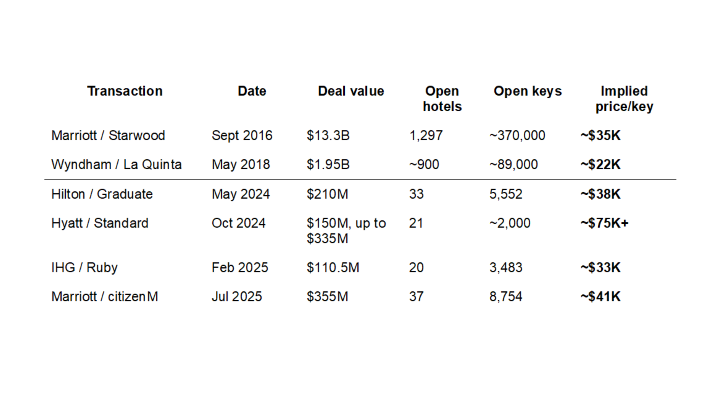 Hyatt’s acquisition of Standard Hotels makes the dynamic particularly clear: it paid $150 million upfront, with consideration potentially rising to $335 million based on future growth. When a brand has a limited existing portfolio or pipeline, the value of the acquisition increasingly depends on third-party capital alignment.
“A successful brand demonstrates to the market that it makes owners money,” said Kara Randall, former VP and managing director of luxury & mixed-use development at Hilton. “Then the market wants to replicate it. The opportunity is to build enough of a track record of delivery to reinforce that confidence.”
Over two decades at Hilton, Randall watched the company evolve from building brands in-house to acquiring and scaling them. In a constrained capital environment, she noted, translating strong brand perception into real estate deals remains the critical bridge to continued growth.
The Capability Behind Growth
Hotel development was once largely a contract sales function. But when the primary obstacle is making the capital stack work, development moves closer to finance.
“The development role has fundamentally shifted,” said Randall. “If you are not evaluating debt service coverage, refinancing timelines, and the complete capitalization structure of a deal, the transaction blows up long before it ever reaches the active pipeline.”
The New Asset-Light Era
Third-party capital still owns the real estate. But when that capital stops producing enough new hotels, brands have to decide where to intervene:
● Incentivize: Put money behind an individual deal.
● Partner: Put capital and alignment behind a developer who can produce a durable pipeline.
● Acquire: Buy an existing platform in the hope that its contracts, relationships, and pipeline translate into system growth.
Asset-light does not mean capital-free; it means the capital sits somewhere else. In a constrained development environment, the question increasingly facing major hotel brands is whether they can continue to rely on someone else to fund it all.
Story contributed by Tara Lobo, founder & strategic advisor, LOBO.
