
In January, at the Americas Lodging Investment Summit, in Los Angeles, one of the hotel industry’s worst-kept secrets was said aloud: “If somebody isn’t willing to be asset heavy, then the asset-light game stops.” It was uttered by Elie Maalouf, CEO of IHG Hotels & Resorts, during a panel session in front of the hotel investment community.
Its impact was immediate: an unvarnished articulation made by someone the asset-light strategy benefits the most. Years ago, before hotel companies spun off their owned real estate and pivoted to franchising, lending their name and likeness in exchange for fees, they dealt with the many same and thorny issues that needle hotel owners today; namely, the costs associated with running hotels. According to CBRE, hotel expenses above gross operating profit increased 4.1% in 2024. Expenses below GOP rose 3.6%. Total revenue, meanwhile, grew 2.4%. The upshot: Costs are outdistancing revenue and the pace isn’t waning.
In an era where costs are eating up the bottom line at an unprecedented speed, a shift in mentality from a revenue-only focus to one predicated on cost containment and profitability drive is paramount. Duetto, with roots as a revenue-management platform that has leaned further into profit optimization, held its “PERFORM” summit in Florida last week, a way to showcase its technology while also engaging with customers and partner tech. The message clear: In an era of expense creep and stagnating revenue, a focus on total profit optimization isn’t only smart, it’s compulsory.
Data back up a profit-minded approach. According to Duetto, over the last six years, RevPAR growth has climbed 19% against a backdrop where booking costs and labor costs have risen 25% and 20% in the same span, respectively. From 2024 to 2025, total revenue per available room, or TrevPAR, increased 3.6%. The bad news: expenses associated with credit card commissions paid, IT systems, sales and marketing, loyalty programs and P&M supplies and labor have all risen above 5%. The math, as they say, doesn’t math.
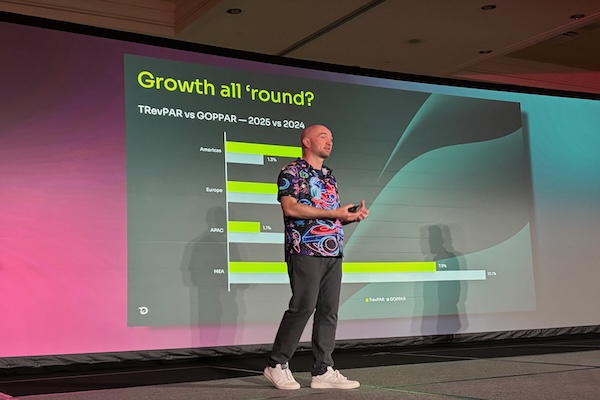
Alex Zoghlin, CEO of Duetto, was hired last June, three months after Duetto made a strategic investment to acquire HotStats, a firm dedicated to benchmarking profitability. The profit strategy was underway—it’s something he said as much during the summit. “Most of the KPIs that we all still use focus on revenue, which do not incentivize looking at the bigger picture,” he said. “The way that we operate needs a new playbook—this really starts by shifting the focus from room revenue and yield to overall hotel performance.”
Historically, RevPAR, a metric that measured how much revenue was generated per room, but discounted revenue coming from other sources, was the most-relied-upon barometer of a hotel’s performance, an easy calculation of rate and occupancy. The more complex hotels got, the more food and beverage became a focal point, the more meetings business—the more ancillary opportunities—the less reliant RevPAR became as a KPI to explain the totality of a hotel’s performance, especially since it also didn’t take expense items into account.
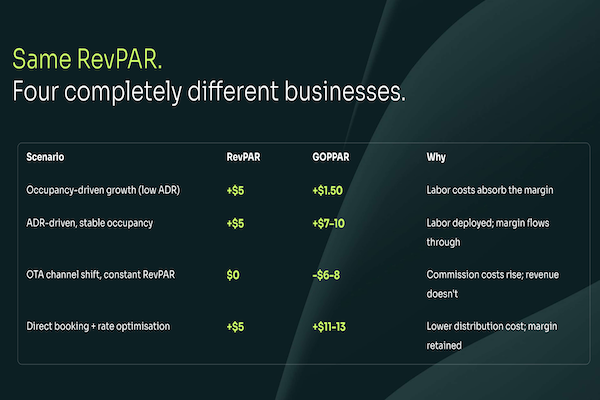
“Today, two hotels with identical RevPAR can have completely different profitability,” said Zoghlin, offering that one could be superior in driving direct business, while managing acquisition costs, keeping margins intact. “The other,” he said, “watches profits bleed out.”
The destination might be the same, but getting to it can be straight forward or circuitous. Consider two hotels with the same $100 RevPAR: It doesn’t mean that both hotels will net the same profit. If hotel A gets to a $100 RevPAR with an occupancy approach that requires more labor, then its gross operating profit per available room will surely be lower than the hotel that builds its RevPAR with a rate-led approach that, subsequently, requires less staffing. Taken further, if the former hotel relied more on OTAs than direct bookings to fill its rooms, it faces further margin compression, while the hotel that fills its rooms via direct channels attains better flow through, or how much of each dollar gained on the top line makes its way to the bottom line.
Shifting to a profit-focused strategy requires buy-in from every level of a hotel, Zoghlin offered, aligning teams on the same goals—from marketing and sales to distribution and revenue management. “You need to communicate and break down those siloes,” he said. “Teams must be confident in the new metrics that they use, that they’re tracking and understand the impact that each of them has.” He calls it “performance engineering.”
In Practice
Duetto is fast down the profitability path. It’s not alone. Bangkok-based Minor Hotels, an owner and operator of hotels, with brands including Anantara and NH Hotels, has bought into a profit strategy to drive its hotels’ performance, moving away from room-only KPI consideration to total revenue and total profitability, with net RevPAR as a truer measure of success, said Irene Villafranca, VP of commercial strategy and systems at Minor Hotels Europe & Americas.
The Sandman Hotel Group is leveraging data to help drive profitability, said its senior director of revenue management and distribution, Michael McNames. “Technology allows for instantaneous results in profitability,” he said. Consider Duetto’s GameChanger tool, which prices rooms based on the value of each booking and sets rates based on room type, booking channel and customer segment. Meanwhile, HotStats allows hotels to benchmark their P&L to competitor sets.

Chris Cylke, president and COO of asset manager REVPAR International, is the first to recognize the preeminence of benchmarking profitability. Still, for an industry that has been a poster child for slow adoption to technology, getting to a profit-first mentality takes time. “Certain companies are taking key initiatives and integrating profit services, but some brands and management companies are dragging behind,” said Cylke.
The case for getting to better profitability stems from, first, deriving better revenue. Because, as Cylke suggested, not all revenue is created equal. It also comes from a full review and grasp of expenses. “It’s about understanding costs and actioning on it from a pricing strategy,” said Katie Moro, VP of data partnerships, hospitality at Amadeus. She added that the expectation is for more hotels to also move to attribute-based selling, a hospitality strategy that unbundles hotel rooms into individual components, allowing guests to customize their stay by selecting specific features, such as a high floor, balcony, or specific view—rather than booking a pre-defined room category.
“Driving profitability is all about data and how to get in the right tools,” added Moro. Amadeus Demand360, for instance, provides data on future hotel occupancy, traveler segmentation and benchmarking. Amadeus Agency360 is a travel intelligence solution that offers hoteliers insights into agent bookings across GDS, OTA and direct channels.
Growing revenue is the first step toward ensuring profitability, which is why there has been such a premium of late on the role of chief commercial officer. Teams aligned to deliver revenue matter, but just as important is being aligned on the bottom line—the commercial team, the finance team, the operations team, to “find the optimal flow that generates profit,” Cylke said.
It’s not easy; it takes time; it’s paramount. “Ultimately,” he said, “the hotel owner takes the bottom line to the bank.”
