
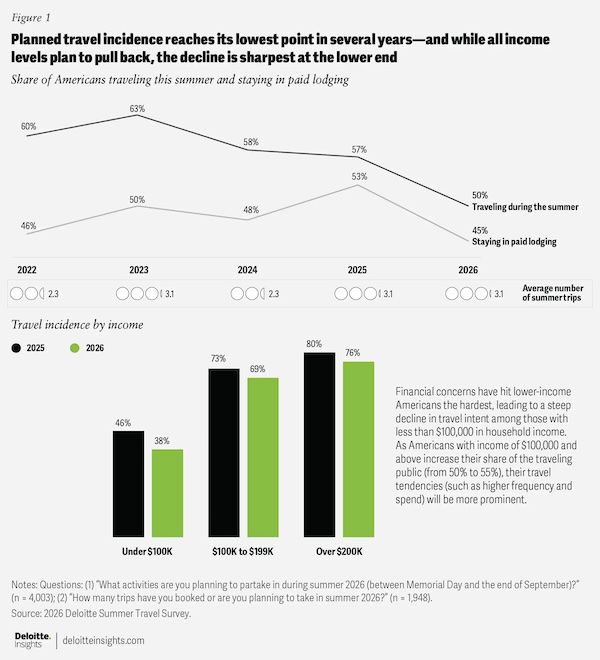
Forty-five percent of Americans plan to take a summer vacation with a stay in paid lodging this year, the lowest figure in six years, according to Deloitte’s “2026 Summer Travel Survey.” Rising costs are the primary driver keeping non-travelers home, with 32% citing travel as too expensive and 35% saying they cannot afford it.
Despite lower overall travel intent, those planning trips expect to spend significantly more. Travelers surveyed anticipate spending an average of $4,049 on their longest summer trip, up 17% from 2025. About one in four travelers plan to significantly raise trip budgets, up five percentage points from last year, driven largely by higher airline and lodging prices.
Travel incidence is down across all income levels but is most pronounced among households earning less than $100,000 per year, falling eight percentage points year-over-year, compared to a four-point decline each for middle- and high-income earners. Most Americans—82%— report some impact from everyday expenses on their ability to spend on travel.
Lodging and Air Travel
Hotel intent remains steady, with 81% of travelers surveyed planning to stay in a hotel at least once during the summer, up slightly from 80% in 2025. Private rentals are expected to see a slight uptick, rising from 25% to 29%. Slightly fewer travelers plan to stay with friends and family this year—37%, down from 39% in 2025.
Among travelers planning to fly, 61% plan to take a domestic flight, up from 58% in 2025, and 32% plan to fly internationally, up from 27%. Price declined in importance when selecting an airline, falling from 65% in 2025 to 60%, while reliability rose from 44% to 51%. Price sensitivity in lodging choices also eased slightly, from 55% to 52%.
Higher-income travelers are showing increased interest in full-service hotels—59% in 2026 versus 54% in 2025—and destination resorts, up to 23% from 14%.
“Amid pricing pressures, those who are packing their bags this summer intend to spend, indicating that many are putting a premium on experiences,” said Kate Ferrara, vice chairman and U.S. transportation, hospitality and services sector leader for Deloitte. “Providers can capitalize on this opportunity by focusing on enhancing the travel experience through upgrades and partner offerings. Those who are traveling have already decided it’s worth the investment, so leaning into the emotional connection to enhance the vacation’s value could be a differentiator this summer.”
Younger Travelers and Technology
Millennials represent nearly a third of all travelers surveyed—31%, up from 29% in 2025. Overall adoption of generative AI for travel planning rose to 25% in 2026 from 15% in 2025, with millennials leading usage at 36%. Gen Z is the largest generation leveraging short-form video platforms for trip planning, at 42% versus 23% overall.
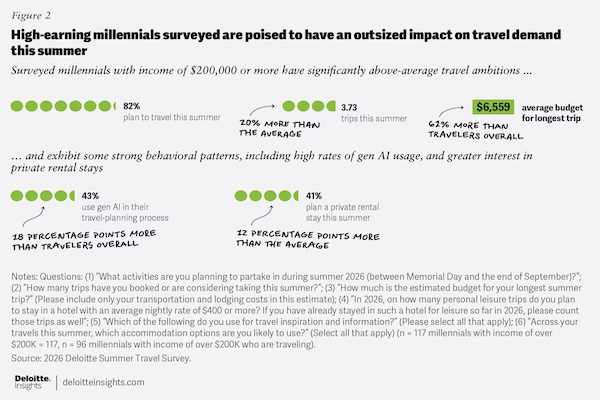
One-third of travelers 34% plan to work during their longest summer trip, up from 23% in 2025. Millennials are the most likely to work while traveling, with 57% planning to do so.
“New generations are shifting the leisure travel landscape. Whether it’s turning to tech for itinerary planning or leaning into luxury bookings, these are trends the industry can tap into as they look to capture and build loyalty with younger travelers,” said Eileen Crowley, U.S. transportation, hospitality and services leader for Deloitte. “Brands looking to capture these younger travelers’ attention should consider what’s driving these up-and-coming travelers to return year after year.”
The Deloitte “2026 Summer Travel Survey” is based on responses from 4,003 Americans surveyed between April 2 and April 9.
