
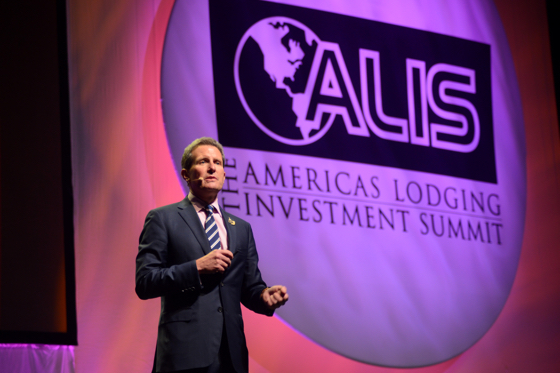
Despite increasingly conservative forecasts for the U.S. hotel business for the first time in the past 10 years, a reported 3,000 people attended the Americas Lodging Investment Summit (ALIS) in Los Angeles this week looking to make new deals.
What is changing is the makeup of conference attendees: BHN’s Jim Burba cited data that said only 83 attendees were over 65, 22% were women and 15% were millennials.
While STR said growth for 2019 in the U.S. hotel industry is projected to include flat occupancy, at 66.2%, and a 2.3% rise in ADR and RevPAR (the lowest RevPAR percentage change for the country since 2009), others are not as optimistic on the data, citing corporate weakness as a potential source of softer hotel dynamcis. By 2021, CBRE is forecasting RevPAR to decline, followed by a recovery year in 2022.
The biggest issues cited for the slower growth numbers were increasing labor costs (some owners reported they are seeing 3% to 4%-plus increases). Also cited were geopolitical uncertainties, which is leading to more conservatism in transactions; Wall Street panelists stated that owners should expect to hold assets for another five years if they don’t sell now due to the prospects of a coming recession in the U.S.
The general consensus is that fewer deals are getting done for the reasons listed above, despite what is perceived as a solid amount of equity at the ready. Big-spending Chinese owners are all but out of the market, and more owners are choosing to refinance versus sell.
Despite the change in the outlook, supply growth is not muted, particularly in the lower tiers of the market. Lodging Econometrics just reported that at the end of 2018, the U.S. construction pipeline continued to trend upward with 5,530 projects/669,456 rooms, both up a strong 7% year-over-year. HOTELS spoke with multiple brand developers at ALIS who boasted still-healthy pipelines. Here are updates from the editor’s ALIS notebook:
Outrigger Hospitality Group: The 70-year-old legacy Hawaiian owner-operator has a new name intended to create greater brand clarity and a new structure for strategic growth, according to President and CEO Jeff Wagoner. Three core categories include its Premier Beachfront Resorts, mostly in Hawaii and Asia Pacific; its “by Outrigger” branded locations; and its third-party managed properties. Wagoner said the group is searching for a head of development as parent KSL Capital Partners raises new funds for growth. While KSL sold six Outrigger assets in 2018, Wagoner projects growth of the 38-hotel platform via acquisition, adding that the group could add a brand in the middle market or even acquire a brand or assets to morph into a new brand.
Meyer Jabara Hotels: Vice President of Development Justin Jabara said the 40-year-old family business has eight hotels under development and is spreading its wings west once again after earlier having sold its assets west of the Mississippi River. It is developing a hotel outside Las Vegas in Summerlin, Nevada, and is creating a real-time P&L statement to better manage day-to-day business.
Curio Collection by Hilton: The brand picked up the Virgin Las Vegas, which is in the middle of its conversion from the legacy Hard Rock Hotel in Sin City. Brand chief Mark Nogal does not expect Hilton to do more soft branding for Virgin, but said the Las Vegas owners, led by Juniper Capital Partners and Fengate Real Asset Investments, like how Hilton can help beef up group business. As Curio turn 5 years old, the soft brand is approaching its 70th opening across 23 countries. It is adding 539 keys at the Martinique in New York City, growing in London, and bringing a second hotel to China. More Curios are coming to Italy, according to Nogal. As for results, he said Curio sells “better than its fair share,” adding F&B plays a big part in the brand’s success.
IHG: In an interview with CEO Keith Barr, the Regent brand was top of mind as owners of the InterContinental in Hong Kong, Gaw Capital, prepare to close the building and take it all the way down to the concrete to recreate what will become the brand’s flagship on the harbor there when it reopens in 2021. A new Regent has been signed for Kuala Lumpur, and Barr said there will be more new signings in February. “We are only looking at ‘A’ locations with the best partners. We are following a path toward where Regent was.” He said IHG is not putting equity into Regent deals and will be measured in its growth over the next three to five years.
Barr was also excited to talk about the international growth of its Kimpton lifestyle brand, suggesting it has new momentum after a slower start outside its North American roots. With 25 hotels set to open in 20 new destinations, all strict management, he pointed to Frankfurt, Tokyo, Mexico City, Paris and Barcelona for showcase variety. After announcing franchising for Kimpton in November, he said the first such deals in the U.S. are pending. He expects international deals will remain mostly managed.
Barr added that IHG is living up to its edict to double the pace of growth. “The pace of the past 18 months has to continue to remain in the leading pack.”
G6: The parent of Motel 6 and Studio 6 brands has new designs and a US$100 million capital plan for its owned assets. Another 80 new, franchise construction projects are planned, according to CEO Rob Palleschi.
In total, 179 projects are in the pipeline and as of today there are some 430-owned assets (about a third of the portfolio) by parent Blackstone. While G6 will continue to sell some assets, Palleschi said the group remains committed to owning, as well.
On the growth front, Palleschi said G6 sees an opportunity to move into more city centers. “We need to get downtown in more major markets with multiple properties per market,” he said.
As part of a new modernization program, G6 is investing in in-room technology, as well as better finishes, flooring, bedding, linen and showers. It is also investing in back-of-the-house areas for team members and online training to aid retention.
Palleschi is going on two years at G6 and is focused on creating best practices, citing Blackstone’s ownership and its desire to make G6 less insular and more open to bringing in leadership to open the company to better industry partnerships.
Interstate Hotels & Resorts. CEO Mike Deitemeyer said the group is focused on taking advantage of its scale to better manage costs to best prove its value and value-add story.
IHR’s current pipeline is 60% full-service. It recently signed 20 deals in central Europe with a more diversified ownership group to solidify its position in the region. Growth looks strong in the U.K. and Russian territories, while in North America the focus is on ownership balance to avoid having any one sale making a serious impact on the IHR portfolio.