
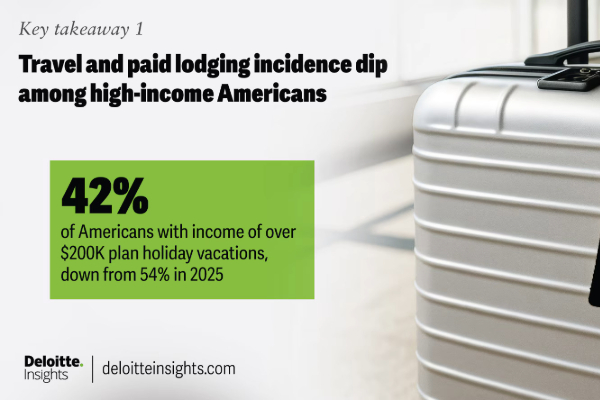
Nearly half of Americans—47%—expect to travel between Thanksgiving and mid-January, according to Deloitte’s “2026 Holiday Travel Survey,” released Nov. 17. The share is down seven percentage points from a year ago. The percentage planning a vacation with paid lodging is 27%, down five points.
Deloitte based the survey on responses from 4,272 Americans, fielded between Sept. 28 and Oct. 2, 2026. Of those, 2,019 respondents who plan to travel between Thanksgiving and mid-January qualified as holiday travelers.
Gen Z reports more financial optimism than other generations. Some 56% say their finances improved over the last year, compared with 42% in 2025, a swing unmatched by any other generation. Gen Z travelers also plan a higher budget increase for their longest trip, up 13% from 2025.
About 23% of surveyed travelers expect the budget for their longest holiday trip to increase significantly compared with last year, up from 19% last year. More than one in four surveyed Americans (27%) plan a vacation, defined as a leisure trip with paid lodging. One in five plan to travel only to visit friends or relatives.
Among respondents who say they are spending less this year, shorter trips, lower in-destination spending and budget-friendly lodging are the most common adjustments.
The largest share of holiday travel is planned around Thanksgiving, with 31% of all holiday trips expected then. The Christmas to New Year’s Eve period follows at 28%. Thanksgiving trips are expected to be the shortest, with 54% lasting three nights or fewer. Trips from Christmas through New Year’s Eve are more likely to last four to six nights (40%).
Some travelers appear to be adjusting plans to avoid busy periods. Among Americans earning $200K or more, the top reason for not traveling over the holidays is timing. One-third (34%) of non-travelers at this income level say they plan to travel after the holidays.
Half of surveyed holiday travelers (50%) plan to fly for their longest trip, and one-third of them plan to take an international flight. Nearly half of flyers (45%) plan to book premium fares, including upgraded economy or first or business class. Millennial flyers are increasingly likely to buy premium fares (52%, up six percentage points from 2025).
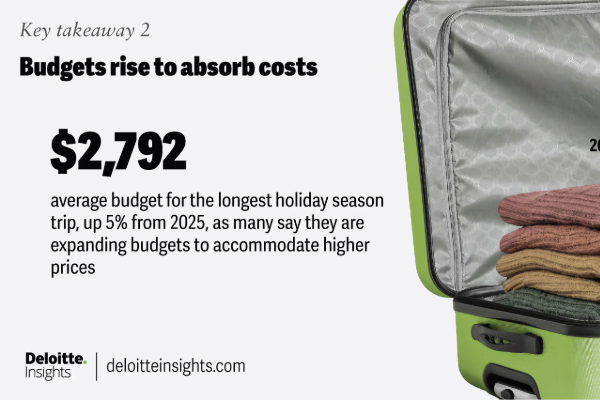
Surveyed travelers expect to take an average of two trips this season, up from 1.8 in 2025. They expect to budget an average of $2,792 for their longest trip, including transportation and lodging, up 5% from 2025. Deloitte said the increase reflects a mix of higher prices and travelers’ spending choices, including willingness to purchase upgrades.
Top-tier airline loyalty program members are three times as likely to purchase first or business class tickets (31% versus 10% of others). Mid-tier members are most likely to book upgraded economy fares (45% versus 27% of others). Nearly one-quarter of travelers (23%) say they drove to their destination in 2025 and expect to fly this year.
Among those expecting to increase their holiday travel budgets, 31% anticipate higher in-destination spending and 26% plan to book more luxurious lodging. Lodging intent is up for all accommodation types. Full-service hotels are expected to be the most popular choice for the longest trip, with 41% planning to stay in one. Hotel and flight intent is expected to hold steady across income groups, and international travelers are planning trips farther from home.
Travelers may place more emphasis on non-price factors this year. For flights, more say they are prioritizing non-stop itineraries and carriers they consider reliable. For hotels, more are weighing service, loyalty memberships and location.
For marquee trips, the share of travelers planning to book direct is down, as more intend to use intermediaries that enable price comparison. Around one-quarter expect to use traditional travel agents and online travel agencies for flights (24%) and hotels (28%).
Intent to take a cruise on the longest trip of the holiday season has doubled. December before Christmas is likely to be the busiest time for cruises, with 29% of cruisers setting sail then.
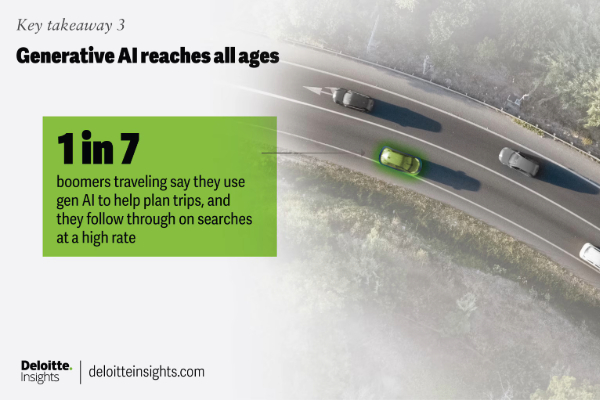
Generative AI use for travel discovery or planning is at 29% of surveyed travelers, up from 24% in 2025 and 8% in 2023. Millennials lead at 35%. Among boomers, 16% use it, close to the 17% who use social media. Adoption is more evenly distributed across generations than social media or short-form video.
Among travelers using generative AI, recommendations for in-destination activities and attractions are most common (61%), followed by restaurants (56%).
Gen Z and millennials plan to include all types of in-destination activities at higher rates than Gen X or boomers. They make up about half of overall travelers but account for 71% of those taking a class and 59% of those visiting attractions. Gen Z (22%) and millennials (34%) account for more than half of luxury travelers. Compared with older generations, they are more likely to gauge a property’s luxury by on-property experiences and the spa, pool or fitness center.
“Holiday travel remains a priority for many Americans, but this season’s findings show that travelers are making more deliberate choices about whether, when, and how to go,” said Kate Ferrara, vice chair and U.S. transportation, hospitality and services sector leader of Deloitte. “While fewer plan to travel during the holiday period, those who say they’ll travel plan to adjust trip length, lodging, or spending to keep travel within reach — and still make room for the experiences that matter most to them. For travel providers, an opportunity is to offer options that balance value, flexibility and comfort.”
“Travel planning is becoming more personal and technology-enabled,” said Suzy O’Mara, U.S. transportation, hospitality and services Audit & Assurance leader of Deloitte & Touche LLP. “Nearly three in 10 surveyed travelers plan to use Generative AI for discovery or planning, up more than three-fold in just three years, and unlike some digital tools, its use is extending across generations. As travelers seek experiences that reflect their interests — from activities and attractions to dining — providers have an opportunity to make planning more relevant and help travelers find the experiences that matter to them.”
