
Caribbean hotels and resorts have delivered some of the strongest performance in the hotel industry over the past several years, making the region increasingly attractive to investors. But many of the assumptions that apply to underwriting U.S. hotels don’t translate directly to island markets. Local geography and policy shape everything from guest arrival patterns and staffing to supply sourcing and disaster recovery. The four “how” questions below can help investors spot risk earlier and make better-informed decisions, while also surfacing operational opportunities a standard underwriting model would miss.
How do guests get here?
Caribbean hotels, unlike most mainland markets, depend almost entirely on air travel to fill their rooms. Because many islands can’t physically expand their airports, capacity is often constrained, as shown below:
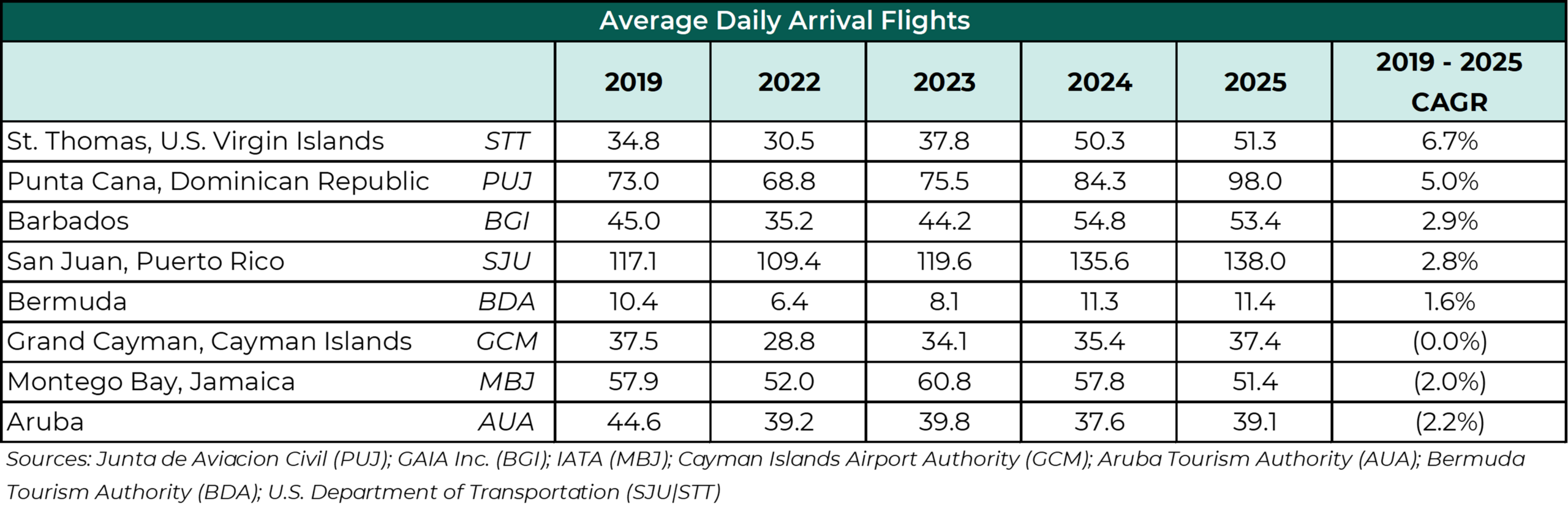
Capacity is a useful top-line metric, but it isn’t the whole picture. Investors should also look at where the traffic originates and whether service is seasonal. Just as important is how reliant the destination is on a single airline or feeder market. A destination served by multiple airlines and diverse feeder markets is generally better positioned to weather shifts in travel demand.
It’s also worth looking at how actively the destination is investing in tourism. Strong tourism authorities work with airlines to add new routes and expand existing service, and they invest directly in promoting the destination to new travelers. Combined with airport expansion plans and passenger growth trends, these efforts are a good indicator of where demand is headed.
In the end, diversified, growing airlift is a stronger foundation for revenue growth than reliance on a handful of airlines or a single source market.
How will you staff the hotel?
In many Caribbean countries and territories, employees are guaranteed minimum hours or pay regardless of occupancy, which makes it harder for operators to flex staffing as demand changes. To size the hotel’s expense line correctly, investors should have clarity on mandatory staffing requirements and guaranteed hours, along with any incentive programs.
Efficient staffing in the Caribbean is also constrained by small national populations and a limited population with hospitality experience. These considerations need to be uniquely factored into operating costs, not just local labor regulations but also additional requirements for recruiting and training.
Foreign work permits have helped ease labor shortages, but restrictions, cost and approval times vary widely by island. For example, Jamaica streamlined its foreign work permit process in 2024 to combat shortages, while Antigua recently increased qualifications needed for work permits to prioritize locals in hospitality jobs. During due diligence, investors should find out how many foreign work permits are available to the hotel, the annual costs, and what qualifications they require. They should also flag which parts of the business plan depend on specialized foreign labor that permits may not cover.
Understanding local labor dynamics helps investors avoid cost surprises that a standard financial review wouldn’t catch.
How does the hotel get supplies?
Almost all operating supplies and capital items Caribbean hotels need must be imported. Even where hotels can secure volume discounts through their brand or procurement company, import duties and other taxes can run as high as 25% in some markets, which makes the non-labor expense load look heavy as compared to U.S. resorts.
If the property’s expense load looks heavy or has climbed meaningfully, investors should look at where products are sourced and what products are being sourced. For items that aren’t brand-mandated or for which the brand allows flexibility, there may be room to improve GOP by sourcing from less duty-intensive countries or different items. Similarly, the type of product being sourced could carry higher import taxes than a similar product (for example, liquid eggs vs eggs in shells).
Storage capacity matters too. Sufficient, well-organized storage and warehousing allow for better inventory management and fewer deliveries, which lowers purchasing costs. Similarly, if the business plan involves expanding or upgrading the operation in any way, such as introducing a luxury brand or a new restaurant, make sure the hotel has room to grow its storage rather than relying on temporary solutions later.
A carefully planned supply chain and adequate back-of-house storage can matter as much to profitability as favorable vendor relationships and purchasing contracts.
How resilient is the destination?
Every destination faces disruption sooner or later, whether from a hurricane, an infrastructure failure, or something else entirely. The question isn’t whether something will happen. It’s the frequency of occurrence and how quickly the destination recovers.
Hurricane risk is the obvious concern, but resilience means more than storm preparedness. Puerto Rico’s recurring power grid failures, the sargassum seaweed blooms that have hit beaches across the region, and the volcanic eruption in St. Vincent that grounded regional air travel all show that disruption takes forms well beyond a traditional storm. Investors should evaluate the reliability of the power grid, water systems, telecommunications, airports and ports, since all of these affect both hotel operations and the guest experience.
Recovery matters as much as preparedness. Investors should look at how quickly a destination has historically restored infrastructure and reopened its hotels after past disruptions, and how fast visitors actually came back. St. Maarten’s prolonged recovery after Hurricane Irma is a reminder that the speed of recovery can meaningfully affect investment performance.
Insurance shouldn’t be an afterthought. Premiums are rising, deductibles are higher, and insurer capacity has tightened across many Caribbean markets. Both the cost and availability of coverage should factor directly into the investment decision.
A strong tourism authority also makes a difference. Destinations that market themselves aggressively and coordinate quickly with airlines to restore service, while keeping travelers informed, tend to recover demand faster than those that don’t.
The most successful Caribbean investments aren’t necessarily in destinations that avoid disruption. They’re the ones that recover from it fastest.
Story contributed by Eliot Lamb, VP of asset management, and Liam Tully, associate of advisory at Hotel Asset Value Enhancement, Inc (hotelAVE). hotelAVE has asset-managed and advised on over 30 Caribbean hotels and resorts across 15 islands, including acquisitions and new developments.