Highlights from Today’s Episode
Episode Sponsors:
This episode was supported through the generosity of the following sponsors:
Front of the House (fohworldwide.com)
Since our start in 2002, FOH has transformed an industry accustomed to the ordinary, by offering stylishly unexpected and uniquely trend-forward collections for hospitality and food service. fohworldwide.com

Episode Transcript
Sid Upadhyay: Think about the skill base. Think about transferable skills. Be fast in responding to people. Much as we aim for our guests themselves, definitely focus on like the culture fit the work style because every role is so unique. And then when you do get time at that stage of making the offer, deliver it verbally, get them that written document as soon as possible. You’ll hear me say the same thing again. Speed and consistency is how we win talent in this marketplace.
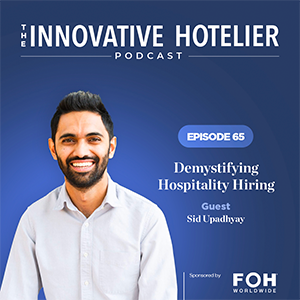
Robin Trimingham: Welcome to The Innovative Hotelier podcast by HOTELS Magazine with weekly thought provoking discussions with the world’s leading hotel and hospitality innovators. Welcome to the innovative hotelier brought to you by Hotels magazine. I’m your host, Robin Trimingham. It’s no secret that hoteliers around the world continue to struggle to attract and hire employees at all levels of their operation, including the HR department itself. So my question today is what do you do when you don’t have a fully staffed HR team or you’re the GM of a boutique property and you’re trying to perform this function without additional support? My guest today, Sid Upadhyay, co-founder and CEO of Wizehire, is here today to offer insights regarding HR, hospitality trends and ideas for attracting screening and hiring qualified candidates at all levels of the hospitality sector. Join me now for my conversation with Sid. F.O.H Is a global food service and hospitality company that manufactures smart commercial grade solutions. Headquartered in Miami, the company designs and manufactures all their restaurant and hotel products. They have showrooms and distribution centers located throughout the globe, and their products are always in stock and ready to ship from any of their distribution centers worldwide. Welcome, Sid. Thanks very much for finding time to chat with me today. I know you’ve been traveling a lot.
Sid Upadhyay: Thanks for the opportunity. Always fun to get together and talk about the industry. There’s so much change going on around us.
Robin Trimingham: A lot of our global listeners may not yet be familiar with Weiss Hire, so perhaps you could take a minute or two. Tell us a little bit about what you do and what inspired you to start this company.
Sid Upadhyay: Thank you for the opportunity again. Weiss Hire is here to take care of the busy work so you can find top talent. We are an online hiring and onboarding platform. We’re almost a decade old and we’ve been on this journey to support everyone from a Main Street business to a growing and expanding business. Our job is to help you ideate the roles that you need. Think about what is top talent look like. Ask you only the questions that you know the answers to. How much is compensation going to be? What’s the location? What does success look like? And based on that, our software and our team of hiring coaches will help you craft a unique job ad that speaks to the best talent out there. We’ll post that ad on all the top job sites. And then as candidates apply, we’ll help you with the real hard work. We’ll pre-screen candidates. We’ll give you guidance on how to interview them so you can deliver that world class interviewing experience akin to the Fortune 500 that you compete with. Our job is to help you get the talent you needed yesterday as soon as possible, and then help you onboard them and set them up for success so you can retain them day in and day out. I think we’re just getting started.
Sid Upadhyay: There’s so much for us to do, but we love the industry and my roots come from it. The background, how we got started was actually personality assessments. It’s actually a great story. I was not a true believer yet. I was working with my co-founder and we were using personality assessments with consultants like Bain and McKinsey going into large organizations and bringing about change. And we saw a pattern again and again, which was the consultant would help people find roles that were a better fit for their true self roles, that help them work with their work styles. And as we step back and recognize so many of the best jobs on Main Street, helping guests would never have access to that thousand dollar an hour consultant. And so we went on this journey building a platform for us to screen candidates. We recognized that managers didn’t have enough candidates. And so we went about and about and just asking why and following our customers needs as brought us here today, where it’s all about delivering that experience that you would get at an apple or a Southwest to that best western down the street. And I think every person needs and deserves that. So it’s a worthy mission and we’re excited about it.
Robin Trimingham: I worked for a major brand that actually was kind of at the forefront of using what I’m going to call personal city screening or interviewing in an electronic capacity in the hiring process. So how would you say your platform differs from what a brand might already have in place?
Sid Upadhyay: If you think about that playbook that you’ll get from a big brand or a franchisor, it’s going to give you the first steps. Our goal is to make that person that that take that context of the personality assessment, a skill assessment, the full backstory about an individual and ensure that that busy, busy general manager can deliver a consistent experience in today’s market. We have to get to candidates as soon as possible. We have to compete with so many more businesses, and the way we do that is by delivering a incredible hiring experience, one that’s effective, empathetic to who they are, one that is thoughtful about all the nuances of hiring that all the other companies have time to think about and read the books about. Our job is to pair that together into like a little, little like primer so that if it’s your. I’m hiring or if you’ve done this dozens of times and have challenges, it’s going to solve the problems. And I’ll give you a specific example. We will give you an interview guide that will step you through the real questions to ask. So versus focusing on surface level discussion, Hey, I see you like the Mets. I like the Mets as well. No, let’s let’s get to the heart of it. Right. Tell me about a challenge that you’ve had with a guest in this experience. And let’s learn from those stories. And I think we’re really doing is delivering a consistent hiring experience. So you truly find great talent versus bringing your own bias to the process, but can do it as fast as you possibly can. So it’s all about working to the scorecard so you can find out is this person the person you want to bet on to deliver that five star guest experience?
Robin Trimingham: Yeah, it’s interesting because you’re right. We’re all human beings and our own bias, our own point of view, that definitely affects our human interactions, particularly when we’re doing something like hiring. How would you say that? Hiring trends now and the use of technology are different from how they were before the pandemic?
Sid Upadhyay: Everything has changed since the pandemic. I think the industry is radically different and it’s changed for the better in many cases for the worker. And I think it’s going to allow us to build better, stronger relationships that ultimately reduce the labor costs. We’re not hiring as regularly. We’re building and developing talent. But if you step back a little bit, we still have a large gap in the industry versus where we were. The demand is ever growing. This is probably one of the busiest summers. I remember being at TSA PreCheck the other day and it was like the day the most passengers with that in mind. And you think about the constraints that we’re facing and the stress that it puts on teams on the ground. We have to get the top talent in ASAP because otherwise that housekeeper that that we’ve been depending on is going to walk because they’re overstretched. And so with technology, what we can do today is expedite the process, but do it so in a thoughtful way. So we’re really getting people that are going to stay with the business in the long run. And it really starts by that first job that we put out. Is it speaking to the talent that is going to be here for the long run, or is it speaking to someone that is just looking to think about this role or the next role? When you think about what happened at the height of the pandemic, we had the introduction of remote jobs enter all of our marketplaces. So we had all this new competition. We were already competing with Amazon and Walmart in many cases, and wages had to rise. That’s something that I think the industry is already arrived at.
Sid Upadhyay: But the second challenge here is all those organizations have world class Fortune 500 recruiters. They have a machine that even if we have our big brand and we’ve got our resources, how do we keep up with it? How do we ensure people show up for the interview when they can in 15 minutes get a role? And that’s where technology and the partnership where it can’t become fully automated. It needs to be deeply personal, just like our client experience allows us to show that candidate what it’s like to work at our business, show our culture, and do it in a way that’s thoughtful. So I’ll give you a really clear example of this Today. I think the best in class hotels will attract the right talent and and respond to them immediately because that response time is critical. They’ll get them on the call. They’ll schedule that interview, we’ll bring them in. And when they bring them in, that’s a chance both to learn who they are, but also to start selling. There’s a lot more that we can do as we get to that offer stage and how we retain them. But just in the attraction and the screening stages, it’s the pace is just faster. And I don’t think that ever goes back to how things were. Candidates are demanding so much more of our industry, and I think it’s through the use of tech. We will rise to the occasion and ultimately show people that this is a great industry to get into because we all are always striving to do the best for the guest. And I think it just aligns everyone really well.
Robin Trimingham: It’s very interesting listening to you talk about how things are now, because I certainly can remember a day when it was the antithesis of what you’re describing where applicants would be forced to fill out online applications and your application would go into the abyss. Exactly. And unless you were the Chosen one or the Chosen three for the interview, there was like there was no feedback. There was no. What did you do? Well, what did you not do? Well, Am I even in the application process?
Sid Upadhyay: Black box?
Robin Trimingham: There’s a lot of that. And applying for work was the most horrible, absolutely horrible experience. It was demoralizing. It would shake your confidence. It was agonizing. It was stressful. So it’s very encouraging to hear that it’s now come around. So we’re thinking much more about the applicant themselves. So the person that we want to hire.
Sid Upadhyay: It’s the start of a relationship and I think it is the big brands in the fortune sized organizations that are raising the bar and putting the onus on us, whether we’re a boutique firm or we’re just getting started, We have to rise to that occasion. It’s only with technology and expert advice can we fast track that journey. Otherwise we’re just playing a losing game. The game. Chance on Main Street versus skill at that enterprise. And I think that’s what we just have to like help and do our part to level the playing field.
Robin Trimingham: You were talking before about this being the busiest summer ever. And I have to say, I agree with you. I talk to people in North America, in the UK, in Germany. I have a conversation coming up with a client in Tibet, if you can believe that. I’m really excited about it, actually. And everybody is saying the same thing, that tourism, travel, hotel bookings, however you’re participating in the industry, everything is on the up. Do you see this situation continuing into 2024?
Sid Upadhyay: So if we were to take a look at the bookings nights chart over like a long term, it’s always been going up into the right in some sense. We’ve had the blips and the ups and downs, but I think our industry is growing faster than the rest of the market, the rest of the economy. And that’s a great thing because as all markets develop as and I’m thinking globally, here we are social creatures, we want to connect, we want to travel, we want to see things. We want to be with our friends and family. And we in the industry have this high opportunity to serve and delight and give that great experience. And so we at Wisehart are so bullish on the industry. I personally come from the industry and I think it’ll be fun for you and I to get together over the couple of years and just see how this thing just keeps clipping and clipping forward. I mean, obviously we’ve seen a big run up and realization of like the trend lines as they were prior to the pandemic and like two years time. But I think it will ease slowly and get back to like just that consistent increase in demand. That’s our sense. But we’ll maybe leave it to like the macro forecasters to give us better guidance on that.
Robin Trimingham: Fair enough. With all of this going on, though, why would you say it’s more important than ever to make sure that your job postings are listed on the right job board?
Sid Upadhyay: This is the first question we get when we start working with someone. The way we hire has changed because again, the landscape around us has changed. There’s so many new players, there’s remote jobs that someone can go for. So we have to work very hard to find that right board, the right site for that right candidate. And it varies by roles. If you’re looking for your back office, your operations, that’s a different candidate and a different candidate pool than someone that’s going to be your guest services person. And that’s why our job is to primarily take care of that busy work. So your general manager is not logging in to 15 sites, downloading candidates, running everything on a spreadsheet, and then like dropping the ball because they got to go deal with something else. We are in this industry, given the high standards that we place for ourselves wearing so many hats. And that’s, I think, where one of the challenges comes up, which is if we are to compete with the Amazons in hiring, we have to do 15 other things that we didn’t have to do previously. And again, back to your question about technology and getting to the right place, that is the only way we can keep up at the end of the day, I think.
Robin Trimingham: So let’s play one. Supposing you post a job for a night auditor, traditionally that’s the really hard job to fill. I mean, it’s all numbers at three in the morning and a lot of us are just not wired for that. But you get 40 applicants. What do you do? What’s your advice for narrowing the applicant pool down to a manageable number of interviews?
Sid Upadhyay: Well, let’s first think about the whole process that we want to build and we want to run this process consistently. We want to set it up from the beginning. Too often I think we’re making up our process as we go, and that’s where we lose great talent. So first off, we want to think about like, what are the outcomes here, right? It’s a very detail oriented work. The hours are tough. It’s also very routine and repetitive work. So from one perspective, that’s where our personality assessments and our risk assessment can come in very handy because you can really focus in on the work style that works best for someone. Now, of course, we’re not going to rely purely on an assessment. We want to when we get someone in, dig into the questions, if they have experience in the industry, that’s going to be helpful. But in this market, we have to draw more people into the industry. This is an opportunity to expand our pool, expand the long term audience that we can build a career with. And those individuals is where you have to really focus in on the questions. Do their past experiences have any transferable skills? Is their work style conducive to the work that’s about to happen? Like have they worked these hours? And this is where like our job is when we work with clients is to provide deep, insightful interview guides that will focus on the individual.
Sid Upadhyay: Hey, John, I understand that you like a range and diversity of work. Can you tell me a little bit about like a past experience where you’ve had to deal with a lot of monotonous work? How did you like cope with that as an example? And that’s getting deep to ground truth, which ultimately I think helps us understand is this person the right person for the role? I think before you get them in for the interview, there is a step I skipped, which is of course getting them to the interview. You’ve gotten resumes, you’ve done some filtering you’re looking at. Are they able to commit to the area? Are there do they have a skill base or experience that that’s applicable here? Maybe you did a skill assessment. Speed to candidate is highly, highly critical in this market. So it’s the moment they apply getting that email out to them, leaning on text messages, doing that phone call. Because if you’re not following through at that pace, another employer is from another industry.
Sid Upadhyay: And that’s, I think, one of the big challenges that we face with no shows, especially as far as interviewing goes. But even first day, no shows, as you get further into the process, you brought them in, They’re meeting the team. Having a team involved in the process is critical because it’s not just a relationship they’re going to build with you as the GM, but at guest services person as they come in to work. That’s a relationship they’re going to have. It makes it easier to sell the role and ultimately get them to say yes and not have them like decline the offer because they’ve built more bonds. So a little bit of advice there. Talk about the skill base, think about transferable skills. Be fast in responding to people. Much as we aim for our guests themselves, definitely focus on like the culture fit the work style because every role is so unique. And then when you do get time at that stage of making the offer, deliver it verbally, get them that written document as soon as possible. You’ll hear me say the same thing again. Speed and consistency is how we win talent in this marketplace.
Robin Trimingham: You’re making me think of a secondary question I’d love to ask you. Is it as effective to do Zoom interviews as it is to do face to face?
Sid Upadhyay: I think in our industry, face to face is like the superior option. But we have to think about the candidate and their process. What I found is that working really well is to do that initial phone screen and then bring people in for that interview. We are, of course, in an industry that works with guests face to face. We work in teams. You are having a call on Zoom, and that’s great that we have that flexibility and ability. But I think the usage of Zoom is excellent at the top of the funnel when we’re really trying to like show our eagerness and willingness to like meet that candidate where they’re at, whether phone or zoom is excellent. But ultimately this is a role where the interpersonal skills and their ability to connect is going to be critical and it does make it easier for them to also get a sense of like what it is like to be in the business and walk around and understand like, this is what my day to day could be like. So nuanced answer, but I think it depends on the role at the end of the day.
Robin Trimingham: Let’s talk about senior roles because we’ve talked a lot about the night auditor and the front desk and guest services. But let’s face it, when you need to hire a key person, I think it’s the same game, but the stakes are much higher. So I think you really have to elevate your game at the same time. Personal story. One of the jobs that I successfully got was by convincing an employer in the province of Alberta that I living in Ontario was the ideal candidate. And I had to fly out there for the big interview, which turned out to be something like three interviews, one after the next, after the next. And finally they give me a hotel room key and tell me I can have ten minutes to go change for dinner. And I knew when I opened the door of the hotel room that I would know immediately if I was getting the job. The hotel suite. Chance is looking really good. Tiny, itty bitty room near the kitchen. Not so much. So I walked through the door of the most beautiful room you ever saw in your life. And I went, I am so going to get this. So what’s my point? That how you handle the face to face experience with a senior person, with a key person that you really need to join the team? I think that’s everything.
Sid Upadhyay: I think it speaks to the fact that the process is us learning about the candidate, but the candidate learning about us and that two way dialogue. Often that’s where we have to start reframing the process at the top of it, which is, Hey, I would love to have a career story conversation. Take me through your journey. I want to feel like I’m watching the novel on screen, but at the end of every conversation, opening it up for them to have a dialogue with you about what are they looking for, what give them a chance for those questions. And if you start to build that rapport early, then I think as you get further in the process, you learn so much more about them and you can tailor that experience. Sometimes I think speaking just broadly about like senior hiring, you may adapt your process here much more than you will for your frontline hires because you want to be flexible to really sell to that candidate. As you start to winnow the funnel, there may be people that they want to meet with that are outside of your normal routine. Like let’s say you’ve got like a food and beverage program and no one has asked about this as an example.
Sid Upadhyay: Well, hey, if this person has a background in food and beverage, give an opportunity to have that experience. Sit down with the director there, have a meal, go have a conversation. Again, we’re in a deeply relational industry, and it’s not about just the 1 to 1 interview of you as the CEO, operator, president and this individual. It’s about the full team sport because you and that incoming GM may have a great rapport, but if they don’t throughout the interview, build relationships with others. Your director of sales as an example, how are they set up for success? And I think this is where at some point in the journey of interviewing that senior leader you’ve winnowed down, you’ve learned a lot. You’re going to keep digging for ground truth, but you’re also starting to set them up for success, potentially. So love the focus that we have to have here, which is like it’s a multiplayer team. At the end of the day, we have to have everyone in the team and as we get them in person, we should be able to tailor that experience to win them at the end of the day.
Robin Trimingham: Established in 2002, F.O.H is a woman owned global food service and hospitality company that manufactures smart, savvy commercial grade products, including plateware, drinkware, flatware. Hotel amenities and more. Driven by innovation F.O.H Is dedicated to delivering that wow experience that restaurants and hotels crave all while maintaining a competitive price. All products are fully customizable, and many are also created using sustainable eco friendly materials such as straws and plates made from biodegradable paper and wood and PBR free drinkware. F.O.H has two established brands. Front of the house focused on tabletop and Buffet Solutions and Room 360, which offers hotel products. Check out their collections today at FOHWorldwide.com. Working in the hotel industry is maybe one of the biggest examples of teamwork, because you interact with people at all different levels, above and below you from a huge number of departments, and they may be doing something critical for you and you don’t really even know very much about what they do other than that’s the guy.
Sid Upadhyay: And there again, that team effort in the interview is critical because you may get a perspective that’s so focused on that ROI that you’re looking for, but the alignment that they have at the peer level is going to speak to their success in the job. So you said it perfectly.
Robin Trimingham: Let’s change the subject a little bit. Hotels, for the most part, whole hospitality industry is very seasonal. It’s the the blessing and the curse of the entire industry. So having the right number of people on staff, given this seasonal ebb and flow, that’s a constant struggle, particularly if you’re a brand that’s been used to using profitability, modeling to determine how many people you should have in the various departments. What are your recommendations for handling this endless revolving door of hiring? And if you’re fortunate enough to have enough staff in the first place, laying people off and then three months later, you have to start the whole process all over again.
Sid Upadhyay: So this is one of our biggest challenges and I think there are some strategies to get ahead of it, and I think it requires us to think about our portfolio of properties. There are some strategies that I think like especially those that are starting to think about de-risking their own business and are focusing on a property portfolio that may be very much summer oriented and then one that’s very winter oriented. I think when you step back and you think about us as operators starting to de-risk our business this way, and then you think about these properties, there’s a really interesting opportunity here, which is to actually build a talent network across your brands. Was just the other day chatting with actually one of our customers, Scott, at Lark Hotels, and they have a portfolio that’s summer oriented. There are a lot in the New England area in America, and they have a lot of properties that are very summer oriented. But then a large number of that see their seasonal peaks in the winters. And what we’ve done with them is build a talent network such that those individuals that may have been up, leveled, brought into the business understand their style of hospitality can transition between properties as they start to think about it. And that’s like mean obviously only accessible to those of us that have larger properties and larger units.
Sid Upadhyay: One thing to consider thinking about is setting of course, let’s say you’ve only got a few properties, you’re not able to take advantage of seasonality and rotate people between. Then you have to have like upfront conversations to set people up for success. It should never be jarring to someone that, Hey, I just entered this industry and wow, three months in like that was so much fun. I had a great summer. But like, what’s happening? You got to ensure that anyone coming into the industry because we want to think about the long term of the industry understands this nuance. And if you start thinking a little bit about the opportunity when you’re up front with them around a multi year career, that is a powerful thing, like the moment when you’re having that conversation, okay, it’s low season and we’re going to have to have a reduction. Yes, that’s tough news. But I think if you’ve teed it up enough and you’ve talked about a lot of other opportunities, and if you’re thinking about your business as one where we don’t want to keep spending our time focusing on acquiring talent, but instead retaining it, and you start thinking about, hey, next summer, here’s where I want you to be and you start planting that seed.
Sid Upadhyay: You talk about the other roles. You start building and developing relationships. You can get ahead of it in the future by having that focus on the long term career plan. We’re seeing so many of the big brands deliver this context, especially their franchisees that have had challenges with this in the past. I was just chatting with someone at Hyatt the other day where they’ve built a plan. We’ve got to keep working on it, but of course it’s a rubric so that you can show someone that there is real long term potential here and the seasonality will become less so as you continue to rise in the ranks. And we really want to be inclusive and bring you into the industry and we’re going to keep in touch with you like, hey, it’s October, it’s our low season. I’m going to call and check in with you because you’re the person that’s gonna be my first call when we start to open up in the spring or whatever the case. Like we have to just take a longer view here. I think that’s maybe the best advice. And of course, for those of us that are fortunate to have a portfolio that allows us to rotate people, definitely that should be like a first tactic.
Robin Trimingham: Yeah. And I think probably a lot of employers are a lot more open to that than they might have been in the past. I talked to a lot of people about AI and data driven analytics, big data, the whole thing in the HR industry, in hospitality. How are HR professionals now able to leverage big data to make more informed decisions?
Sid Upadhyay: Yeah. So one thing if we think about, again, the challenge that’s all around us, there’s not enough experienced talent in the industry and we have to. Ring talent in one of the biggest places that we’re seeing technology and I have come into play is to really help that general manager, that busy hiring manager, understand transferable skills. How is a role that they’ve not seen before? A patient care coordinator at a multi-unit hospital network? How is that person a good example for our industry? No, literally I was coaching someone about this just the other day and it was like an aha moment when we showed a report that said, actually, there’s a lot of transferable skills here and as a result got.
Robin Trimingham: A lot of rooms. They have to be cleaned or people checking in. Yeah. Like this.
Sid Upadhyay: And so that’s one example. We’ve obviously with the advent of like all of us have been using OpenAI as ChatGPT, we’ve seen a great usage of that in the hiring process with that hiring manager that was stuck on writing a job ad like they needed talent three weeks ago, but they’ve not had a moment to sit down and write a ten minute ad like there’s been a great use of technology there. So we’re very bullish on like what’s about to come about here. But the one thing that we recognize is that it can be unnerving. There’s obviously the concerns of bias, and I think that’s where there’s a lot of great work happening to reduce bias in AI. One thing we’ve been helping to spearhead, but the most applicable use cases are going to be to take care of that busy work because at the end of the day, screening and assessing talent has to be done. Face to face has to be done person to person, because it is the most critical decision you’re going to make. So I would emphasize that anyone listening to this think about this technology and how it helps to augment you, take over that busy work back to that idea of like, Hey, there’s a candidate I might not have even seen because I looked at it and said, Oh, that’s not even in industry, let’s revisit that. But as we get further in the process, we’re not going towards a world where the AI is going to say hire fire. That’s not the case. It’s a very nuanced decision and you’ve got to just lean on more inputs to get to the answer.
Robin Trimingham: Yeah, there’s the old expression knowledge is power. So what strategies are you seeing being implemented to address the skills gap You’ve alluded to that you’ve alluded to being more open minded about what skills might be transferable, but when you are taking people on who’ve worked in the hospital industry, okay, they know hospital, they understand the basic process, but they’ve never worked in a hotel, They’ve never been a concierge. How do you handle that?
Sid Upadhyay: Yeah. So this is, I think, where great credit to all the brands in the industry. We’re seeing so much work happening in onboarding and training and learning and development. I think I was talking to somebody at Marriott the other day where, you know, they for many years now had a program that they can deploy very easily. It’s all about and if you think about this, we’re bringing in talent. That talent is excited and eager about our industry. There’s a skill gap. We’re going to get courseware, we’re going to get content, we’re going to get training and development at not just our location, but a group of locations to up level people. We’re going to connect them in peer groups so that they’re learning from one another. But the amazing thing that we have to recognize here is if we do this right and we lean in and we invest in this talent, we are opening them up to our industry and particularly our brand for the long term, because as we step back and we’re so insular in thinking about our industry, but very other, very few other places invest so much, are willing to invest so much in individuals. And if we do it well and we teach them about our industry the way they prefer to learn, whether it’s through through videos or whether it’s through like like just the face to face interaction and feedback on what goes well and doesn’t go well, especially on what doesn’t go well.
Sid Upadhyay: That’s going to set them up for success because then they can see that journey. Final bit about this is it’s not just about delivering content and delivering context, but it’s also talking about like, what is this going to mean for you in the future? Back to career paths. This is all about bringing people in, showing them the journey and like having examples in your business to say, Hey, Cardo started out actually, I don’t know if you know this, you should ask her, but she started out in this role like six, seven years ago and through the same program that you’re going through social proof, this is where she got to. So there’s a lot of openness, I think, in our industry. You should reach out to your franchise or if you aren’t familiar with the programs, but everyone is building these programs right now. Just bring in new talent and up level them to understand what is hospitality look like at this brand or whatever the case.
Robin Trimingham: Let me ask you a little bit of a tough question or maybe it isn’t. I don’t know. We’ll find out.
Sid Upadhyay: I’m excited.
Robin Trimingham: We talked a little bit about an automated screening process being more fair when it comes to screening applicants. Is there a way, though, to promote diversity and inclusion through all of this? Because that is one of the big ESG buckets?
Sid Upadhyay: Yeah, I think one of the best ways to think about this is the hiring process that we’ve run previously is haphazard. It brings our own bias to it. It lacks consistency. And when we have a process that leads to one person back to our other dialogue, having a conversation about how much they love the Mets and so does the general manager. What are you learning from that? You’re actually bringing so much bias and you’re probably preferring that candidate. And so back to like fundamentals. When we think about what success in the role looks like and we think about an interview process and a screening process that’s consistent where every person gets the same questions, Hey, take me through your career. I want to understand your journey. I want to ask a couple of questions. I want to be focused on this part of the guest experience, this part of the back office experience. By being consistent, we root out the bias that has prevented us from being truly inclusive. And I think that’s like a powerful thing. It’s such a simple thing, but it’s ultimately just focusing on getting the right person by having a great process that ensures that one, we’re treating everyone that does opt in to our process. Well, now there’s a caveat there, which is this is the tough part of the question. That’s if they raise their hand and are interested in the role, we have to be more proactive in casting a wider net. And if you think back to our conversation previously about the right job sites, the right way to message to candidates, that is where there’s a lot of subtlety and that’s where definitely the Fortune 500 companies have way more advantage.
Sid Upadhyay: Our job is to make that more accessible. But by us or your general manager posting on all the job sites, you’re getting more individuals by having language that is speaking to the best candidate. Because again, so often when we’re hiring managers, the last time we applied for a job may have been like 15 years ago. Right? The whole world has changed. We have to meet the candidate where they are. And so these are a couple of the tactics, right? It’s definitely the process is one of the best ways to build a great like background. But we have to think and push ourselves even further. We were talking about key hires and how that’s a team sport in the hiring process. Who you involve in that. That interviewing process is critical. If there’s a lack of diversity in the interviewing process, what are you telling the diverse candidate at the end of the day? So tough conversations have to be had here. But I think it all comes down from we’re all aspiring for the right things. We got to just think about our process, how we attract, how we screen, how we interview and ultimately retain individuals. And it’s it’s great to see so much positive change happen so quickly.
Robin Trimingham: I think you’re making a very interesting point because what you’re essentially saying is when we level the playing field, what we’re actually doing is dissolving what I’m going to call the glass ceiling.
Sid Upadhyay: Ideally, ideally, and I think these are aspirational goals. It all comes down to us taking a step back, especially if we run larger operations on taking stock. Hey, how did we do last quarter? If you have a VP of HR ask the questions like I’m hearing they’re implementing a scorecard based interviewing process. I’m hearing that we’re making it consistent, but how did we do? Did we actually change the shape of the business? Are we bringing in new perspectives? Because that’s ultimately how we tailor the experience for such a diverse set of guests at the end of the day.
Robin Trimingham: Let’s ask this sort of same thing from a completely different angle. We now have a workforce where the Gen Z people are taking up employment, but older people are working longer and longer to use family terms. You could have the grandchild and the grandparent of different families, but the mindset on the same team. How are HR departments adapting to the evolving expectations of this really diverse, multi-generational workforce?
Sid Upadhyay: I love this question. So often when we have conversations about generational shifts, it leads to this very black and white kind of perspective on individuals. And I love having conversations with hiring managers where it’s all about nine out of ten things everyone’s going to agree on. Candidates in this world have so many more options. Inflation had been on people’s minds. Compensation was on people’s minds. People were looking for routed routes that they can lay down in organizations and build careers and think. A lot of those are the same things that actually previous generations have wanted and needed. Maybe we’re hearing it much more from recent generations, but I’m seeing, at least with our customers, a great excitement to meet these needs of talent because people are recognizing, hey, I don’t want to go through 2021 ever again. I don’t want to have that summer where everything opened up and I had half of my properties closed because we just couldn’t find the talent. And so we have a much more progressive view on like retaining talent today. And I think listening to the team really enables us to retain everyone. I’ll give you a couple of examples. We’re seeing next day pay become a bigger and bigger topic, especially amongst entry level roles, and that’s solving a bigger challenge that’s happened in our society, which is like, hey, like so many people have lived historically paycheck to paycheck.
Sid Upadhyay: Now there’s only so much that we as employers can control. But today, with the advent of technology and like our payroll systems, we’re able to, in many cases give them second day pay. That is leading to greater retention, that is attracting more talent as well. Everything we discussed about showing what a career path looks like. That’s another great example where all the best practices that we want to do to retain our existing team is just going to open us up to bringing in so many more people and it’s going to help that person that’s just fresh out of like high school or college all the way to the person that’s been in our business for probably 20, 30 years. Because all at the end of the day, I’ve wanted a place that they can say is a great place to work, where they’re finding meaningful work. And if we can deliver that, bottle it up and continue to listen to the team, I think we’re set up for success and I think our industry is being so reflective right now.
Robin Trimingham: We’ve got 1 or 2 minutes left here. So I’m going to ask you the question I ask a lot of people. What do you feel is the greatest mistake that hoteliers are making at the current time?
Sid Upadhyay: This is a tough one. I think. One of our biggest opportunities is to accelerate the change and embrace it. We have gone through so much change and in some cases we have begrudgingly just had to adapt. I think if we’ve learned one thing from the peak and the trough following the pandemic, it’s that change is only accelerating. And I think the best hoteliers today are looking out to other industries. You know, they’re talking to people on Main Street, the other businesses down the street to understand what is going on so we can accelerate change, because where we were with minimum wage as an example or the wage average in our industry, we were at the back of the curve in terms of meeting candidates needs and as a result, bringing in talent that can deliver that five star guest experience. I think we have to recognize that we don’t want to fall behind or stay static, and I think it’s really all about that adaptability. So that’s maybe I’m always an ever optimist. So that’s my point of view, which is like, we’ve changed a lot, but we can’t stop and we got to like, embrace it and get ahead of it, get ahead of the competition because the competition is not the other hotel down the street. It is every other business in between the two of you. And I think that’s the right mindset that we need to have a big flip in right now.
Robin Trimingham: I think that is a very insightful point and a great place to leave it. Sid I want to thank you so much for your time today. You’ve been watching the innovative Hotelier. Join us again soon for more up to the minute information and advice specifically for the hotel and hospitality industry.
Sid Upadhyay: Thanks again for the opportunity. It was an excellent conversation.
Robin Trimingham: You’ve been listening to the Innovative Hotelier podcast by Hotels magazine. Join us again soon for more conversations with hospitality industry thought leaders. And.