
Costalegre is not the obvious place to deploy hundreds of millions of dollars in hotel investment. It’s a remote patch—150 miles along the Pacific coastline stretching between Puerto Vallarta and Manzanillo in the Mexican state of Jalisco. That obscurity, however, is precisely why some of the world’s most selective luxury brands and developers are planting flags on its wild and rugged shores.
Jalisco is home to tourism and economic powerhouses Puerto Vallarta and Guadalajara and is currently tracking more than $1 billion in private hotel investment across 38 new projects scheduled through 2028, according to the Jalisco Tourism Board. The bulk of capital is flowing into the aforementioned established markets, where infrastructure, airlift and demand support rapid absorption. But a meaningful share is being directed to Costalegre, a sparsely developed Pacific coastline where density is capped, timelines are long and development friction is part of the deal.
The decision runs counter to prevailing investment logic. Nationally, Mexico’s hospitality market is projected to reach $61 billion in 2026, growing to $82 billion by 2031, according to market research firm Mordor Intelligence. In most regions, that growth is translating into more keys, faster cycles and denser resort and urban projects. Costalegre is moving in the opposite direction. It’s a broad region rather than a single destination: There is no anchor city, nothing resembling a resort strip and little in the way of connective infrastructure. The drive from Puerto Vallarta takes roughly three hours on winding roads that cut through jungle, ranch land and long, undeveloped beaches. Cell service is intermittent. Reliable Wi-Fi is not guaranteed. Apart from Puerto Vallarta’s international airport in the north, the southern gateway is Manzanillo, a port city better known for shipping containers than leisure travelers.
For decades, those limitations kept Costalegre off the mainstream tourism map. What once discouraged investment, however, is now its impetus.
A COASTLINE UNDEVELOPED
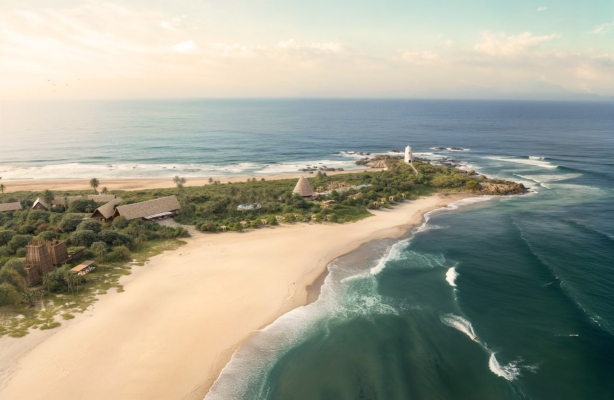
For most of the last century, Costalegre was preserved less by master planning and more by inconvenience. The coastline’s rugged terrain, lack of infrastructure and distance from major population centers made large-scale development impractical long before environmental regulation entered the conversation. The region largely remained untouched because getting there required a tolerance for uncertainty.
The one notable exception was Careyes, a privately developed enclave established in the late 1960s by Italian banker Gian Franco Brignone. Careyes introduced a model of architectural experimentation and controlled access that attracted artists, designers and a discreet international set. But it was never intended to scale. Outside its gates, the coast remained mostly unchanged.
The combination of pockets of intentional privacy and broad underdevelopment elsewhere shaped Costalegre’s foundation. When environmental protections and zoning restrictions were later formalized, they cemented an existing reality rather than imposing a new one.

DIFFICULTY AS A DRAW
Luxury hospitality has spent the last decade chasing remoteness, often discovering, too late, that remoteness without regulation quickly erodes itself. Costalegre presents a different proposition: It’s a place where difficulty is structural.
“Jalisco is unusual in that it offers both momentum and restraint simultaneously,” said Diego Gutierrez, co-owner of Chablé Hotels, which is slated to open Chablé El Tezcalame in 2027. “Not every market should be optimized for volume. Costalegre’s value lies precisely in what it resists: over-density, short-term speculation and homogenous resort formats.”
That resistance has attracted brands willing to trade speed for longevity. Architect and designer Santiago Cuaik, lead architect for Chablé El Tezcalame, describes Costalegre as a market where land, rather than demand, drives development. “Chablé’s owners were searching for a territory rather than a site,” he said. “Costalegre offers a rare convergence of mountains, jungle, estuaries, beaches and open ocean within a single landscape. That layered natural context invites a more thoughtful, place-driven approach to hospitality.”
Low density in Costalegre, Cuaik added, is not a marketing concept, but a spatial reality. “Rather than measuring success through scale, we focus on influence and how the project shapes experience, perception and long-term value,” he said. “In this context, intimacy and restraint create a stronger and more lasting brand presence.”
THE BENCHMARK: FOUR SEASONS RESORT TAMARINDO
The turning point for Costalegre’s credibility as an institutional luxury market came with the opening of the Four Seasons Resort Tamarindo in 2022.
The project demonstrated that large-scale capital could coexist with low density, environmental oversight and long-term stewardship. The project also proved that operational excellence could compensate for logistical challenges, from staff and supply chains to guest access, without compromising rate integrity or brand standards.
COMMITTING CAPITAL
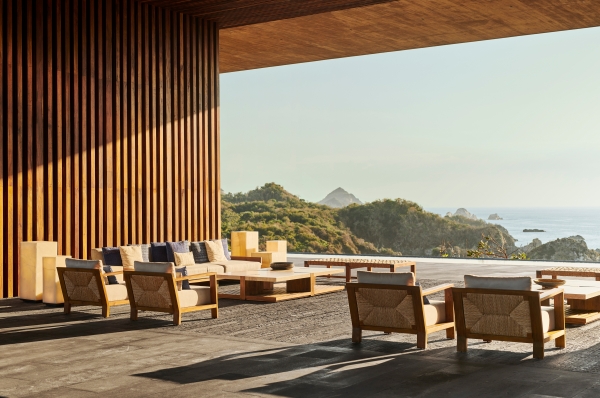
The dollars have followed since Four Seasons Tamarindo. Chablé El Tezcalame is backed by approximately $251 million in private capital and aligns with Chablé’s broader philosophy of ultra-low-density development grounded in wellness, architecture and cultural specificity.
For IHG Hotels & Resorts, Costalegre represents one of the most selective brand deployments in its global portfolio. Six Senses Xala, scheduled to open in 2027, is part of a broader $165-million allocation across seven IHG projects in Jalisco, but stands apart in both scale and intent.
“The limitations for development are one of the things that attracted us,” said Paul Adan, regional SVP of development for Mexico, Latin America and the Caribbean at IHG Hotels & Resorts. “We don’t want Six Senses to be in a corridor with 500 hotels. We want something pure, unique and exclusive that is still within reach of an airport, but truly distinctive.”
Reflective of current luxury development trends, both Six Senses Xala and Chablé El Tezcalame will include branded residential components. “Owners want hotels with branded residences,” Adan said. “They combine perfectly well with the services, maintenance and security of a luxury hotel, and they help support overall project returns.”

SCARCITY AS STRATEGY
Costalegre’s development math is different. Projects involve extended underwriting periods, slow absorption and fewer keys.
Returns are structured around scarcity, pricing power and long-term asset appreciation, as opposed to quick stabilization.
“There is always an inherent tension between scale and quality,” said Juan Bremer, co-founding partner of the Six Senses Xala project. “Our focus is firmly on very low-density, high-end products. Once a hotel reaches a large scale, it inevitably loses what makes it special from both a guest experience and a brand standpoint. When a project remains rare and intimate, the ADR naturally reflects that value.”
That restraint is embedded physically into the projects themselves. At Six Senses Xala, roughly 1,200 acres of the larger master-planned site are designated as protected land. Chablé El Tezcalame has committed 521 acres— approximately half of its total landholding—as a protected reserve, while Four Seasons Tamarindo preserves more than 3,000 acres within its broader development. In each case, conservation is not peripheral to the investment thesis; it defines the amount of buildable land, the scale of inventory and the long-term scarcity that underpins value.
“From the outset, we are clear that destinations like Costalegre are not about fast absorption or short-term yield optimization,” Gutierrez said. “They are about being irreplaceable assets.”
Hervé Fucho, resort manager at Four Seasons Tamarindo, shares that view. “Rather than maximizing keys, the focus is on depth of value for guests,” he said. “That restraint reinforces exclusivity and ensures relevance decades ahead.”
In this environment, brand selection functions as risk management. With little margin for error, developers gravitate toward operators with long term alignment, operational discipline and the patience to work within constraints.
A LOOK AT GUADALAJARA
Costalegre’s slow-burn model would be far more difficult to sustain without the broader economic engine of Guadalajara.
While the coast advances deliberately, Guadalajara is absorbing the bulk of the state’s hotel growth. According to the Jalisco Tourism Board, 12 of the 38 hotels planned statewide are scheduled to open in the metropolitan area before the 2026 FIFA World Cup, adding roughly 1,500 rooms to an already deep inventory base of about 30,000 rooms.
For global hotel companies, the city offers the opposite development profile: faster cycles, diversified demand and predictable absorption. “Guadalajara has consolidated its position as a major economic hub with strong foundations in technology, healthcare, education and manufacturing,” Adan said. “Having that in the same state as a high-value leisure corridor is huge, and not easily replicable in Mexico.”
Marriott International views Guadalajara as a multi-brand platform. “Guadalajara has emerged as a strategic, multi-brand development hub, supported by its robust corporate environment, lifestyle and culture and clearly defined micro-markets, such as the historic downtown, Andares, and Zapopan districts,” said Alejandro Acevedo, regional VP for development for the Caribbean and Latin America at Marriott International. Acevedo also mentioned that Marriott has its sights on the Costalegre, though there currently are no concrete plans or details.
The layered demand allows capital to move efficiently in urban markets, offsetting the long timelines required along the coast.
TWO SPEEDS, ONE STRATEGY
Jalisco’s hotel strategy is intentionally differentiated. That differentiation is codified in long-term planning. State officials have outlined a 20-year development framework for the Costalegre that prioritizes low-density construction, environmental protection and controlled land use along the coast. The plan is designed to limit overdevelopment while allowing select projects to move forward within clearly defined parameters.
According to state tourism officials, that clarity has reinforced investor confidence by providing legal certainty and predictable frameworks across markets. Costalegre remains the most delicate part of the equation, and the most closely watched.
“Costalegre is not an emerging market in the conventional sense,” Gutierrez said. “It is a protected one.”
Whether that protection holds as more brands circle will determine whether Costalegre remains an outlier or becomes a model for what luxury development looks like when difficulty is treated as an asset instead of an inconvenience.
Story contributed by Meagan Drillinger.