
Nothing quite beats the anticipation of arriving at a guestroom door, opening it, walking over the threshold and taking it all in—no matter if it’s a standard queen room or a spacious suite with all the trappings. The excitement and suspense are the same. Hotels are more than just a place to sleep, offering a variety of ancillary experiences and opportunities, but the fact remains that guests still spend the majority of their time in the guestroom. It makes sense, then, that rooms are equipped with the best and latest in technology to ensure a guest’s stay is as memorable as it is functional and easy to navigate. Technology at its best is like good officiating in sports: it’s present, functions optimally and there are no complaints. It’s what guests want: a no-hassle experience that delivers. At the same time, smart technology is a money-saver for hotel owners. Here are six companies outfitting and equipping rooms with the latest and greatest technology that ensures an indelible guest experience and operational excellence.
Samsung
Find them @: samsung.com

Samsung is synonymous with TV. And in the same way that Samsung is associated with television, for the hotel guestroom, the TV is not only table stakes, it’s a focal point. Meanwhile, hotel TV today is way more than just “free HBO,” and even more than just a place to watch and stream shows. (It does that, too: Samsung Smart Hotel TVs have Samsung TV Plus, which provides free access to over 500 channels, while guests can also use their own devices to stream using tools like AirPlay or Google Cast.) At its best, Samsung helps guests achieve a great experience. “Guests expect the best and the in-room screen is now at the center of the guest experience,” said Richard Leonarz, director of hospitality product management for Samsung Display Solutions, adding that the endgame is to make every guest feel like they’re at home, having the same seamless experience that they’d have from their own couch. But unlike at home, hotel screens need to integrate with other internal hotel systems, even helping hoteliers grow ancillary revenue. “These solutions make it simple for staff to add personalized messages on screens or encourage visitors to take advantage of hotel amenities, such as dining options or spa appointments, all of which can be booked directly through the display,” Leonarz said. In the end, it comes down to hotel success through partnership. “Hotels that create connected, in-room experiences are better positioned to build guest loyalty, deliver more consistent service at scale and adapt quickly as guest expectations evolve,” Leonarz said.
DirecTV
Find them @: directv.com
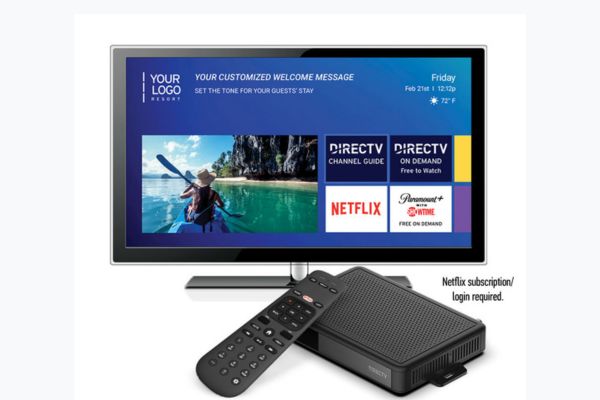
As good as a TV screen is, it needs content. Enter content provider DirecTV, which originally launched in 1994. It’s come a long way. DirecTV Hospitality’s own research shows its worth: While fast, reliable WiFi tops the list of things most important to guests, the ability to use their own streaming accounts and watch live networks and events comes second. Even more telling, these same features apply across all hotel segments, noted Kimberly Twiggs, VP of market development for DirecTV Hospitality. “Consumers are no longer satisfied with the bare minimum; their appetite for consuming entertainment in various ways and on their own terms drives their hotel choices,” she said. At the same time, DirecTV goes beyond entertainment. Its Advanced Entertainment Platform also supports contactless services, allowing hoteliers to share property information with guests, such as restaurant menus, locations and hours. Meanwhile, the Advanced Entertainment Platform’s EventSeeker and CitySeeker apps give guests suggestions on local attractions and events based on the hotel’s location and include the ability to purchase tickets. “In a time when repeat business and loyalty are more important than ever, we help hoteliers deliver value, differentiate offerings and create memorable stays,” Twiggs said.
Intelity
Find them @: intelity.com

All the enjoyment a guestroom provides begins at the door. It makes sense that opening it should be a simple, easy affair. It turns out that’s not always the case in an age where plastic room-key cards are still the norm. Companies like Intelity and its mobile key solution are changing that. “Mobile key has transformed arrival by giving guests choice and control,” said Steve Proctor, CEO of Intelity. “Guests can bypass the front desk or engage with staff on their own terms. It removes friction.” Meanwhile, guest adoption of mobile key is an operational win for hotels. “It immediately reduces front-desk congestion during peak arrival windows,” Proctor said. “That translates into fewer bottlenecks, lower stress on staff and more consistent service delivery.” It also reduces costs: Those plastic key cards are a hard, line-item expense, not to mention an environmental waste. The ROI further increases when the mobile key is connected to a broader platform. Intelity’s ties directly into mobile check-in, guest messaging, service requests and analytics, Proctor noted, adding that a unified approach delivers measurable outcomes, including fewer arrival-related service issues and faster average check-in times, which improve the guest experience. Research suggests that the mobile key adoption rate reached around 70% in hotels in 2025. Barriers are less about guest willingness and more about technology stacks that create friction, poorly integrated lock or PMS environments and a lack of guest communication, Proctor argued. “The most successful properties treat mobile key as optional empowerment, not forced automation,” he said.
Indel B
Find them @: indelb.com

It’s not your grandfather’s minibar anymore. Take it from Massimo Chiarelli, business unit manager of hospitality at Indel B, a leading supplier of cooling systems for the hospitality industry. The minibar has come out of hiding. “Once considered a mere functional accessory, it is now a protagonist across three fundamental pillars: design, sustainability and comfort,” said Chiarelli, putting forth that the minibar has become an iconic piece of furniture. Consider Indel B’s Fridom line, which can be wall-mounted or freestanding. “These designs can harmonize with the room’s aesthetics while also facilitating cleaning operations for staff,” he said. At the same time, minibars need to function properly and efficiently. Technology has evolved to meet an essential requirement: maximum energy efficiency linked to environmental sustainability. Chiarelli said Indel B has compressor technology that can achieve savings of more than 75% for hotel owners by concentrating cooling cycles when the room is empty. Of course, guests care about one thing: what’s on the inside! Water and soft drinks, sure, but minibars are now becoming territory for great wines, especially in well-known, wine-growing regions. Indel B’s Ecosmart glass door line has specific bottle-holding accessories, while its K35 Winebar line is a hybrid product that merges the features of a wine cellar with those of a minibar: an internal separator allows for the management of two different temperatures within the same compartment. Experience matters; hoteliers also want ROI on their investment. “The real value stems from the combination of long-term product reliability and low-energy consumption,” Chiarelli said.
HCN
Find them @: hcn-inc.com

In an age where everyone carries a smartphone, is an in-room tablet necessary? It sure is, according to Terry Donnelly, chief revenue officer of HCN, a provider of tablet technology. Both, he said, can exist at once. “Tablets are not competitors to smartphones; they are the dedicated command center for the property, solving a critical friction point in the guest journey: app fatigue,” he said. Here’s the thing: Though smartphones contain an array of apps, Donnelly said that only about 15% of hotel guests download hotel-specific apps. “Guests view their phones as personal sanctuaries for work and social media, not as tools to navigate hotel logistics,” he said. The in-room tablet bridges the gap by providing logistical access to the hotel’s array of amenities without the barrier of downloads, logins or authentication hurdles. “Ultimately, the tablet is property-tech, not personal tech,” Donnelly said. HCN tablets also go beyond mere information into services, such as the functionality to order extra pillows or book a spa treatment and also control the room’s lighting and drapery. Tablets, which have integrations with a hotel’s PMS and POS, can also serve as revenue generators; for instance, as Donnelly pointed out, replacing paper menus with high-definition digital visuals can increase the average in-room dining check size by as much as 22%. “Guests eat with their eyes,” he said. “In short, the tablet transforms the guest room from a passive space into an active, revenue-generating environment.”
Vingcard
Find them @: vingcard.com

Guestroom automation done right has a major impact on the guest experience and a hotel’s operations: it simplifies the stay, saves money and, of course, adds a touch of flourish and wow. One company that puts automation on autopilot is Vingcard, which provides integrated, energy-efficient lighting control systems for hotels, using sensor technology to automatically adjust lights and other room services, such as HVAC and curtains. Put simply, it’s a win-win for hotel customers and hotel owners. And for anyone who has fumbled for a light switch, it matters. “Smart lighting control does not just focus on saving energy, but also fundamentally shapes how a guest feels and interacts within a space,” said Toni Adrian, associate head of business, Axxess Industries, a part of Vingcard. “Thoughtfully implemented lighting creates a welcoming, comfortable environment that responds intuitively to guest needs.” Hotels up and down the chain scales can benefit from automated solutions, whether off a PIP or from the ground up. With energy costs across the U.S. increasing unabated, smart, automated technology is a boost for the bottom line. “By using occupancy sensors, automated dimming and time-based scheduling, properties can significantly reduce wasted energy,” Adrian said. “This is especially valuable for unoccupied rooms that represent a drain on utility bills.”