In a city renowned for its cosmopolitan culture, the quiet sophistication of the Four Seasons Montreal suits its worldly clientele. Opened in May in the Golden Square Mile, Montreal’s posh downtown district, the destination bears a pride of place considering it is only the fourth property in Four Seasons Hotels and Resorts’ home country of Canada over the company’s nearly 60-year legacy.
Dana Kalczak, vice president design, Four Seasons Hotels and Resorts, says the team was mindful that the project should honor the brand’s heritage, and therefore recommended several Canadian architects and designers to owner Andrew Lufty, CEO of Carbonleo, a Quebec-based property developer.
Contributed by Alicia Sheber
Highly collaborative in the creative process, Lufty helped define the design narrative of Montreal as “the perfect nexus of France’s ‘old world’ and Canada’s ‘new world’ sensibilities,” she says. This synthesis led to the appointment of assorted design professionals, with the new building created by Lemay and Sid Lee Architecture, both Canadian practices, and the lobby and F&B interiors by Montreal-based Atelier Zébulon Perron.
Lufty’s desire to connect with Canada’s French origins came to fruition with the guest rooms, spa, ballroom and non-F&B public areas designed by Paris studio Gilles et Boissier (read more about the public spaces here). The office also collaborated with Montreal architect and designer Philip Hazan, who created the 18 private residences.

Human-centric
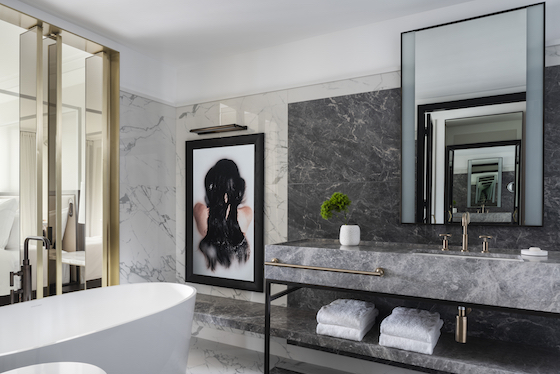
“Thoughtful, human-centric design is Four Season’s secret sauce,” Kalczak says. “We even sit in our model rooms’ bathtubs to know what guests will see.” This careful orchestration extends to the new-build hotel’s blend of contemporary and old-world spirits, including bedrooms with clean lines, four-poster beds and wall moldings.
“Avant-garde and stylish himself, Andrew [Lufty] wanted the guest rooms to up their game,” Kalczak says. As a result, sliding panels in the 169 rooms and suites filter natural light from the bedroom into the bathroom, while the circular, wall-mounted brass cocktail cabinets are already popular on Instagram.

‘Cool factor’
Perron modeled the design of chef Marcus Samuelsson’s eponymous 200-seat seafood restaurant, which introduces Canada to his culinary artistry, after a brasserie, encouraging conviviality by placing tables closer together than at Michelin-starred establishments. Noble materials such as marble convey permanence in what the he hopes will become a dining institution. “Marcus is such an incredible personality, so the very fact he’s with us is already a cool factor,” says Kalczak. It also bodes well for Four Seasons’ aim to attract younger crowds.
The adjacent terrace is, Perron believes, unique to Montreal with a removable glass wall system for al fresco dining or a greenhouse atmosphere during the winter. Either way, the space enjoys views of the city — and a soaring mural of Montreal native Leonard Cohen.
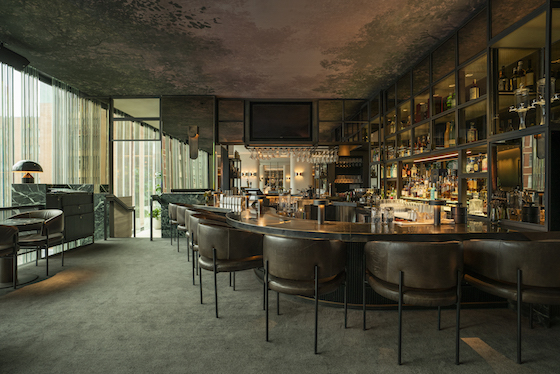
For the moody vibe of the night bar, Perrron commissioned 360-degree panoramas of the shadowy nighttime treescape of Mount Royal Park, located five minutes from the hotel. “We wanted a dark, sexy and immersive mood,” he says. The photos were transferred to a custom tapestry that wraps onto the?lowered, curved ceiling above a raised seating platform, suggesting an intimate nook beneath a tree canopy.
“In today’s fast-paced world, luxury is having time for real, meaningful connections with places, people and even yourself,” Kalczak says. “It’s important architects and designers read how spaces will be used so people get what they really need. And then there’s beauty; not just finishes or shapes, but also functionality and comfort. Real luxury isn’t one moment enjoying precious materials, it’s the whole package.” With that definition, the Four Seasons Montreal passes with flying (yet subtle) colors.