
Rising out of the sand-colored desertscape in Utah like a luxury-laden mirage, the latest development from Canyon Equity LLC became a tangible reality in December with the debut of Aman Residences, Amangiri, in Canyon Point, Utah.
Showcased are the first of 12 über luxurious homes set across 900 acres of the Colorado Plateau in Canyon Point. The development is proximate to Canyon Equity’s five-star, 34-suite Amangiri, which will serve as a source of amenities and services for residents.
Helmed by CEO Robert Hee, Canyon Equity is the operating arm of Larkspur, Calif.-based private equity firm Canyon Group, and is the owner/developer of the project, which was on the company’s agenda for almost two decades. “The vision to create branded residences at Amangiri is not new; it has been part of the property’s make-up since inception and the opening of the hotel in 2009,” said Hee. “But the ideation underwent different revisions. The market went through different cycles and the resort itself evolved.”
Part of that, he noted, was the successful opening five years ago of a glamping outpost, Camp Sarika by Amangiri, with 10 luxury tented pavilions and common areas, located within a mile of the resort. “The traction of Camp Sarika, Amangiri’s growing reputation and loyal base of guests, as well as a growing interest in branded residences, all led us to feel the time was right to turn our attention back to the development of residences at Amangiri,” said Hee.
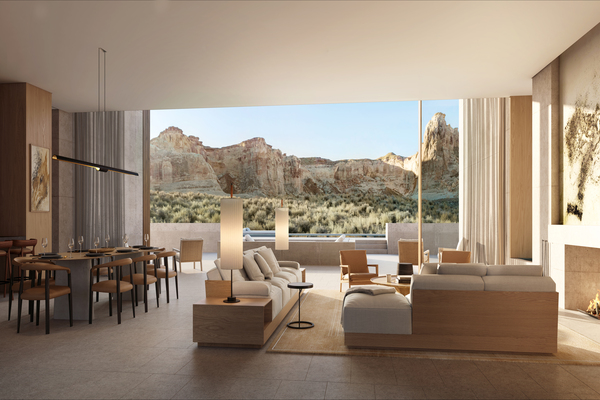
The homes, designed by Los Angeles-based Masastudio, mirror the subtly luxe Modernist aesthetic of the hotel, and reflect the surrounding desert landscape. Residences offer four to eight bedrooms on five to 19 acres and include a variety of outdoor spaces and a swimming pool.
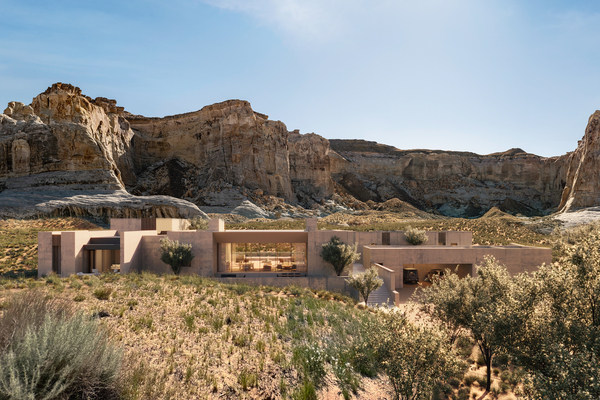
Hee is buttoned up over specific price points for the residences, but he did note each home is uniquely designed to each specific lot and topography and to enhance its viewshed, orientation and privacy. “As such, the pricing varies from residence to residence, but we are achieving the highest price per square foot in the area,” he volunteered, adding he expected the dozen properties to sell out in the next couple of years.
Asked if demand might see that number increase in the future, Hee said the focus is on selling the 12 homes and “building a community of like-minded, discerning and passionate residents at Amangiri.”
Once one or more of the residences is built and bought, a buyer could opt to return his/her property to the hotel’s rental pool for overnight stays and a prospective owner would be able to “test drive” the residence in person.
Who the potential owners of the Amangiri Residences will be remains to be seen, but, according to Hee, there isn’t a specific buyer profile. “Attachment to the destination is a driving factor,” he said, offering that a residential owner is likely to be someone who has been a hotel guest at some point or has an affinity for the Aman brand and experience. “They are looking at incorporating the [Aman] lifestyle into their own,” he said.
Bringing residences to the area did have some development challenges, namely construction costs, bloated by the relative remoteness of the region, the materiality and scale of the homes and topographical, soil and environmental factors.
Infrastructure and services were not an issue since Canyon has been embedded in the region for more than 20 years— Amangiri opened in 2009.
In addition, while distances from homes to the hotel vary, most are within walking distance of the resort. Owners are also provided golf carts to traverse the property or can utilize the hotel’s services.
UNIQUE MORE THAN ‘BOUTIQUE’
Canyon Equity is a two-decades-old investment company and though frequently described as a “boutique” firm, it’s an appellation Hee rejects, calling Canyon an investor, developer and asset manager that is “unique” for its focus on projects with smaller key counts and an ultra-luxury experience. “We particularly take the asset management role to a deeper, more involved level based on our unique niche,” he said.
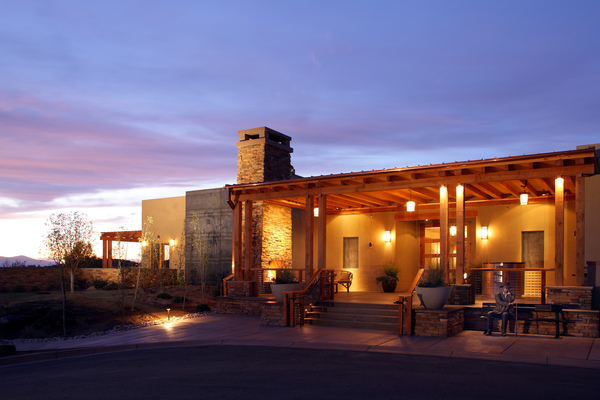
Within that niche are several other operating assets. In the luxury tier, these include the 65-room Four Seasons Resort Rancho Encantado in Santa Fe, N.M., and the 25-suite Jean-Michel Cousteau Resort in Vanua Levu, Fiji. It recently completed a complete renovation of the rooms, outdoor and group spaces at the former and is expanding several of the hotel bures (Fijian style huts/cabins) at the Fiji resort, while also adding a fitness center and performing several other renovations, slated for completion in the first quarter of 2026.
Another luxury project, the Six Senses Villas at Papagayo, Costa Rica, is on pause, Hee said, though more details are forthcoming.
Also in abeyance are several land-bank opportunities, notably the 1,100-acre Hacienda La Gavia in Mexico and what Canyon Equity calls Ostara, 101 acres of undeveloped land in Malibu, Calif. “We continue to explore the right development opportunities for both,” Hee said.
Canyon Equity’s confidence in a particular hospitality project stems from its strong conviction in the ultra-luxury market and the historic resilience of that travel sector through economic cycles. “When evaluating a new opportunity, we are looking for one that either has an established presence in the market or unmet demand at the ultra-luxury level, where we can create such [an] established presence,” Hee said. “Numerous factors play into the evaluation of the latter: It might be a spectacular location in a region with high visitation, but a dearth of luxury products.” Case in point: Amangiri. “Back in 2005, the region was nowhere as popular as it has become,” Hee said. “And while we have a trailblazing spirit, we are always looking to do it with a great brand, like Aman.”
That strategy can even be found with Canyon Equity’s single anomalous property, a select-service Hyatt Place, in Page, Ariz., which Hee still calls unique because it was built, he said, to a higher standard than normal select-service stock. “We took much of what we know from ultra luxury hospitality, along with our experience in the region, and applied it to create a best-in-class hotel that challenges many of the conventional norms surrounding select service development and operation,” he said.
ROI and exit strategy on assets like a select-service property typically have a shorter time horizon than hotels in the ultra-luxury stratosphere, which are considered more long-haul assets. “For some of our investments, like Amangiri, ownership is more generational in nature,” Hee said. “And while we must be profitable, we are more concerned with creating lasting value than seeking maximum returns.” Canyon sets hurdle rates that are based on a multiple of investment, rather than an internal rate of return. Rough targets would be multiples of 2.5x-plus on acquisitions and 3.0x-plus on development projects, Hee said.
Looking to 2026 and the headwinds and tailwinds that might influence Canyon Equity’s strategic plans, Hee sounded an upbeat note. “As we explore future projects, we are seeing a lot of interesting opportunities, especially in new developments. There are some truly unique projects being planned throughout the world, which we are excited to explore,” he said. “The field is not as crowded as the acquisition of existing resorts, where markets feel more saturated. Acquisitions will continue to play a role, but the challenge is finding the perfect balance between existing performance (i.e., price) and our ability to create upside. These opportunities are relatively rare, but when we find them, they can be truly exceptional.”
Story contributed by Stefani C. O’Connor.