
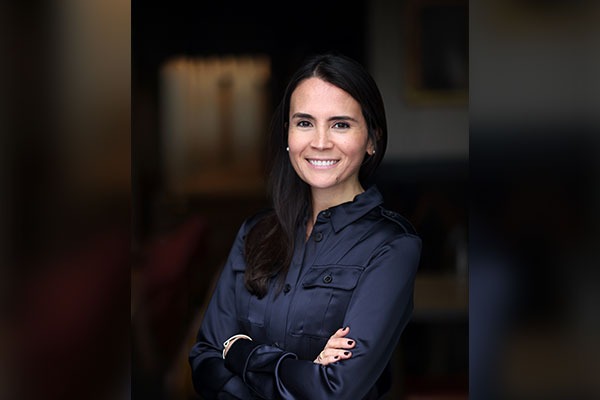
The late-day sun sinking behind the San Gabriel Mountains is no match for Gilda Perez-Alvarado: steely-eyed, as shafts of light creep through the blinds of a guestroom window on a high floor of the JW Marriott Los Angeles L.A. Live, coating her placid countenance. Colleagues scramble to scotch the offending beams—not like they need to: The impact on Perez Alvarado is negligible, which makes eminent sense for someone who personifies focus and concentration, impervious to something as trifling as the sun.
Perez-Alvarado is the chief strategy officer and CEO of Orient Express for Accor. She is petite, soignée, apt descriptors since Perez-Alvarado works for a famously French company with roots that stretch back to the late 1960s. Its present-day president & CEO is Sébastien Bazin, whose frankness—ne pas mâcher ses mots—is complemented by an acute understanding of hospitality and the forces that impact it. He’s also a good judge of talent. Bazin plucked Perez-Alvarado from JLL, where at her height she was global CEO of the commercial real estate company’s hotels and hospitality group. Stints at EY and PwC helped prime her for the position. After several years of Bazin courting, she joined Accor in 2023, first as chief strategy officer, then, shortly after, was conferred the title of CEO of Orient Express, one of the most famous names in travel: The author Agatha Christie wrote about murder on the train.
In the late 19th century, the Belgian businessman Georges Nagelmackers luxurified train travel, which up until then had been modest, even dangerous. Through his company Compagnie Internationale des Wagons-Lits, he developed an international network of trains beginning in Europe and spreading south and east from there. The most famous of these trains, the Orient Express, gained the sobriquet “Train of Kings” for its gourmet dining and sleeper cars with silk-sheeted beds. It connected Paris to Istanbul (then Constantinople) and defined the Golden Age of rail travel. (As a point of differentiation that often gets confused, the Venice Simplon-Orient Express, established in 1982, is separate from Orient Express and owned and operated by Belmond.)
In 2017, Accor purchased a 50% stake in the Orient Express brand from SNCF—France’s state-owned railway operator—for the right to use the name. (By 2022, it had full ownership.) Subsequently, Accor said it would use the Orient Express name to brand hotels and, in April 2025, opened Orient Express La Minerva in Rome, a 129-room restoration of a 17th-century palazzo. A year after the initial investment, Accor began renovation work on 1920s- and 1930s-era CIWL carriages from the defunct Nostalgie Istanbul Orient Express that will carry passengers between Paris and Istanbul beginning in late 2026. Last April, Accor launched La Dolce Vita Orient Express, in partnership with Arsenale Group, which traverses 14 Italian regions. And there’s more to come—on land and sea: This year sees the opening of Orient Express Palazzo Donà Giovannelli, Venice, a 47-room restored palace, while the first yacht bearing the Orient Express name will set sail this October on a Caribbean itinerary. It will be joined by a sister yacht set to launch in 2027.
PAST FOR PRESENT
The history of Orient Express acts as a lodestar for Perez-Alvarado. (Orient Express employs a 41-year-old, in-house historian, whose PhD work focused on the history of Orient Express. His research involved tracking down original Orient Express train carriages.) In fact, her curiosity in its past is a driving force for the brand’s future. A voracious reader and eager researcher, Perez-Alvarado drops easily into days of yore in discussing Orient Express. “Every asset that we have opened celebrates the time period,” she said, before recounting Orient Express La Minerva’s palace days and subsequent transformation into a hotel in the 1800s. Here, Perez-Alvarado added her own imprint, paying homage to the past. The hotel features a ground-level speakeasy, Perez-Alvarado’s own idea to add a 1920s-era bar that was reminiscent of the underground bars that emerged during the reign of Benito Mussolini. Certain elements of the hotel take cues from Roma Ostiense, the 1930s-era railway station, and features classic design, from the Travertine marbled facade to the black-and-white mosaics of its main entrance.

Accor’s upcoming Venice property was a noble residence built in 1436 and formerly the private residence of the Dona and Giovannelli families, known as great patrons of the arts. Yachts celebrate the 1920s; La Dolce Vita harkens back to post war Italian glamor. “What I’ve enjoyed most about the Orient Express projects is their connection to history,” Perez-Alvarado said. “You wish the buildings could talk to you.”
Accor’s control of Orient Express could be fleeting. In 2024, LVMH took a 50% stake in Orient Express. It was later disclosed that as part of the deal, LVMH could exercise an option to acquire the remaining 50% from Accor by 2027. LVMH already operates the Venice Simplon Orient-Express train service through its Belmond subsidiary.
FINDING HER WAY
Perez-Alvarado’s position with Accor isn’t transitory; she’s a linchpin, with an upbringing that readied her for success in the global profession of hospitality, even if she was unaware of it at the time. Her introduction to hotels began at an early age. Born in Costa Rica, Perez Alvarado’s grandmother owned a hotel and a restaurant and her mother worked in the largest hotel in the Central American country. “I grew up in hotels,” she said. “It was the early ’80s. Everything was still done old school.” She fondly remembers working a switchboard.
Despite an early hospitality induction, Perez-Alvarado wanted to be a biochemist; a rough first day of organic chemistry forced a rethink. She returned to hospitality and ended up graduating from the famed hotel school at Cornell University. Her affinity for the profession of travel is an expected outcome of a sundry family: an El Salvadoran father, an American mother, married to a Spaniard. She also moved around a lot in her early years, with time spent living in Madrid and Algeria. She went to high school in West Lafayette, Ind., where, ironically, another famed traveler studied at Purdue University, Neil Armstrong. “I’m very curious. I like to travel,” she said.
Her first gig out of college placed her in Miami as a consultant with PwC, where Perez-Alvarado worked on several Latin American projects. A tyro there, Perez Alvarado became a formidable, sought-after expert and force during her 19 years at JLL, attaining a unique understanding of the ebb and flow and intricacies of real estate. She became a master of the subject matter, as she said, establishing an extensive network. Then she left it all.

In an asset-light business where lodging company success is predicated on growing their brand networks, Accor is at the vanguard. At least by brand number. It doesn’t have the most hotels or rooms in the world—more than 5,500 properties globally—flying its flags, but it’s got the most to choose from, more than 50 altogether in the luxury and lifestyle and premium, midscale and economy segments. It’s a distinction not lost on Perez-Alvarado: In joining Accor, she was making a hairpin career turn, moving from the buying and selling of hard assets to one with more nuance, building, curating and cultivating brands and convincing owners of their bottom-line results delivery. “Honestly, I couldn’t have changed things more,” she said. It was also a culture shock, for one: At Accor, French is the prevailing language (she speaks it un peu). Perez-Alvarado is no masochist, but she does enjoy the thrill of moving outside her comfort zone. “I enjoy putting myself in this very vulnerable position,” she admitted, especially since there was the excitement of getting to learn something new. “That’s what I wanted,” she said.
It also meant picking up and moving from balmy Miami to old-world-charm Paris and its decidedly more temperate climate. A smart elegance about Perez-Alvarado makes it no surprise that she loves living in the City of Light. Ultimately, it was top leadership that mattered most to her—and that’s Bazin, who Perez-Alvarado calls one of the most unique and erudite executives going in the lodging industry. “I’ve had the privilege of working with brilliant minds,” she said, recounting her time with other lodging luminaries like Ian Schrager, Barry Sternlicht and Arne Sorenson. She recounted showing the Paramount Hotel in New York to Schrager on a preset tour and the exactitude he exhibited in wanting to see specific rooms. “He knew the exact room numbers he wanted to see,” she said. She puts Bazin in this company.

THE NEXT 100 YEARS
Orient Express is one tentpole amid the luxury and lifestyle framework at Accor. Others include the likes of Fairmont, Raffles and Sofitel on the luxury side to the lifestyle brands within Ennismore, including SLS, Mondrian, 21C Museum Hotels and more. (Pullman, a brand within Accor’s Premium category, has a slight connection to Orient Express. It was born out of the U.S. railroad manufacturer; Nagelmackers drew inspiration from it. When the CIWL created the Compagnie Internationale des Grands Hotels in the late 19th century, years later it introduced Pullman wagons in Europe, which became so popular that many of CIWL’s top hotels were turned into Pullman Hotels.)
The last three years have led to what Perez-Alvarado called a “burnishing” of the brands. Here, again, Accor reaches back into the past to move forward. “It’s about going back to find their roots, their reason for being and to make sure that what we’re doing today will carry on for the next 100 years,” she said. Today, Accor’s luxury brands—from North America to Southern Europe—are set up to reap the rewards of the so-named K-shaped economy, which favors the affluent, who continue to spend vast sums on travel. “We’re well-positioned,” Perez-Alvarado said.
She views brands through the prism of history and is quick to point out that some brands today don’t carry the depth and legacy that many—like Orient Express, where actual carriages are being refurbished at three sites across Europe— do at Accor. “They are just a name and a design—that is not a brand,” she said.

Looking after Orient Express has been a prime objective for Perez-Alvarado, but her dual role as chief strategy officer allows her to flex her enduring real estate muscle. In it, she looks after Accor’s significant circle of real estate investors, many of whom she has known and worked with for years. “We have a very clear roadmap in terms of what we promise. It’s up to us to make sure that we’re optimizing our portfolio,” she said, adding that Accor’s investor base is broad and invests up and down the chain scales. They can have a foot in luxury, another in lifestyle and another appendage in midscale. “We need to be organized at the enterprise level to make sure that we have a long-term strategic relationship with that particular investor so that we can grow the portfolio.”
Between launching hotels, trains and yachts, Orient Express has the feel of “Planes, Trains and Automobiles,” the 1987 comedy starring Steve Martin and John Candy. At this, Perez-Alvarado chuckles. “That’s a throwback,” her rejoinder. For Orient Express, that’s exactly the point.