
LOS ANGELES — The bad news first. U.S. revenue per available room contracted in 2025, decreasing 0.3% year-over year, according to data released by CoStar. The good news: This year should see an increase—albeit minimal—but like any forecast, subject to change.
So moves the hotel industry—like a Pong ball at the whims of an economy and political climate it can’t control.
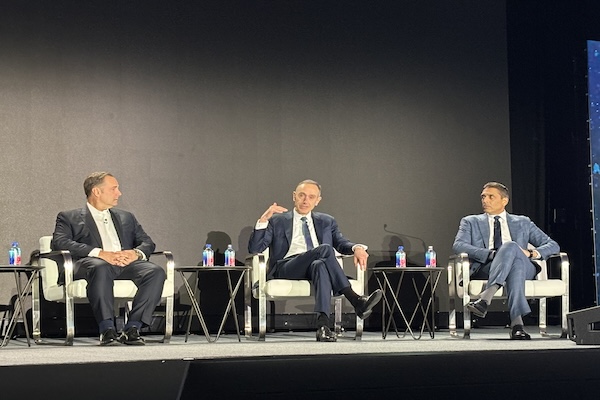
The indeterminate swings are a nuisance for hoteliers that thrive on certainty, but lodging company CEOs, speaking at the Americas Lodging Investment Summit, here at the JW Marriott Los Angeles L.A. LIVE, offered optimism regardless of the environment.
“There’s been a disaggregation between the growth of travel and the growth of economies,” Elie Maalouf, CEO of IHG Hotels & Resorts, said of the last few years. He pointed to the record amount of inbound travel to Europe from the U.S. as example.
Inbound travel to the U.S. is another story. In October, U.S. Travel projected a 6.3% decline in inbound visits, and preliminary data through year-end largely confirms that outlook. Total international arrivals are estimated to have fallen from 72.4 million in 2024 to 68.5 million in 2025—a decline of 5.4%. December followed the pattern seen throughout the second half of the year. Visits from Canada were down 25.1% year-over-year, while travel from Mexico increased 4.8% and overseas visitation declined 1.3%. Though Canada still led all countries in U.S. travel spending at nearly $16 billion, the early and sustained decline in visitation reflects deeper challenges that won’t be fully captured by near-term year-over-year comparisons.
Travel to the U.S. is projected to fall to just 85% of 2019 levels in 2025.
“The U.S. is slower,” Maalouf said, citing tariff turmoil, government cutbacks and the government shutdown as three culprits leading to enervated growth rates. He’s more sanguine on 2026, especially since comps will be demonstrably easier and huge demand generators, highlighted by America250 and FIFA World Cup, will have a propitious impact.
Mit Shah, CEO of Noble Investment Group, which invests in and owns hotels, parroted Maalouf, vexed by wigwag performance from late 2024 into 2025. Noble’s Q4, he said, was up 7%, which carried over into January 2025, when they were up 8%. “I was wildly optimistic,” he said. Then came DOGE, the Department of Government Efficiency, an initiative by the second Trump administration to modernize information technology, maximize productivity and cut excess regulations and spending within the federal government. “It took a significant amount of government travel out of the system almost immediately,” he said. “Then the Canadians started disliking us and then there was Liberation Day and a record government shutdown.”
Even against forces outside his control, Shah remains bullish on the prospects of travel. “I continue to believe that the secular trends out there bode well for travel in general and for global and domestic business.”
Beyond U.S. borders, CEOs cheered the apparent, though still tepid, China comeback, both on the travel and development sides of the ledger, with Tony Capuano, president & CEO of Marriott International, pointing to optimism about growth moving forward. “Even in an environment like that, we signed more deals in China [in 2025] than we have in any year in history, even against the backdrop of weak performance,” he said.
Buy, Build or Sell
All of this is against a backdrop that makes building new hotels and buying older hotels difficult, laborious projects. While the consensus is that this year will be better than last, there remain structural issues and pressure points up and down the hotel investing spectrum, including a prolonged gap between seller expectations and what a buyer is willing to pay for an asset. This gums up deal flow, which continues to be a laggard to the consternation of not only property seekers, but third-party management companies that rely on and grow when assets transact and owners seek out new management. Meanwhile, as Shah pointed out, there is a vast swath of hotels in need of Covid-deferred CapEx.
Bucking the trend, however, Shah said Noble had its largest transactional year in 2025 in its 32-year history as a company. Hospitality, he said, is an eight-cap business where buyers can finance deals at SOFR-plus 200. The Fed at its most recent meeting decided to hold the Fed funds rate steady at a range of 3.50% to 3.75%. Lower interest rates decrease the cost of debt, which is a catalyst for increased investor competition and, subsequently, higher property prices that compress cap rates. As financing becomes cheaper, buyers accept lower returns to acquire assets.
Transaction and new-construction activity may still be stilted, but the 30-plus brands Marriott International has in its quiver remain at the ready to fly. The one sharp arrow continues to be luxury, which thrives in this K-shaped economy of haves and have nots. “Luxury has been the strongest performing tier for us,” said Capuano. In the segment, Marriott features such brands as Ritz-Carlton and St. Regis. Since ground-up development has been harder to metabolize, Marriott, and its peers, have leaned on conversions for growth. Capuano said conversions account for as high as 40% of new signings and openings. “We’ve built an infrastructure and a philosophical approach that even when we find ourselves in a booming economy, I don’t anticipate a pullback from conversions. They’ll be a more fundamental part of the growth story for big brand companies on a permanent basis,” he said.
IHG’s Maalouf said that lenders are more friendly to conversions. “You’re adding newer product without adding supply to the market,” he said.

It’s Expensive Out There
A thaw in deal activity and growth in new development is not a panacea for other ills faced by the industry; namely, expenses up and down the P&L that threaten margins and operating income. “Most expense items continue to grow at pace at or ahead of the historical base and it has put extraordinary stress on the return proposition of the investment,” Capuano said, adding that investors are using it as impetus to explore investments outside traditional hospitality, such as in the alternative-accommodations landscape. “There is a fundamental dilution on the return model for investing in hotels,” Capuano said. Brand companies have aimed to ease the cost burden by examining affiliation costs, ramp-up standards and leveraging scale to save more in procurement. “There is urgency around making these investments as compelling to our partners as they once were, because that’s not where they are,” he said.
Noble’s Shah tracks it closely and gives credit to the brands for trying to find solutions for owners that make hospitality investment more attractive. “There is real dialogue and strong efforts by brands at looking at this operating model,” he said, beyond reliance on the delta between RevPAR and total expense growth. He called profitability a team effort built on partnership. “I’m actually more confident and optimistic than I ever have been that we are down that path,” Shah said.
IHG’s Maalouf tapped into owner frustration by offering both empathy and solutions. “There’s no question that the last five years have been kinder to brand companies than to ownership companies—the share prices tell the story,” he said. “We can’t be successful without hotel investors. If somebody isn’t willing to be asset heavy, then the asset-light game stops.”
As succor, he ticked off various ways through scale and technology to assist owners in revenue management, marketing, on-prem support and more. “AI allows us to keep that quality of service high, but lower the unit cost,” he said. In May 2024, for instance, IHG lowered its standard loyalty assessment fee that owners pay into the fund.
Global brand companies, he said, are adopting technology to help cover escalating costs. “That’s what great businesses do. They don’t adopt technology just to produce more things, but to lower costs,” Maalouf said.

The highest cost to owners is labor. Shah said that his hotels have now relied less on contract labor in favor of “own in-house labor,” which, he said, has helped shift the conversation from margin compression to margin expansion, along with the ability to drive higher rates as consequence of rising inflation. (Hotels can reprice rooms daily.) Brand standards, he said, are also under scrutiny as they pertain to the operating model. “Is that food-and-beverage brand standard the right standard?” he asked, offering that technology, now, has the ability remove costs from the system and enhance efficiency.
F&B programming and how to use space efficiently has long been a thorn in the hospitality industry’s side—more so now as traveler expectations and experiences have immutably changed. For instance, there are a multitude of hotels, as Capuano said, that are now obsolete, anachronistic product. The white elephants of the hotel industry, if you will. “We built these amazingly efficient boxes in the midscale and select-service tier, but at that upscale and upper-upscale tier, that’s the riddle,” said Capuano. “You’ve got thousands of hotels that were designed for a different era.” He added that traditional roles, from bellman to doorman, are likely due for a reset.
If hotels need a rethink, don’t expect room sizes to get bigger. Marriott and IHG each made big acquisitions in 2025; the former of citizenM and IHG with Ruby Hotels, both European-born brands. CitizenM is known as a tech-forward brand that cracked the code on self-check in, while Ruby Hotels has been described as “lean luxury.” Both favor activated public spaces and smaller room footprints. “We call it urban micro,” said Maalouf. “Where you can shrink the room size, but with artful design, people feel really good about that room.”
In economic terms, smaller rooms gives developers the ability to add more room density, which increases ROI and, as Maalouf pointed out, “your square foot return is much better.”
According to Maalouf, all you need is 140-square foot-rooms and a buzzy public space. “That actually makes money,” he said.