
Most hotels don’t like to publicize their celebrity guests. Fouquet’s New York didn’t have to: the celebrities did it for them. Around the time the Tribeca-located hotel opened in 2022, the supermodel triad of Cindy Crawford, Helena Christensen and Christy Turlington snapped a selfie at the hotel’s tucked-away Titsou Bar that quickly went viral. (They were later joined by husbands Rande Gerber and Ed Burns.) It’s the kind of publicity a luxury hotel might shy away from, but from there on, the hotel, with its Parisian heritage, became a locus for the glitterati, a who’s who of musicians, actors and athletes—yes, Taylor Swift—imbibing cosmos at Titsou or nattering over Dover sole at Brasserie Fouquet’s.
How Fouquet’s New York came to be is a question best left for Joshua Caspi, CEO of Caspi Development, which developed and owns the hotel alongside equity partner Jim Parks of APW Avenue Group. Since the late 1990s, Caspi has led more than $ 2 billion in real estate transactions spanning development, acquisition, repositioning and restructuring, with other landmark New York hotels including The Chambers and The Watson, which in its prior incarnation as a Holiday Inn was known for its rollicking rooftop pool and eccentric GM.
The Fouquet brand, as one might gather from the name, is not U.S. based. Barrière Group in France is a pioneer in hospitality with multiple hotels, gaming and restaurant outlets. A family business née Société des Hôtels et Casino de Deauville, its roots stretch back to the early 18th century. In 1962, scion Lucien Barrière took the helm and quickly modernized the company. In 1998, it acquired the famous Fouquet’s brasserie and eight years later opened Hôtel Barrière Le Fouquet’s above the restaurant at the corner of the Champs-Élysées and Avenue George-V. Today, fourth-generation hoteliers Alexandre Barrière and Joy Desseigne-Barrière lead the group.
The Barrière Collection now numbers 19 hotels, but only one is in America. To hear it from Caspi, it didn’t happen by chance, but through assiduity and due diligence. Referring to it as a “robust” process more than a decade ago, “We interviewed everyone under the sun,” Caspi said, with luxury players like Montage and Auberge in contention. Of Barrière? “These guys were complete outliers,” Caspi said. “We had never heard of them.” But they flew to New York; he flew to France; and, as he told it, “I was taken aback by their level of hospitality.”
In an age where brand awareness, loyalty and global distribution are the names of the game, Caspi could have taken the easy route and chosen a brand with a larger global network and higher recognition. And he wouldn’t have been blamed for it. But there was new blood at the top of Barrière that was reinvigorating the group, as Caspi saw it. In fact, some time into the building process, Caspi still hadn’t decided outright on an overall design aesthetic. A conversation with Mitch Hochberg, president of The Lightstone Group and a mentor of Caspi, changed that. “He was like, ‘Go with your gut.’”
Paris Meets New York
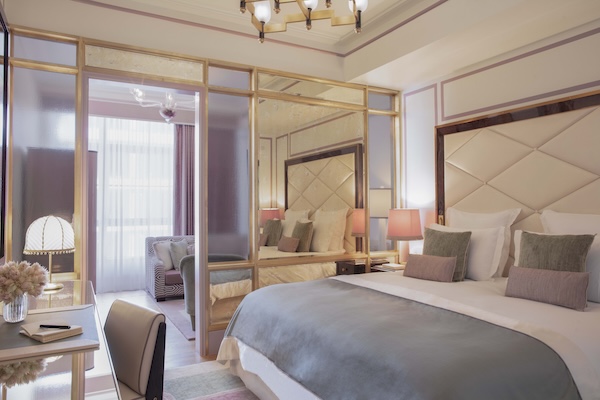
The hotel could be described as a marriage between Paris and New York—a blend of Parisian panache and Tribeca cool, with the 97 rooms and suites designed by the world-renowned Martin Brudnizki. The distinctly French lavender color is incorporated throughout the guestroom design.
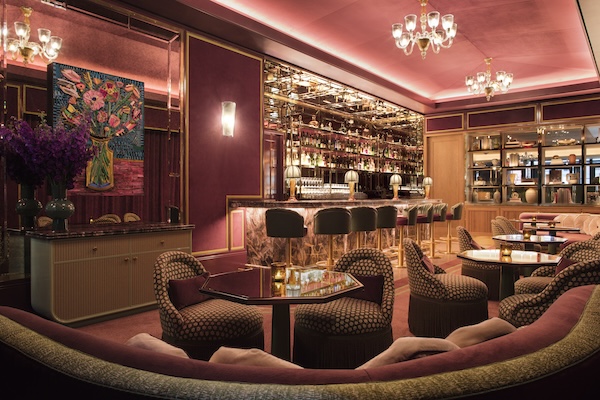
Beyond Brasserie Fouquet’s, beyond Titsou Bar, the hotel features the all-day bistro Élysée’s and a rooftop outdoor space called Le Vaux that is inspired by the French gardens of Vaux-Le-Vicomte and Versailles. Other amenities include a spa with indoor pool and, fittingly, a screening room: Ever since Robert De Niro conceived the Tribeca Festival in 2002, the neighborhood has been synonymous with cinema. (De Niro developed The Greenwich Hotel just blocks south of Fouquet’s.)
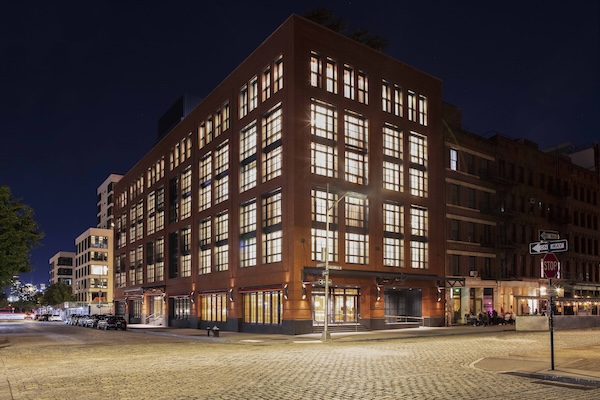
Space in downtown New York is limited and comes at a premium. Fouquet’s New York was a ground-up build that replaced a razed one-story parking garage in a landmark district, which made construction a challenge from the jump. (The 100-year ground lease was originally controlled by New York developer phenom Sam Chang, who had earmarked it for a Hyatt project before Caspi took over.) A landmarked site has special protections requiring approvals for any alterations, demolition or renovations to preserve original character. Construction becomes more onerous than it typically might be. In the case of Fouquet’s, the property was initially supposed to go one story into the ground. “You really can’t squeeze all the amenities you want one story in the ground,” Caspi said. “We were going 25 feet below the Hudson River.”
The hotel used a secant design system, a two-year effort that involves deep excavation and a special type of retaining wall that creates a watertight barrier.
A luxury property is only as good as its delivery. Staffing has a “Top Gun” feel to it: hire the best of the best. Fouquet’s New York’s executive director of sales, Diana Chan, came from Faena Group and the consistent, luxury-award-winning Faena Hotel Miami Beach. Perhaps Caspi’s biggest coup was prying the general manager away from the Crosby Street Hotel, another New York property known to attract a famous clientele. He calls GM Michael McGinley the heartbeat of the hotel and liaison between Barrière and Caspi Development.
“We weren’t really on the map as formidable until people started to see what it was all about; then the performance started to kick in,” Caspi said.
Staying on trend, the hotel also boasts a private members’ club. It’s part of the hotel’s program to generate ancillary revenue out of every square foot of expensive real estate. It’s a lesson Caspi learned from his friend, Bruce Beal, Jr., president and partner of Related Companies, the prominent New York real estate developer behind such projects as the Equinox Hotel in Hudson Yards. His advice: monetize every square inch. Consider Titsou Bar: It’s a sexy, furtive space in the evening, but night turns into day. When the sun breaks, the curtain is pulled back, and the bar serves as a meeting space offering light food and beverage.
Brasserie Fouquet’s and the spa are large sources of ancillary revenue, the latter benefitting from a high volume of sales in product and clothing.
Made in New York
Caspi Development has been a mainstay in New York real estate since the 1950s when Caspi’s grandfather, Joseph, started the business. In the 1990s, under the leadership of Caspi’s father, Steven, the company diversified its portfolio to include hotels. The Chambers Hotel on 56th Street was the first hotel Caspi built, and it did it in good company, alongside tandem developers Ira Druckier and Richard Born, and designer David Rockwell. Caspi compares hotels to works of art that guests—the audience—get to appreciate.
Caspi grew up in the Westchester suburb of Rye, N.Y., about 45 mins north of Manhattan. For several years he lived in Miami, where he was doing condominium projects in South Beach and Bay Harbor. In 2009, he moved back to New York, in what he called “an epic time” of picking up distressed properties expectorated from the global financial crisis.
It was around this time that Caspi leaned into office, buying up small buildings and leasing them out to tech companies and other growth businesses. “We had great timing,” he said. COVID, however, crushed office along with other asset classes, though like any cycle, Caspi now sees class-A office as a growth story.
Fouquet’s New York is the diamond in Caspi’s portfolio, but it also has hotels up and down the chain scale, including a Midwest three-pack Residence Inn, Hilton Garden Inn and Courtyard by Marriott, where ADRs are considerably lower than Fouquet’s. Caspi is known to on occasion send his Midwest GMs copies of Fouquet’s STAR report just to give them a laugh.
There is little regret for Caspi. In Greenwich, Conn., where he lives, he is currently building a 75-unit “ultra-luxury” condo building on land he bought two years ago. One lament he has was not adding a residential component to Fouquet’s New York, but he said he is considering a condo project next door, though there is no timetable.
The same could be said for future Fouquet’s hotels. Earlier this month, a hotel and residential project backed by the Fouquet’s brand in Miami’s Design District was announced with an anticipated opening in 2030. Caspi is not the developer on the project.
Beyond Miami, other locations are on the radar, including resort and ski locations, such as Aspen, Deer Valley and Cabo San Lucas. “I’d love to do one in Beverly Hills,” Caspi said, before adding Palm Beach to the wish list.
“Fouquet’s is definitely on the radar now; it’s substantiated itself,” he said. “Our RevPAR index surpasses all the top hotels in the city. We’ve proven the business model.”