
It’s not new, but it’s essential. Hoteliers had already dabbled with contactless solutions at their properties before the pandemic, it was just accelerated in the aftermath. Though some features, such as self check-in, ordering food and cashless payment existed, many hotels’ apps now have unique and customizable options.
Consider citizenM, the tech-centric, Netherlands-based brand. It has been exploring contactless solutions long before 2020. This helped the company fast-track and deploy it effectively early into the pandemic. The company has been making upgrades to its existing platform ever since.
The foundation of citizenM’s contactless platform is its citizenM app, which has been improved to enable check-in and even control guest room functions, such as lighting, entertainment and shades, all from a smartphone. The primary goal of contactless technology is to streamline and improve the guest experience. The app empowers guests to minimize personal contact, but it’s only one part of it.
“The real benefit is that our guests have a unique level of control over their experience. They have the opportunity for personalization which sets their stay with us apart from what they would find with other brands,” said Mike Rawson, chief information officer of citizenM.
For instance, the app remembers a guest’s preferred room temperature. And as more and more of people’s lives become digital, they begin to expect this level of control and personalization.
“It’s what so many of us have in our homes. Why shouldn’t hotels become an extension of that environment? This kind of guest-centric approach will make hospitality brands successful in the future,” said Rawson.

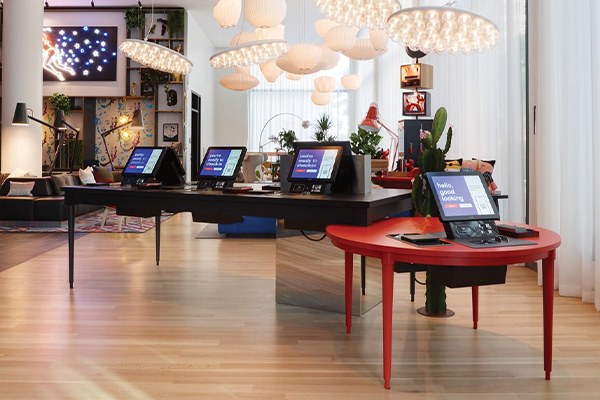
At YOTEL, another tech-forward hotel brand, all properties are built with contactless capabilities. All properties have check-in/check-out kiosks, which are continuously being updated. The London-based hotel company is currently testing a new app that will help guests check-in, retrieve keys, manage their stay and explore the city—all from their phones.
The company recently teamed with fintech reservation provider, Selfbook, to offer an improved booking experience.Guests can now go from search to confirm reservation in just a few clicks using Apple Pay or Google Pay.
“Technology is considered essential to every aspect of our operations, from customer interactions to behind-the-scenes processes. We prioritize practical technology integration, rather than adopting gadgets for the sake of it,” said Rohan Thakkar, chief development officer of YOTEL.
POWERING IT
Onity is one provider of technology hotels use to ensure a seamless, contactless experience. Its DirectKey mobile access locks are Bluetooth-enabled to stay in a ready state, so that guests can unlock doors while on the go without having to stop or touch their phone to the lock.
“Since the launch of DirectKey, guests have used Onity’s mobile key credentials to open doors more than 250 million times,” said Fayyad Sbaihat, president of Supra & Onity.
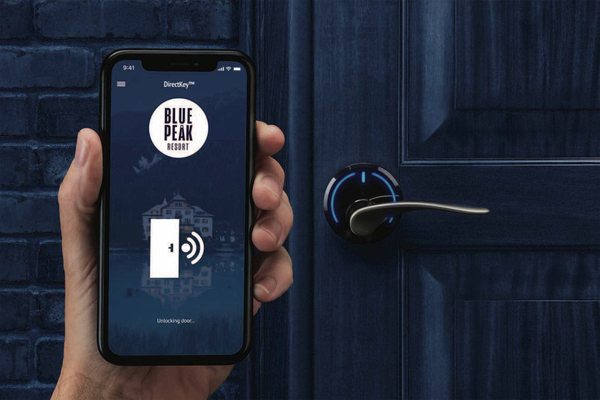
Technology, such as DirectKey, also reduces the use of plastic, eliminating the need for physical key cards.
Onity’s mobile key credentials use 128- bit AES data encryption, which provides an additional layer of security along with the locking system features like user access permissions and audit trails.
In many cases, contactless access can be achieved through simply upgrading existing locks and across lock brands. Hotels will be willing to invest in technological upgrades as long as it guarantees an enhanced guest experience and reduced operating costs.
“The more independent a guest can be in a hotel room, the higher their satisfaction and loyalty,” said Sbaihat.
LABOR USE
Contactless technology frees up hotel staff so that they can concentrate on other tasks.
At citizenM, contactless technology allows “staff ambassadors” to focus more on the guest experience. “Because they don’t need to get bogged down in basic processes like check-in, our ambassadors are free to be just that — ambassadors of the citizenM brand,” said Rawson.
There are direct cost savings, too. “By enabling our guests to select opt-in housekeeping as a service via the app, we have created a more personalized experience to our guests while saving time and costs,” Rawson added.
YOTEL has implemented delivery robots at their hotels in Porto, Geneva and Singapore, which removes the need of hotel staff to deliver basic amenities, such as extra towels or a toothbrush.
“Our hotels have always had a lean operating model and we aren’t looking to cut down on labor costs but rather make jobs easier for our crew,” said Thakkar.
UP NEXT
A fully connected and personalized guest experience is the future, said Onity’s Sbaihat. “We are just scratching the surfaceof what’s possible with mobile access,” he said. “Imagine a guest entering their room using a mobile key, then a custom welcome message displays on the TV, lamps turn on automatically, drapes open and the thermostat adjusts to the preferred temperature based on the guest profile.”
What, then, does automation mean for the future of the traditional front-desk agent? The classic hotel lobby never represented the optimal use of space, said Rawson. citizenM designs their lobbies to function as living rooms and gathering spaces, with art, designer furniture and F&B options.
While YOTEL does not consider lobbies to be out of style, the company has evolved from a traditional lobby and turned it into what it calls “Mission Control.” While the lobby will continue to welcome guests as its primary function, YOTEL’s have evolved with additions of grab-and-go food stations, co-working spaces and restaurant and bars to create a more open space.
“We aspire eventually to completely phase out the kiosks once all our guests transition to using the phone check-in/check-out system,” Thakkar said.
“However, we anticipate that this is still a few years away.”