
The hotel industry is a peculiar business. It’s one where a single asset can have multiple hands in it: the owner of the real estate; the operator of the real estate; the brand affixed to the real estate. Oftentimes, each has competing motivations within that triangle: the owner wants profit; the operator pushes revenue; and the brand, well, it really wants to add more hotels. It’s seemingly diametric, but, somehow, has not only become the norm—it’s worked!
A similar sort of antithesis exists between institutional capital and private equity that gun for huge, often highly leveraged returns and smaller real estate firms firmly planted in hotel real estate investment with a tendency toward longer asset hold periods.
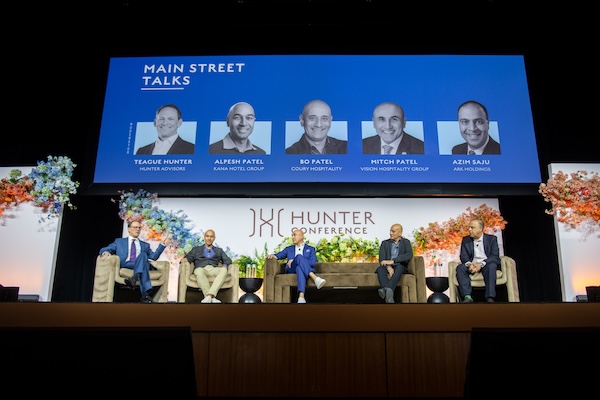
At the Hunter Conference, which swapped out its longtime location at the Atlanta Marriott Marquis for the Signia by Hilton Atlanta Georgia World Congress Center, disparities—and parities—between Wall Street’s notions of investment compared to Main Street’s were put under the microscope during two back-to-back panel discussions.
Street Smarts
Hotels are a unique asset class, as Mitch Patel, founder & CEO of Vision Hospitality Group, made clear—a service business that is layered atop real estate. This structure makes it decidedly different from other asset types. “Wall Street forgets this is a people business,” he said, adding that because hotels are a service business, and in an era of hyper transparency, people—those serving customers—have the ability to impact cash flow positively or negatively. “A 4.8 versus 4.0 rating can be the decider between success and mediocrity,” Patel said. “There are many levers to pull, unlike other asset classes.”
Fellow hotel owner Bo Patel, COO of Coury Hospitality, shared Patel’s view of how staffing a hotel has a direct impact on success and performance. “GSS [guest satisfaction scores] matter,” he said. “That gets lost. The customer isn’t just going to come.”
Main Street capital sometimes acts differently than institutional capital, Mitch Patel offered. Both invest with partners that fund these enterprises, but, as Patel suggested, not all investment partners are equal. “We have a disciplined model and patient capital,” he said, intimating that on Wall Street, money can be more restless. (The recent spate of private-capital investors wanting to pull their money out of funds is evidence of this.) Patel said that they look at deals through a different prism, with longer timelines, and with partners, who, he said, “have no pressure to get out.”
Private-equity groups like Blackstone had been rather quiet on the hotel acquisition front post-COVID, but in the last 16 months, Blackstone has made a series of hotel deals, including Four Seasons Hotel San Francisco, Kimpton Hotel Eventi in New York, three hotels in Japan, including The Ritz-Carlton, Okinawa, and EAST Miami. Last November, fellow private-equity giant Brookfield Asset Management scooped up the 1,003-room Sheraton Phoenix Downtown, the city’s biggest hotel. The seller was Blackstone.
Outside Control
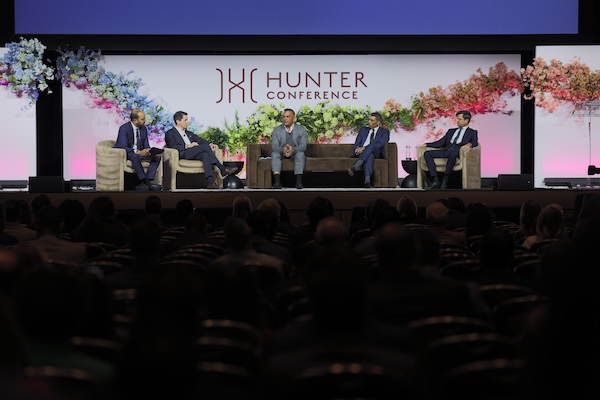
These recent deals bode well for a headier transaction market through 2026 after a strong start to 2025, which was derailed in April by the so-named “Liberation Day,” when President Donald Trump initiated major tariff increases, as Scott Trebilco, senior managing director in the real estate group at Blackstone, alluded to. “There was optimism into into 2025,” he said. “Then April happened.”
The back half of 2025 picked up. “We were calculated and targeted,” Trebilco said. Blackstone, with its thematic investment ethos, homed in on assets in major urban cities, like New York, Miami and, bucking the trend, San Francisco, areas “with multiple demand drivers,” as Trebilco put it.
At the Americas Lodging Investment Summit, earlier this year, in Los Angeles, Mit Shah, CEO of Noble Investment Group, which invests in and owns hotels, said Noble’s fourth quarter was up 7%, which carried over into January 2025, when they were up 8%. “I was wildly optimistic,” he said. Then came DOGE, the Department of Government Efficiency, an initiative by the second Trump administration to modernize information technology, maximize productivity and cut excess regulations and spending within the federal government. “It took a significant amount of government travel out of the system almost immediately,” he said. “Then the Canadians started disliking us and then there was Liberation Day and a record government shutdown.”
Two months later, Shah is optimistic about RevPAR growth in 2026, despite most forecasters predicting flat to even negative growth. He is buoyed by events such as FIFA World Cup and America250.
On the deal side, Noble bucked the overall trend. Shah said Noble had its largest transactional year in 2025 in its 32-year history as a company. Hospitality, he said, is an eight-cap business where buyers can finance deals at SOFR-plus 200.
Karim Alibhai, founder and principal of Gencom, has been active; he’s been aggressive. One of its most recent acquisitions, in partnership with two other firms, was the InterContinental New York Times Square for a reported $230 million or just shy of $379,000 per key. A year ago, Gencom acquired The Ritz-Carlton, New Orleans and the Courtyard by Marriott French Quarter Iberville, a combined 758-room hotel portfolio in the city’s French Quarter.
“There has been some loosening up in the last 24 months,” he said. “Sellers are more realistic on pricing and valuations.” Despite more challenging underwriting, Gencom’s advantage is its preference of long-term asset holds. “We don’t have pressure of three-year IRR goals. We underwrite 10-year goals,” he said. “You factor the noise into the underwriting,” Shah added.
Christian Charnaux, CDO for Hilton, pointed to the resilience of the hotel industry despite the cost pressures that owners face down. “We are manically focused down the middle of the P&L,” said Trebilco, since its hotels aren’t managed by them.
The resilience theme is shared by Main Street, as voiced by Mitch Patel. “You couldn’t create policies less detrimental to our industry, but we still have positive gains,” he said.
Positivity in overall travel was a sentiment shared by Shah, who said that travel is innate within us all. And while the K-shaped economy has been an enduring theme, where high-income earners thrive and rise and lower-income households struggle, Shah said it’s starting to narrow. He also referred to the great wealth transfer, an unprecedented, multi-decade shift of an estimated up to $124 trillion in assets from baby boomers and the silent generation to their heirs (Gen X, millennials, and Gen Z). “When you pass down money they didn’t earn, they will spend it on travel,” Shah jokingly said.
Back on Main Street, Mitch Patel reminded the audience that the hotel industry is a corner-street business. And while it can be a risky business, as Azim Saju, CEO of ARK Holdings, said, those with conviction, belief and entrepreneurship are positioned to succeed. “Bet on yourself,” he said.