
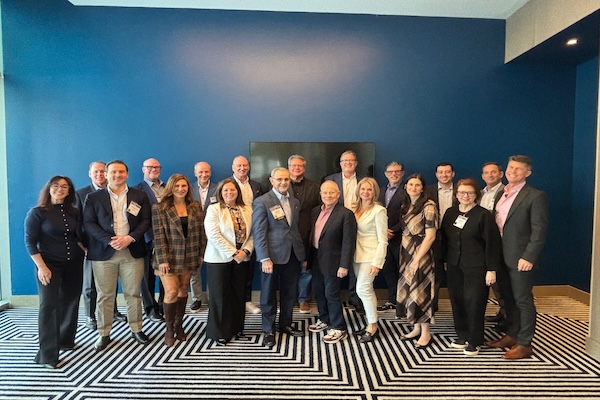
The triannual meeting of the Lodging Industry Investment Council is a cross-section gathering of the hospitality industry across a variety of disciplines, from brokerage to brands, asset managers to owners.
They have a lot to say, naturally. And, oh, the times call for it. That was the context for the assemblage at the start of the Americas Lodging Investment Summit. Fittingly, since the January conference acts as a baseline, taking the initial pulse of the collective hospitality industry as it moves forward into the year.
In the headlines: ICE. And grabbing them was the alleged refusal of a Hampton Inn hotel outside Minneapolis to accommodate U.S. Immigration and Customs Enforcement (ICE) agents and immigration officers. Hilton subsequently deflagged and removed the property from its system.
The decision by Hilton was swift, but was it the right one? Mike Cahill, CEO and founder of brokerage HREC and leader of the LIIC think tank, posed this question to the group: “ICE wants to block a group of rooms in your nationally branded hotel. Accept or refuse?”
The response from the group was a resounding “accept”: 83% versus 17%. The former’s reasoning clear: franchise covenants that stipulate the duty of hostelry not to discriminate or disallow guests based on their beliefs, as long as there isn’t a perceived criminal nature or threat. (One respondent said that while they felt compelled to accept on business and contractual grounds, morally they were hesitant; they floated one idea to repel ICE business legally: remove the government rate.)
No Cap
Outside politics, discussion turned on investment. U.S. hotel deal volumes have been well done since their 2015 apogee, when transactions hit $45.7 billion, according to data from JLL. In 2022, they hit $42.6 billion, but ensuing years have produced more muted numbers. Transaction volumes in 2025 hit $24 billion, and while far below 2015 levels were 17.5% higher than 2024 and slightly higher than 2024.
Some of the deal thaw can be attributed to lower interest rates, with borrowing costs dropping nearly 300 basis points since Fed rate cuts began in September 2024. Still, the higher cost of capital has stymied more fluid deal flow and impacted cap rates, simultaneously. Higher interest rates steepen cap rates because they increase borrowing costs, reduce demand and raise the required rate of return to justify paying more. When financing becomes pricey, investors demand lower property prices (higher cap rates) to maintain profitability and compete with safer, higher-yielding investments like Treasury bonds. Hotel cap rates hovered just over 5% in 2025, according to CBRE data.
Where are hotel acquisition capitalization rates headed in 2026? According to LIIC members, most, just shy of 50%, say they will be flat one year from now, with an even split of 27% saying higher and 27% saying lower.
One of the flatters is Cahill, who invoked President Trump in his cap-rate thinking. “Interest rates are not going up based on Donald Trump,” he said. Though a sitting U.S. president doesn’t have direct decision-making power over interest rates, Trump, on several occasions, has made his thoughts public, showing displeasure for current Fed Chair Jerome Powell. In January, Trump announced his nomination of Kevin Warsh to succeed Powell once his term as chair ends in May 2026.
Cahill’s colleague is more bearish. Scott Kaniewski, a managing director at HREC, expects cap rates to move up as the pool of capital for assets decreases. “There will be less offers and less buyers and asset values will go down,” he said, adding that he expects interest rates to move up, not down.
At the same time, Charles Oswald, president and CEO of third-party management company Aperture Hotels, said cap rates will slightly compress, predicting that labor statistics would be an impetus for the Fed to lower interest rates. The Fed typically would lower interest rates when unemployment rises as a method to allow businesses to expand more readily.
Some, like John Hamilton, EVP of Pyramid Global Hospitality, think that cap rates will rise, but not on the interest-rate thesis; rather, because hotels thirst for CapEx spend. “Hotels are for sale because they are capital starved,” Hamilton said. “Risk goes up and cap rates go up with it.”
The same thinking is shared by Michael Torress, EVP of Fulcrum Hospitality. “Cap rates will move up slightly as hotels push off renovations. These are coming up on their hold and there will be pressure to sell,” he said.
Jim Butler, a founding partner of Jeffer Mangels Butler & Mitchell LLP, and who recently joined Blank Rome, is in the higher-cap-rate camp. “Values are all over the place,” he said. Little CapEx drags values down.”
There are those confident among the group, including Greg O’Stean, chief development officer of Hotel Equities, who said cap rates will fall. “I’m an optimist,” he said.
Travelin’ Man
Beyond cap rates, one theme driving the hotel industry is upmarket strength versus poorer performance returns in lower-segmented business. “The American middle class is dying and doesn’t have discretionary income,” Cahill said. “It’s a world of have and have nots, where the former aren’t price concerned.” He cited, for instance, the some 42 million Americans on the Supplemental Nutrition Assistance Program or SNAP. “They aren’t traveling and the rich are getting richer.”
Red Roof Inn is one brand that sits at the lower end of the market. It is owned by Canada’s Westmont Hospitality Group. During COVID, it, and its budget peers, performed admirably. That’s changed, five-plus-years on. ‘We are suffering the most of all the segments,” said Dorraine Lallani, senior director of asset management at Westmont Hospitality Group. “Our customers are not traveling.”
Many customers are traveling and staying at short-term rentals, eschewing traditional hotels. “The desire to travel hasn’t gone away,” mentioned Isaac Collazo, senior director of analytics at STR, but there is growth in STR, he added (the lodging product, not his company). Aperture’s Oswald added that many transient travelers are turning to extended-stay product and that “STRs are picking that [business] up.”
“It’s all supply and demand and there is lot of demand and we let STRs take a lot of it,” said Jonathan Falik, founder of JF Capital Advisors. He called the Airbnb business model brilliant. “It turned every host into a highly committed marketing agent,” he said.
Multi-generational travel is also a boon for the likes of Airbnb, Vrbo and other STR accommodation companies, which have better pricing and more unique accommodations, argued Tiffany Cooper, head of development in the Americas for Mandarin Oriental Hotel Group. “Hotels don’t have the communal spaces, like at Airbnb,” she said, adding that hotels, also, are typically more expensive to book. Mandarin Oriental, she said, is looking at how to add or curate more multigenerational spaces in its hotels.
One of the biggest catalysts that drive demand in the hospitality industry is the powerful brand loyalty programs. One problem, noted O’Stean, is that younger travelers aren’t brand loyal, which he said is a win for Airbnb and its peers. “There is zero brand loyalty for the young,” he said, adding that it’s cheaper to get one Airbnb rather than four separate hotel rooms. “It’s a generational thing,” he said.
Frank Nardozza, chairman and CEO of REH Capital Partners, concluded the proceedings on a more sanguine note. “We need to think about accommodations and what it means in the future,” he said. Airbnb is an OTA. The hotel industry has transformed many times before and will transform again.”