
Earth’s biggest sports tournament is coming to North America this summer, but its seismic effect on the hospitality industry is already being felt.
Hosting duties for the 2026 FIFA World Cup will be shared by three countries—the United States, Canada and Mexico— and for 40 days, an estimated seven million international visitors will flood the continent in the spirit of sport and splendor.
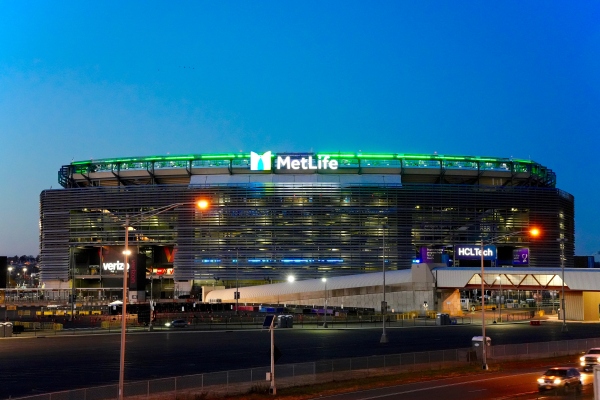
From the opening ceremony in Mexico City’s Estadio Azteca on June 11 to the championship match at MetLife Stadium in East Rutherford, N.J., on July 19, this unprecedented experiment in international sports travel will dominate terrestrial life. Estimates predict 75% of travelers will visit one of the 11 U.S. host cities, creating a singular moment for national hospitality.
A CONTINENTAL EXPERIENCE
This year’s World Cup will certainly look different structurally from four years ago. In 2022, Qatar hosted the tournament, prompting the government to build an entire city complex in Doha from scratch, linking all stadiums, lodging and amenities a short distance apart by newly minted roads. This time, teams play all their first-round matches in different cities, requiring huge jumps in distance. Consider perennial favorite Germany, which plays matches in Houston, Toronto and New York.
For German-born Jan Freitag, national director of hospitality analytics at CoStar Group and avid “football” fan, the logistical challenges of attending matches are not to be underestimated. “People who don’t understand American geography don’t have a sense of the proportions,” he said. “In Europe, everything is like an eight-hour car drive away, but in the west, you’ve got to fly everywhere to bridge those distances.”
The price point of tickets will play an outsized role in booking a hotel, said Freitag, not to mention team schedule, tournament success and the cost of travel, but operators should remain confident that hospitality sectors in all regions will see a healthy bump thanks to the games.
“If Cape Verde suddenly makes it to the Round of 16—which would be a huge surprise—obviously they won’t have as many fans as Brazil, [but] if you end up with one of the last 16 teams, people just like to watch soccer,” he said. “Stadiums are going to be sold out, which implies hotels should bank on that demand no matter where it’s coming from.”
The spread-out nature of the tournament will afford smaller host cities, such as Seattle, Kansas City and Vancouver, the opportunity to capitalize on compressed demand, while larger cities, including Atlanta and Los Angeles, can diffuse the demand influx to a variety of peripheral, tertiary markets.
Travelers on the East Coast can commute between venues, but for many, it will be a week-to-week journey across the country as the tournament progresses. Rob Smith, president & CEO of Stonebridge Companies, a third-party management company, counsels hoteliers to set appropriate rates early to capitalize on the surge.
“The majority of international [bookings] come six months before, and U.S. based comes in 60 to 90 days,” said Smith. “The one thing we must be worried about is that there’s not much movement 30 days out, so make sure your cake is baked before you get into that 30-day window. Once you get to 30 days, you won’t get that last-minute business because people need tickets and visas and all the other things that go along with this.”
Still, as a global audience of more than four billion tunes in, there’s a chance that fùtbol fever compels travelers to book late into the tournament.

THE RIGHT RATE
Of the 22 World Cup tournaments held since the first, in 1930, the most comparable in terms of data is Russia, in 2018. That tournament featured 11 host cities spread throughout European Russia and though surpassed by North America 2026 in terms of distance, it offers clues to how geography— and geopolitics—could affect hotel rates.
Russia’s dubious human rights record and expansionist drive didn’t discourage international tourism, noted Ryan Meliker, president & co founder of Lodging Analytics Research & Consulting (LARC).
“If you take a look at Moscow—granted, Moscow is not the end-all, be-all—but ADR growth in June and July of 2018 was 200 percentage points higher than actual growth in months before and after the World Cup,” Meliker said. “You’re seeing triple the ADR on a year-over year basis versus the prior months. That points to the willingness travelers have to spend on hotels during these types of special events that are effectively once-in-a-lifetime opportunities.”
In Meliker’s view, high-volume properties in host cities shouldn’t experience drastic changes in occupancy, but as travelers begin arriving, they may be willing to pay more. That may send the normal convention crowd elsewhere, but it will free up inventory for short-term gains.
As demand radiates outward, non-host cities could see an ADR boom, too. Whether serving as waypoints along the tournament trail or atypical vacation destinations, LARC estimates the ADR lift from the World Cup will raise RevPAR growth across the U.S. by almost two percentage points.
“My advice to hoteliers is to be aggressive—push ADR now, upfront,” Meliker said. “If you get to the point where it’s not coming through toward a month out, you can cut rates and still probably get the demand that you might’ve gotten [without] rate increases. But World Cup related demand will get you to the occupancy levels you were at before.”
On the ground, properties like the soon-to-open Caravan Court Hotel, in Arlington, Texas, 20 miles west of Dallas, anticipate strong demand during the tournament driven by a mix of corporate groups, international delegations and high-value transient travelers, said the hotel’s director of sales & marketing, Anna Darden. The 143-room hotel, on the site of a former motel, is set to cash in on the tournament, with its May opening under Valencia Hotel Collection.
“Given the property’s proximity to Arlington’s major sports venues and its boutique positioning, demand is expected to extend beyond match days into shoulder dates, with compression felt across the full event window,” she said.
At the tournament’s peak, Caravan Court is projecting ADRs exceeding $900, reflecting its limited boutique inventory, heightened international demand and experience-driven accommodations. Rates are expected to remain elevated across pre- and post-event shoulder nights as travelers arrive early and extend stays, added Darden. Occupancy is forecasted at approximately 95% or higher throughout match dates, with sustained high occupancy on surrounding shoulder dates. “The hotel expects to sell out well in advance, supported by contracted corporate demand and strong transient pickup as the event approaches,” she said.

AMERICAN HOSPITALITY
Los Angeles is no stranger to major sports events, but even the World Cup will pose a unique challenge. Current estimates project that at least 200,000 attendees are coming into the L.A. market, booking more than 300,000 room nights and generating roughly $600 million in economic activity.
Michael D’Amodio, group VP of regional operations for Azul Hospitality Group and a past president of the LAX Coastal Chamber of Commerce, has closely tracked the situation for months and is optimistic. “We feel bullish,” he said, adding that, through internal research, each visitor will spend around $2,400 upon their visit, with 50% of that going toward hotels and lodging. “That’s a big number,” he said.
D’Amodio has been working with hotel operators to coordinate their room rates, watching the tournament calendar to maximize stay length, while still saving last minute inventory.
“If you have a Saturday game, you don’t want to sell out on a Saturday and all of a sudden have this big hole on a Friday and a Sunday; you want to try to encourage people to come in on a Thursday or a Friday and stay through Sunday,” said D’Amodio. “You’re positioning your rates by controlling the length of stay and getting multiple stays instead of just the day of.”
Azul Hospitality is leveraging several of its properties’ proximity to Los Angeles International Airport by offering shuttles to SoFi Stadium, a revenue generator for local bus companies that also solves a critical guest consideration. It’s one of many ways they, and countless others, are using this moment to welcome the world.
“We’re looking at this as a 30-day opportunity to have the world’s eyes on us, to kind of open our arms,” said D’Amodio. “This could be a huge windfall for our whole country.”
This story was contributed by Derek Herscovici.