
Duke University is one of those places that reflexively whips up emotion. Some bristle at the mere mention of the institution; others fawn over it like a newborn baby. This animus or adoration has less to do with it as an institution of higher learning and everything to do with its wildly successful basketball program, which many despise for not only winning but how they win—and their cloying fandom (the so-called “Cameron Crazies,” a student body that zealously supports the home team and jeers its rivals with scripted provocations that, many times, are effective in throwing opposing players off their game).
Orchestrating all this was the now-retired Mike Krzyzewski, known affectionately as Coach K, a five-time national champion and all-time winningest men’s basketball coach—a paragon of success and offeror of wisdom that stretches well beyond the confines of the basketball court.
Which brings us to Kurt Alexander, the fresh-faced president of Omni Hotels & Resorts, who is still on the earlier side of his forties. Don’t get it confused: Alexander did not play basketball at Duke; his slight build is proof. He did graduate from Duke and for any person in a position of leadership, the question inevitably comes: “Do you carry any lessons from Coach K into your professional life?” Here, the spirit of Coach K has an almost unwitting effect on Alexander: Like the compulsory portrait of the sitting U.S. president hanging on the walls of government offices, a photo of Coach K adorns his Dallas office. Alexander is quick to say that Krzyzewski isn’t central in his mind—until he is.
“He was the coach at Duke for nearly 45 years and consistently, day in and day out, year after year, modeled excellence in everything he did,” Alexander said, before swiftly pivoting to tie that longevity and steadiness to Omni Hotels, where its chief human resources officer recently celebrated her 46th year with the company. “I tell her often: You are like Coach K,” he said.
He delves deeper, noting how Krzyzewski wasn’t intransigent in his coaching style and would adapt to accommodate his players and the way the game evolved. “That kind of fluid leadership and dynamic mindset is important,” Alexander said. “He would often say you have to be really clear about expectations and then it’s everybody on the team’s job to hold one another accountable to those expectations.”
For a guy that doesn’t think a lot about Coach K, Alexander sure thinks a lot about Coach K. “Maybe it’s subconscious by just being a Duke fan,” he said.

CUT DIFFERENT
Alexander has been with Omni for more than 11 years and stepped into the president role almost four years ago when it was vacated by Peter Strebel. Leading a company with such a venerable history as Omni is humbling for anyone, let alone someone still a year shy of his 40th birthday when he took over as head honcho. But that was Alexander when he assumed the role after spending five years as CFO. It comes as no surprise that the self-effacing Alexander felt a slight tinge of imposter syndrome. “I don’t think it ever really goes away. It changes a little bit,” he said. Alexander contends that it doesn’t matter if you are Joe Smith or Joe Burrow: everyone has insecurities, but they mold character. “It’s fundamental to the human condition,” he said, and also inescapable. “Deep down, at my core,” he queried, “do I have it? Am I good enough?”
Unlike most of its peers, Omni Hotels & Resorts is a vertically integrated company: it owns hotels, it manages hotels, it brands hotels. Presently, there are around 50 properties across North America, a sui generis spread of properties if there ever was—from urban convention-center properties, such as the Omni Dallas Hotel, across the street from the Dallas Convention Center, to The Omni Homestead in Virginia, a resort cozied into the Allegheny Mountains with roots that stretch back to the 18th century and where Thomas Jefferson once sought ablution in the property’s nearby warm springs. It recently wrapped up a $170-million renovation project.
To hear it from Alexander, the intention has never been to commit to constructing such a disparate portfolio of properties; it’s just turned out that way. It has landmark hotels like Omni Parker House in Boston, which opened in 1855, to its newest property, Omni Fort Lauderdale, an 801-room, glass-sheathed hotel that opened in December 2025, with direct access to the city’s convention center.
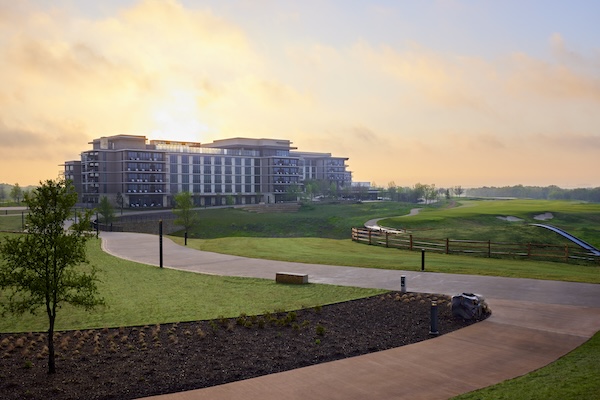
Then there is sport. Omni split the fairway with the 2023 opening of Omni PGA Frisco Resort & Spa, which will play host to the 2027 PGA Championship. Beyond its golf resorts, Omni has a knack for hooking up with sports franchises. Omni Frisco Hotel at The Star is adjacent to the Dallas Cowboys headquarters and practice facility and is partly owned by Cowboys owner Jerry Jones; Omni Hotel at The Battery Atlanta has ballpark-facing rooms that allow guests to catch Atlanta Braves games at adjacent Truist Park; Omni Viking Lakes Hotel in Minnesota is next door to the Minnesota Vikings’ headquarters. Omni is in discussions with other sports teams around doing these kind of mixed-use developments with a sports anchor, Alexander said.

ROCK STEADY
Happenstance, not programmatic planning, is one way to describe Omni’s growth footprint. “There was never a grand plan to say, ‘Let’s come up with this eclectic portfolio that we can then kind of hang our hat on,’” Alexander said. Instead, he continued, it’s happened for a couple of reasons. “For a smaller, independent brand like us, to be successful, we have to be in highly differentiated locations with compelling, unique experiences,” for one, he said. Its second strength is that Omni sits at the crossroads of group and leisure business, a best-of-both-worlds scenario that allows its properties to resonate with both cohorts, which means demand stays strong. About 50% of Omni’s overall business is derived from groups, large corporate meetings or annual association gatherings, for instance.
February 2026 marks 30 years of TRT Holdings’ ownership of Omni Hotels & Resorts. TRT is a private holding company based in Dallas that was founded by Bob Rowling in 1989. Unlike Marriott or Hilton, Omni is not publicly traded, which allows it to grow at its own pace, free from the distraction of Wall Street and its deafening call for constant expansion. Not having to concentrate solely on that allows Omni to be a true steward of hospitality. “Every single person in our company is focused on one thing: the guest,” Alexander said. Owning and managing its hotels allows for that attention, he added: There is no third party inserted to manage an asset, an asset that is owned by Omni. It’s a straight line from the hotel guest to the top. “We control every touch point,” Alexander said.
A private vertical integrated structure allows Omni to take a more holistic focus and approach toward the customer experience, concentrating more on that than delivering next quarter’s numbers. It’s something Alexander understands and is fully appreciative of. “In a commodity industry, scale is the only thing that matters,” he said, and in the hotel industry, that means more hotels and more loyalty members, constantly chumming the waters to lure in more and more.
Omni’s Select Guest Loyalty Program is infinitesimal compared to its peers, but is based on spend rather than frequency, which adds a dash of substance. “If everybody is a Hilton Honors member or everybody is a Marriott Bonvoy member, then nobody is a Bonvoy member or nobody is an Honors member,” Alexander said.
Still, he understands Omni’s limitations. With only 50 hotels, it makes it hard to connect the dots and keep loyal guests in the loop. “The drawbacks are clear,” he said. “You might love us, but if you’re going to a wedding in Kansas City, sorry, you can’t stay with us.”
And while Omni is not adding a new hotel a week, it isn’t sitting pat. Omni breaks ground on hotels in Midland, Texas, and Raleigh, N.C., this year and is working on a deal in New Orleans for a 1,000-room convention-center hotel. Meanwhile, Omni is currently under construction on Omni Pontoque Resort at Punta de Mita, in Mexico, which will be its first property outside the U.S. and Canada when it opens in 2027. Omni is deploying north of a billion dollars of capital toward its overall growth strategy.
It shows conviction; it also shows smarts. One of the other benefits of being a private hotel company is that it can renovate assets on its own timeline. While larger lodging companies and franchisors can force owners to renovate, Omni has the luxury of doing it at its own pace and discretion. “We’re not needlessly throwing capital at something,” Alexander said. Fresh off the Homestead renovation, Omni Houston is set to go under the knife this year.
Alexander may still be a tyro when it comes to his leadership position, but he’s already looking years into the future, challenging the notion that the big brands are the guiding light in hospitality. How can they be, he pondered, if they fundamentally outsource the core competency of hospitality?
And, so, he sees it this way. “Watch this play out over the next 30 years,” he said. “In 30 years, we could be the prettiest girl at the dance. We jokingly refer to ourselves as the last real hospitality company.” Or, maybe, he’s serious.